


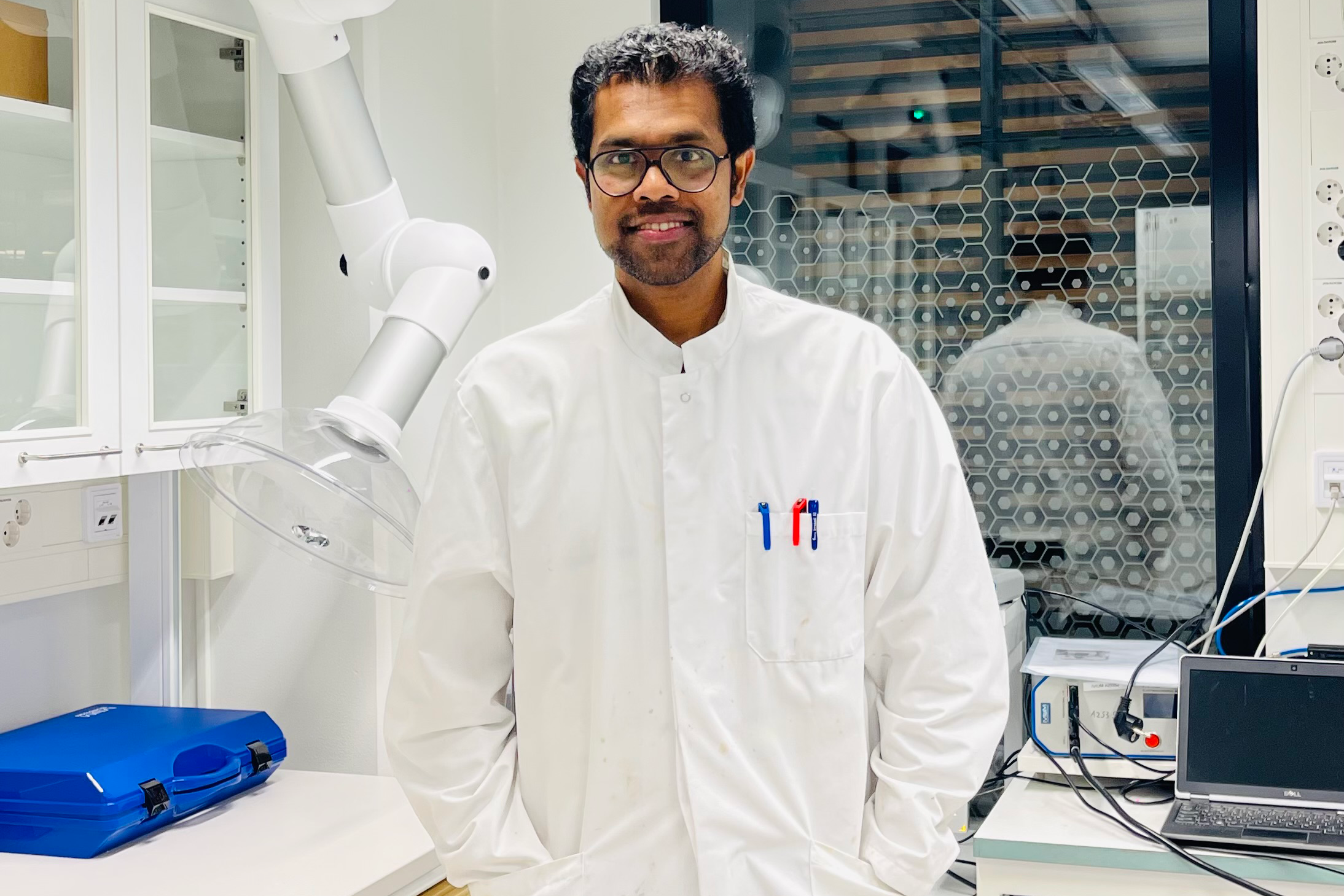
The growing demand for sustainable and energy-efficient technologies has increased interest in smart materials that can perform more than one function at the same time. In his doctoral dissertation, MSc Sachin Kochrekar developed materials that can both change colour and store electrical energy. In the future, this technology could be used, for example, in energy-storing, self-tinting smart windows.
This work developed thin polymer films based on porphyrins, molecules that occur widely in nature, for example, in chlorophyll and hemoglobin.
“For example, thanks to the porphyrin structure found in chlorophyll, the plant is able to recover energy from sunlight through photosynthesis. The ability of this natural molecule to transfer electrons and change its state in a controlled manner is also an interesting starting point for us materials scientists,” says Doctoral Researcher Sachin Kochrekar
In the dissertation, novel membrane structures were constructed in two different ways: as a hybrid structure together with an electrically conductive material, and with a simpler method, in which porphyrins were joined together with the help of a bridge molecule to form a polymer membrane.
In addition, the study examined the effect of metal on the properties of the material. Either nickel, zinc or no metal at all was placed in the middle of the porphyrins.
Small structural changes were found to have a significant impact on the performance of materials.
The results showed that the nickel-based film is able to change colour between three different colours, while the zinc-based and metal-free films changed colour between the two states.
All materials reacted quickly, in less than two seconds, showed clear visual contrast and maintained colour change even after the power was turned off.
The membranes were also tested to store energy in a water-based electrolyte, which is safer and more environmentally friendly than commonly used alternatives. This is reportedly the first study in which porphyrin-based polymer membranes are used as electrochromic supercapacitors in a water-based electrolyte system.
All three materials demonstrated good energy storage properties, making them promising materials for future multifunctional energy solutions.
“The materials are low-cost to produce, easy to control and highly adaptable and can be integrated into a wide range of applications, including flexible and stretchy substrates. In the future, these materials could be used, for example, in sensor technology, flexible electronics, smart clothing and solar energy solutions. For example, new types of smart windows could simultaneously store solar energy and darken in the bright sun, which would reduce the need for cooling in the building,” says Kochrekar.
Kochrekar’s doctoral dissertation was conducted in Professor Carita Kvarnström’s Materials Chemistry research group, which is part of the research line of the Department of Chemistry at the University of Turku. The group has been researching and developing organic colour-changing materials, i.e. electrochromic materials, for a decade.
Applications for these new types of materials include smart windows and various glass surfaces, anti-glare rear-view mirrors and sunroofs used in the automotive and aerospace industries, display technologies such as billboards and spectacle lenses, and energy storage devices where materials visibly change colour to indicate the device’s charge level. In addition, materials can be used as visual indicators for chemical sensors, changing colour when exposed to certain gases or biological markers.