


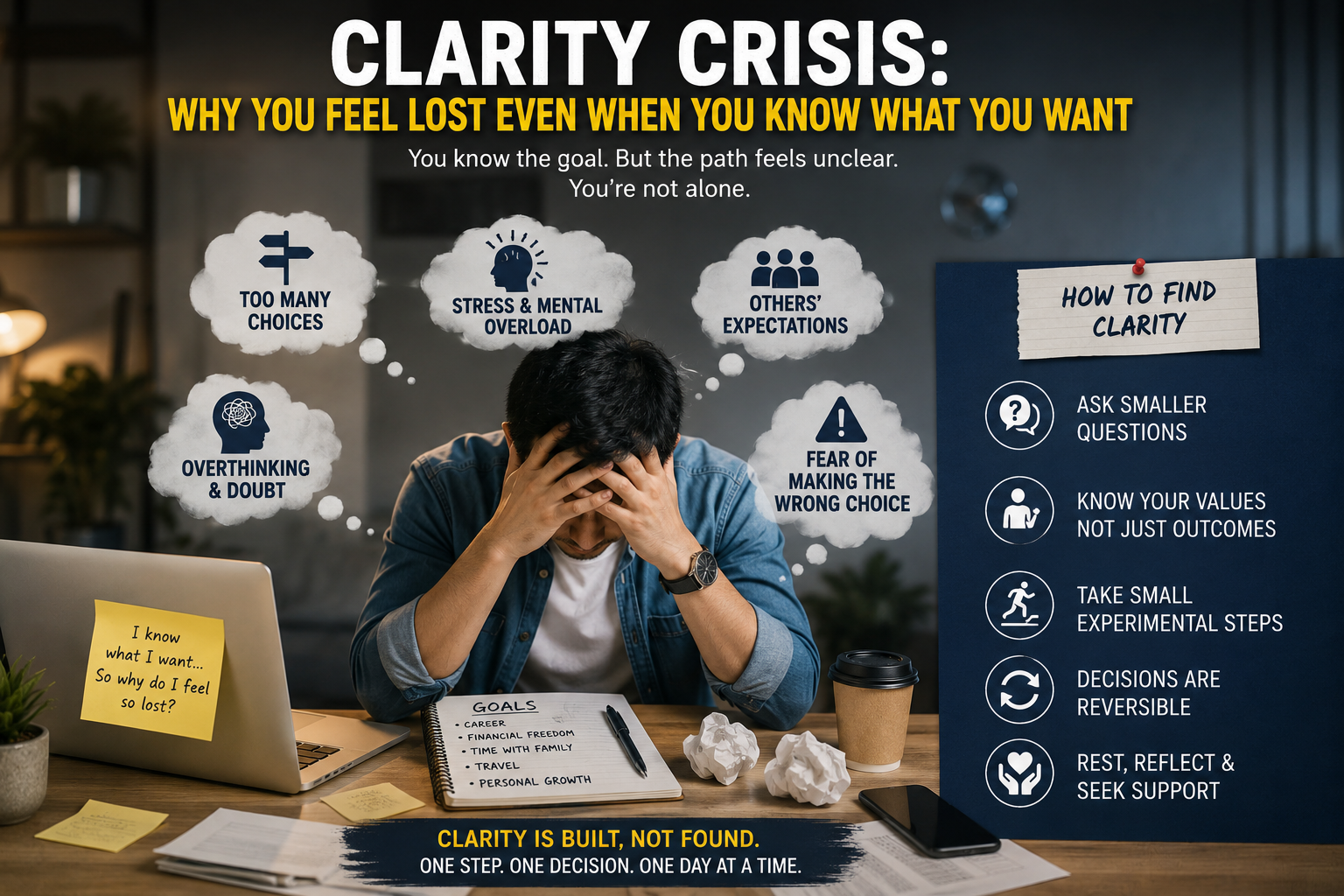
Aug 13:There is a strange kind of confusion that many people experience but rarely talk about. You know what you want. You may have a fairly clear idea of the career you want, the relationship you want, the business you want to build or the kind of life you want to create. And yet, you feel stuck.
You think about the next step, research your options, make plans and then question them again. Sometimes, you make a decision only to wonder almost immediately whether it was the right one.
This is what a clarity crisis can look like. It isn’t always about not knowing what you want. Sometimes, you know exactly what you want but struggle to trust yourself enough to move towards it.
The Clarity Crisis in Four Questions
If you’re feeling lost even though you know what you want, the problem may be one of four things:
- You know the goal but not the path.
- You know the path but fear making the wrong choice.
- You have too many competing priorities.
- You are mentally exhausted and trying to make decisions without enough space to think.
Recognising which problem you’re actually facing can be the first step towards finding clarity in life.
What Is a Clarity Crisis?
A clarity crisis happens when your destination seems relatively clear but the path towards it feels uncertain.
You might find yourself thinking:
- “I know what I want, but I don’t know where to begin.”
- “I know this feels right, so why am I still anxious?”
- “What if I make the wrong choice?”
- “Why does everyone else seem to have their life figured out?”
- “Why can’t I commit to something I already know I want?”
The problem may not be a lack of direction. Too many competing thoughts, expectations and uncertainties can make it difficult to act on the direction you already have.
The American Psychological Association notes that uncertainty can increase stress and anxiety, particularly when people feel they have little control over what happens next. One practical approach is to focus on the areas of life that remain within your control rather than trying to eliminate uncertainty completely.
Why Do You Feel Lost When You Know What You Want?
Knowing What You Want Isn’t the Same as Knowing How to Get There
Having a goal gives you a destination. It doesn’t automatically give you a roadmap.
You may know that you want to change careers, start a business or move to another city. But figuring out exactly how to get there can be much harder.
That gap can be frustrating.
Instead of thinking, “I know what I want, but I need to work out the next step,” you may start wondering whether the goal itself is wrong.
Sometimes, it isn’t.
The goal can be clear even when the process isn’t.
You’re Waiting for Complete Certainty
Another reason people remain stuck is the belief that they need to feel completely certain before taking action.
But important decisions rarely come with guarantees.
You can’t know for certain whether a new career will work out, whether a business will succeed or whether moving to a new city will make you happier.
Waiting for 100% certainty can therefore become another form of procrastination.
In many situations, clarity comes after taking action, not before it.
A small step can tell you more than hours of thinking.
Too Many Choices Can Make You Feel More Confused
Having choices sounds like a good thing. But too many choices can make decisions harder.
You may have several career options, different business ideas, multiple cities you could move to and endless advice available online.
Every option creates another question.
Should you choose money or meaning? Stability or growth? Security or adventure? What you want or what your family expects?
Eventually, you aren’t lacking information.
You’re overwhelmed by it.
Stress Can Make Decisions Feel Harder
Sometimes what looks like a lack of clarity is actually accumulated stress.
Work pressure, financial concerns, family responsibilities and uncertainty about the future can consume mental energy. When your mind is already overloaded, even relatively simple decisions can feel exhausting.
Research discussed by the American Psychological Association has linked high levels of stress and uncertainty with difficulties in decision-making. During the pandemic, for example, many adults reported that stress and uncertainty made it difficult to make even basic decisions or plan for the future.
The lesson isn’t that every episode of indecision is caused by stress.
It is that an overwhelmed mind can feel confused even when the underlying goal is clear.
Other People’s Expectations Can Blur Your Own Goals
Sometimes, the life you think you want isn’t entirely your own idea.
Parents may have expectations about your career. Friends may influence your definition of success. Social media can make someone else’s lifestyle look like the standard you should be trying to achieve.
Over time, it can become difficult to separate what you genuinely want from what you have been told you should want.
Self-Determination Theory, a well-known framework in psychology, places importance on autonomy, competence and relatedness. In simple terms, people tend to be more motivated when they have a sense of choice, capability and meaningful connection.
That matters because a goal can look impressive from the outside and still feel empty if it doesn’t reflect your own values.
You’re Afraid of Making the Wrong Choice
Sometimes the problem isn’t confusion.
It’s fear.
Fear of failing. Fear of disappointing people. Fear of wasting time. Fear that another option might have been better.
This can lead to endless comparison.
You research one option, discover its disadvantages and move to another. Then you find problems with that one too.
Eventually, you don’t make a decision at all.
Trying to avoid every possible mistake can prevent you from making meaningful progress.
Decision Fatigue Can Leave You Stuck
Modern life involves an extraordinary number of decisions.
What should you work on first? Which email should you answer? What should you buy? Which opportunity should you pursue? Should you change jobs? Should you relocate?
When major decisions are combined with hundreds of smaller choices, mental energy can run low.
The World Health Organization has highlighted excessive workloads, low job control and job insecurity as potential risks to mental health at work. It estimates that depression and anxiety contribute to approximately 12 billion lost working days globally each year, with an estimated US$1 trillion in lost productivity.
This doesn’t mean every difficult decision is a mental-health problem. But prolonged pressure can make it much harder to think clearly and prioritise effectively.
Your Goal May Be Clear, but Your Priorities Aren’t
You may want career growth, financial security, more time with family, better health, travel and personal development—all at once.
None of those goals is wrong.
The problem is that they compete for the same limited time and energy.
Clarity doesn’t always mean discovering one perfect goal.
Sometimes it means deciding what matters most right now.
Your priorities can change with different stages of life. What matters at 25 may not be what matters at 35 or 45.
That’s not inconsistency. It’s growth.
Feeling Disconnected Can Make It Harder to Find Perspective
When you’re struggling with a decision, having someone you trust to talk to can make a difference.
The World Happiness Report 2025 found that 19% of young adults globally reported having no one they could count on for social support in 2023. The report also highlighted the importance of social connections to well-being.
Loneliness doesn’t automatically cause a clarity crisis, but isolation can make difficult decisions feel heavier.
Sometimes you don’t need someone to tell you what to do.
You simply need someone who can listen while you work out what you already think.
How to Find Clarity in Life
Ask a Smaller Question
Instead of asking:
“What should I do with my life?”
ask:
“What is the next decision I need to make?”
You don’t have to solve the next ten years.
You only need to identify the next useful step.
Separate What You Want From What You Should Want
Take a piece of paper and make two lists.
On one side, write what you genuinely want.
On the other, write what you think you should want.
Look at the difference.
You may discover that some of your confusion comes from trying to satisfy expectations that aren’t actually yours.
Focus on Values, Not Just Outcomes
Ask yourself:
- What kind of person do I want to become?
- What do I want my everyday life to look like?
- What am I unwilling to compromise on?
- What would I value if nobody could see my achievements?
- Which goals give me energy rather than simply status?
These questions can help you move beyond the pressure to achieve a particular outcome.
Take a Small Experimental Step
You don’t always need to make a huge commitment.
Thinking about changing careers? Talk to someone who already works in that field.
Considering a business idea? Test it on a small scale.
Want to become a writer? Publish something.
Thinking about moving? Spend some time in the city before making a permanent decision.
Small experiments replace assumptions with real experience.
Stop Treating Every Decision as Permanent
Many decisions can be changed.
You can change jobs. Learn a new skill. Modify a business idea. Move somewhere else. Change your priorities.
Treating every decision as permanent can make ordinary choices feel overwhelming.
Instead of asking, “Is this the perfect decision?”, ask:
“Is this a reasonable decision for where I am today?”
That question is often much easier to answer.
Clarity Crisis vs. Burnout vs. Lack of Direction
These experiences can look similar, but they aren’t necessarily the same.
| Experience | What It Often Feels Like | What May Help |
|---|---|---|
| Clarity crisis | You know what you want but struggle to choose or act | Break the goal into smaller decisions |
| Burnout or exhaustion | You know what you want but don’t have the energy to pursue it | Rest, boundaries and addressing the sources of stress |
| Lack of direction | You genuinely don’t know what you want | Exploration, reflection and trying new experiences |
| Decision fatigue | Too many choices make even simple decisions feel difficult | Reduce unnecessary choices and prioritise |
| Fear of failure | You know what you want but keep delaying action | Accept uncertainty and take smaller, reversible steps |
The distinction matters.
If the problem is exhaustion, creating another five-year plan may not solve it. If the problem is lack of direction, forcing yourself to make a major decision may not help either.
The first step is identifying what kind of stuck you actually are.
Clarity Is Built, Not Found
We often imagine clarity as a sudden moment when everything finally makes sense.
Real life usually isn’t like that.
Clarity develops through experience, experimentation, mistakes, conversations and reflection.
The American Psychological Association’s guidance on uncertainty encourages people to recognise that some uncertainty is unavoidable and concentrate on what they can actually influence.
In other words, clarity isn’t simply about thinking harder.
It is also about creating enough space to observe what happens when you take action.
You May Not Be Lost—You May Be Overwhelmed
This distinction is important.
If you genuinely don’t know what you want, you may need to explore.
If you know what you want but don’t know what to do next, you may need a plan.
If you know what you want but are afraid to act, you may need to become more comfortable with uncertainty.
And if you know exactly what you want but feel too exhausted to pursue it, the issue may be stress or burnout rather than a lack of direction.
Different problems require different solutions.
Being Lost Can Also Mean You’re in Transition
Feeling lost doesn’t necessarily mean that your life is going in the wrong direction.
Sometimes an old version of your life no longer fits, while the next version hasn’t fully taken shape.
That period in between can feel like confusion.
You may be leaving behind a career that once defined you. Your priorities may have changed. Your definition of success may no longer be the same.
Instead of forcing yourself to immediately figure everything out, it can be useful to accept that you’re in a transition.
Not every uncertain period needs an immediate answer.
When Feeling Lost Needs More Attention
Occasional uncertainty is a normal part of life.
But if persistent feelings of distress, hopelessness or confusion are affecting your ability to work, maintain relationships or manage everyday activities, it may be worth speaking with a qualified mental-health professional.
Asking for support doesn’t mean you’ve failed to figure things out.
Sometimes, an outside perspective can help you understand whether you’re dealing with uncertainty, exhaustion, fear or pressures that have accumulated over time.
Conclusion: You May Not Need More Clarity—You May Need More Movement
A clarity crisis can feel like standing at a crossroads without knowing which way to go.
But sometimes, you already know the direction.
What you don’t have is certainty about the journey.
And that’s okay.
You don’t need to know exactly how everything will turn out before taking the next step. You need enough clarity to make one reasonable decision, learn from it and adjust if necessary.
Research on uncertainty, stress and social connection points to a broader lesson: clarity doesn’t exist separately from the conditions in which we live. Stress can make decisions harder, uncertainty can increase anxiety and social connection can provide valuable perspective.
So if you’re feeling lost even though you know what you want, don’t immediately assume something is wrong with you.
You may not need another five hours of thinking.
You may need one small experiment, one honest conversation, one clear priority—or simply enough space to hear yourself again.
Knowing what you want is the beginning of clarity, not the end of the process.