


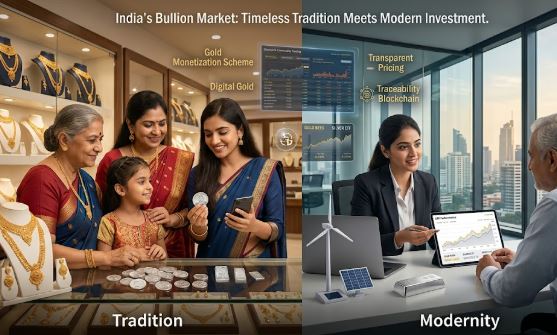
For generations, gold and silver have represented security, prosperity and tradition in India. Gold jewellery is closely woven into weddings and festivals, while coins and bars have long been considered a dependable way of preserving wealth. Yet behind this familiar relationship is a sophisticated bullion market that is rapidly adapting to the needs of a modern economy.
The bullion market is no longer limited to physical bars and coins. It now connects banks, refiners, bullion dealers, jewellers, commodity exchanges, financial institutions and investors through an increasingly organised ecosystem. Global prices, currency movements, interest rates and geopolitical developments can all influence the value of precious metals in India.
From Tradition to Modern Investment
Gold continues to occupy a special position among Indian investors because of its combination of cultural significance and perceived wealth-preservation qualities. During periods of economic uncertainty or market volatility, investors often turn towards gold as one component of a diversified portfolio.
Silver, meanwhile, is developing a broader investment story. In addition to its traditional appeal, silver has important industrial applications in electronics, electrical equipment and solar technology. As India expands manufacturing and renewable-energy capacity, industrial demand adds another dimension to the silver market.
This changing demand profile is making both metals relevant beyond traditional jewellery consumption.
India’s Bullion Market Is Becoming More Financialised
One of the most important developments in recent years has been the growth of financial products linked to precious metals.
Investors can now gain exposure to gold and silver through products such as Gold ETFs and Silver ETFs without necessarily purchasing and storing physical metal. These instruments offer a more convenient route for investors who are already familiar with financial markets.
India’s regulatory framework is also evolving alongside this transformation. SEBI has strengthened the valuation framework for physical gold and silver held by mutual fund schemes, including greater use of domestic exchange-linked spot pricing. Such measures can improve price discovery and make valuations more closely aligned with India’s own bullion market.
Commodity exchanges have further expanded participation by providing futures and other instruments that can be used for price discovery and risk management.
Global Markets Still Shape Domestic Prices
Although India’s bullion ecosystem is becoming more sophisticated, it remains closely connected to international markets.
Gold prices in India are influenced by international bullion prices, the rupee-dollar exchange rate, import costs, domestic demand and taxes. This means a major movement in the global gold market can quickly find its way into Indian prices.
The same connection is visible in India’s gold imports. Changes in international prices and domestic demand can significantly affect the value of imports, making bullion relevant not only to investors and jewellers but also to the country’s broader trade dynamics.
Technology Is Changing the Bullion Experience
Technology is adding another layer to this transformation.
Digital investment platforms have made it easier for individuals to track precious-metal prices and access market-linked products. At the industry level, technology is supporting electronic trading, faster settlement, verification and supply-chain monitoring.
For an industry where trust is fundamental, developments in authentication and traceability are particularly significant. Consumers and investors increasingly want greater confidence about purity, sourcing and ownership, encouraging the industry to adopt more transparent processes.
A Market for a New Generation of Investors
Perhaps the biggest change is the widening profile of bullion investors.
The traditional buyer may have preferred jewellery, coins or bars kept at home or in a bank locker. Today’s investor has a much broader menu of choices. Physical bullion remains relevant, but financial products can provide an alternative for those seeking convenience, liquidity and portfolio diversification.
Businesses also use precious-metals markets differently. Jewellery manufacturers and bullion traders can use derivatives to manage price fluctuations, while institutional investors can consider gold and silver within broader asset-allocation strategies.
This diversity demonstrates how the role of bullion has evolved from simply preserving wealth to becoming part of a sophisticated financial ecosystem.
The Future of India’s Bullion Story
India’s relationship with gold and silver is unlikely to lose its cultural importance. What is changing is the way these assets are accessed, traded and integrated into modern finance.
With stronger market infrastructure, expanding financial products, digital platforms and growing awareness among investors, India’s bullion market is moving steadily from tradition towards greater financialisation.
Gold and silver may be ancient assets, but the marketplace surrounding them is becoming increasingly modern.
The future of bullion in India will not simply be about owning precious metals. It will be about combining their timeless appeal with technology, transparency and new investment opportunities.