


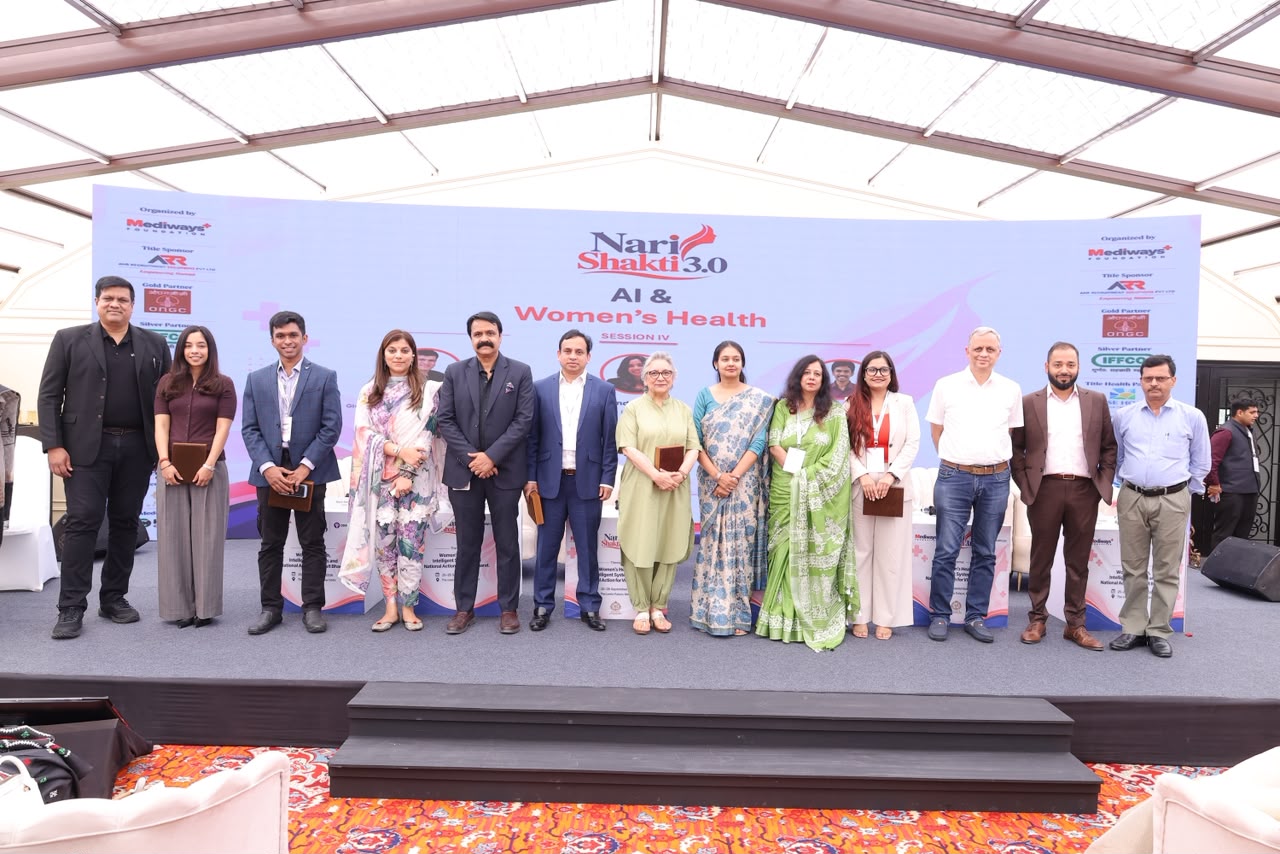
Mediways Health Foundation’s Nari Shakti 3.0 continued into its second day at The Leela Palace, New Delhi, as discussions turned to technology, public health and action. The session highlighted how intelligent systems can help address persistent gaps in women’s preventive healthcare. The day’s programme was led by Ms Pragya Sharma, Director, Maharishi Ayurveda, as Chief Guest, with discussions placing particular focus on the role of technology in improving early detection, diagnosis and access to care.
Addressing the gathering, Ms Pragya Sharma brought a holistic perspective to preventive health, emphasising the relationship between human wellbeing, nature and healthcare practices.
“Technology can help us make healthcare smarter, but intelligence in healthcare should also mean understanding the person, the environment and the early signs of imbalance. Ayurveda has always placed emphasis on prevention and on listening to the body before a condition progresses. If we bring that preventive wisdom together with AI, modern medicine and practices such as meditation, we can build a more holistic health system—one that is not only advanced, but also accessible, responsive and rooted in human wellbeing.” said, Ms Pragya Sharma
The day opened with Keynote address by Shri Rajeev Ranjan, Executive Director HR, Indian Oil Corporation Limited, highlighting how prevention works only when it becomes part of the system, not something we postpone until symptoms appear.
“At IndianOil, we monitor our critical assets for early warning signs; we need the same discipline for women’s health. That means giving women not just access to healthcare, but the time, confidentiality and support to act on it. Technology can strengthen this journey, but its real value lies in making care more dependable, inclusive and human.”
Session IV, “AI and Women’s Health,” moderated by Varuni Trivedi, brought together Roch Ferreira- Global VP, Corporate Marketing, Virtusa; Nandini Goel- Founder, Byome; Sarvesh Sudhan P- Senior Product Developer and AI Researcher, Avo Automation; Rahul Puri- Senior VP, Digital Transformation, Revenue Assurance & Fraud Control, Tata Play; and Vishal Sinha- CEO and Co-Founder, NewFangled Vision to examine how AI can move beyond technological promise and address real-world gaps in women’s healthcare.
A key thread emerging from the discussion was the importance of building better health data before expecting AI to deliver meaningful outcomes. Vishal Sinha highlighted the need to connect clinical research data with the lifelong health data of individual women, arguing that this combination could help create more personalised and context-driven healthcare.
Taking the discussion further Rahul Puri pointed to India’s shortage of reliable healthcare data as a fundamental challenge for AI-led healthcare. He emphasised that without representative and usable data AI systems cannot be expected to produce meaningful insights for Indian patients.
The conversation also examined how technology can extend screening and diagnosis beyond major urban centres. Roch Ferreira highlighted emerging possibilities in early disease detection, including technology inspired by biological signals, and pointed to the potential of low-cost screening tools that can take preventive healthcare closer to communities.
Nandini Goel brought the conversation back to the question of inclusion, stressing that AI does not necessarily need to reach every woman directly to benefit her. She highlighted the potential of technology to strengthen local physicians, clinics and screening processes, making screening more portable, affordable and accessible while also supporting earlier diagnosis and more women-centric medical research.
Sarvesh Sudhan P emphasized how AI in women’s health should not remain a technology conversation. The real value lies in building solutions that can understand a woman’s health journey and translate data into something useful for doctors, patients and healthcare systems.
The discussion reinforced a central point emerging from the session: the value of AI in women’s healthcare will depend not simply on the sophistication of the technology, but on the quality of data, accessibility of solutions and their ability to strengthen healthcare systems where women actually seek care.
The programme thereafter moved to Session V, “Public Health Systems for Women”, bringing perspectives from CSR, healthcare, public health and community-focused organisations into the wider discussion on access and continuity of care.
The second day also featured Young Minds: Dr Ridhima Kamal, Public Health Expert, who addressed the theme “From Outreach to Outcomes: Closing the Gaps in Women’s Preventive Care.” The programme concluded with a National Action Synthesis, followed by the formal close and vote of thanks.