


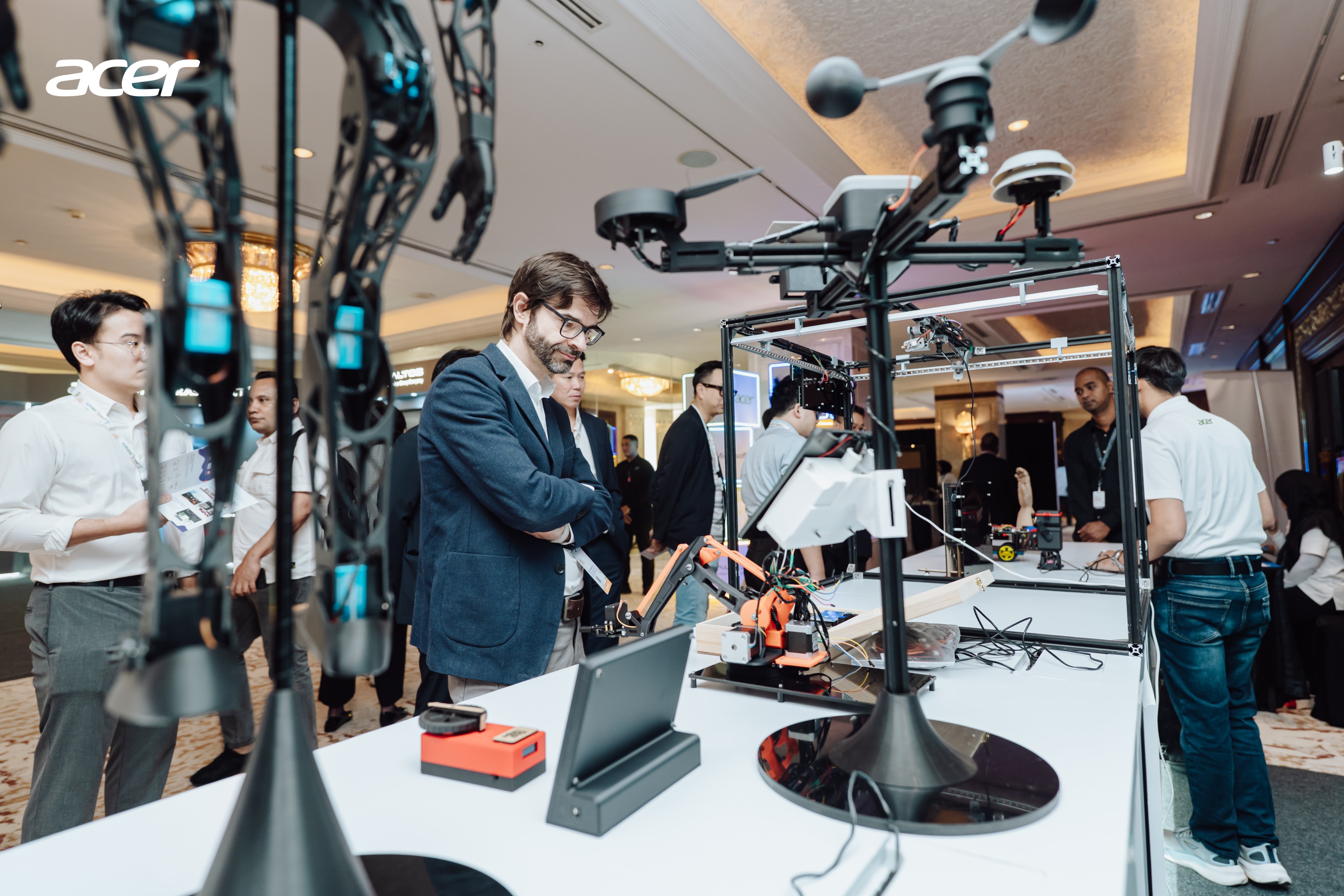
India Apr 23: Acer successfully concluded its Acer Edu Summit Asia Pacific 2026, reaffirming its commitment to advancing education across the region as artificial intelligence (AI) reshapes the future of learning. Under the theme “Future–Ready Learning: AI, Innovation, and Human-Centered Education,” the summit brought together education stakeholders in the region to drive inclusive AI adoption and accelerate meaningful transformation in education.
The summit was held in Jakarta on April 22–23, following its debut in 2025. It convened delegations from Australia, Hong Kong, India, Indonesia, Malaysia, Singapore, Sri Lanka, South Korea, Taiwan, Thailand, the Philippines, and Vietnam, reinforcing Indonesia’s role as a key market in Acer’s digital education ecosystem. The event served as a platform for cross-sector dialogue, enabling educators, policymakers, and industry leaders to exchange insights and explore practical applications of technology to enhance learning outcomes.
Andrew Hou, President of Pan Asia Pacific Operations at Acer Inc., said, “The Acer Edu Summit Asia Pacific reflects our ongoing commitment to shaping the future of education through technology. Through this event, we are also strengthening regional collaboration among countries to drive collective progress in education. At Acer, we believe that meaningful transformation happens when innovation is guided by human needs. This summit is part of our continuous efforts to empower educators, institutions, and policymakers to build an inclusive, future–ready learning ecosystem across the region.”
Collaboration Forum for an Adaptive and Sustainable Education Sector
Over the course of two days, the Acer Edu Summit Asia Pacific 2026 brought together discussion sessions, presentations, and knowledge-sharing forums exploring how AI can be effectively integrated into education. Key topics included personalized learning, the enhancement of digital literacy, and the evolving role of educators alongside technological innovation. As a strategic platform for educational transformation, the summit emphasized a human-centered approach where technology and educators work in harmony to build a more inclusive, adaptive, and sustainable education system, while encouraging the development of new ideas and solutions that foster creativity and unlock potential.
This year’s Acer Edu Summit featured the latest work in AI education from the MIT Media Lab’s City Science Group and introduced its Learning Foundry for AI and Robotics (FAIR). Dr. Michael Lin, Research Scientist at MIT, together with Dr. Wolfgang Gruel, Professor at Stuttgart Media University and Research Affiliate at the MIT Media Lab, shared how Learning FAIR leverages AI to enable personalized, scalable learning and better prepare students for the future. Their session explored how emerging technologies are reshaping education and empowering learners to address real-world urban challenges.
The summit also brought together diverse perspectives on AI in education through sessions led by academic and industry leaders from across the region. Among them, Jun-Yu Fan, President of Chang Gung University of Science and Technology, presented a compelling roadmap for pedagogical transformation, “The Algorithm of the Nursing Soul,” illustrating the shift from rote learning to AI-enhanced clinical insight. Complementing this academic vision, Charles Le, AI Solutions Senior Manager at Altos Computing, addressed the critical imperative of building a robust educational infrastructure to accelerate AI implementation.
Extending these discussions into practical application, Altos Computing demonstrated its full-stack AI infrastructure, headlined by the high-performance Altos BrainSphere™ R680 F7 AI server and the P330 F6 SE, P130 F10, and GB10 F1 AI Workstations. This robust foundation is optimized by the Altos aiWorks GPU resource management platform, while the Altos aiGeni AI deployment platform streamlines the entire AI lifecycle. By integrating OpenClaw to accelerate Enterprise Agentic AI adoption, Altos empowers institutions to bridge the gap between infrastructure setup and the seamless deployment of autonomous AI agents.
Acer also highlighted its latest Copilot+ PCs powered by Intel® Core™ Ultra Series 3 processors, including the TravelMate P4 Spin 14 AI, TravelMate P4 14 AI, and TravelMate P2 AI series, as recommended devices for modern classrooms. Designed to be lightweight and versatile, these devices support both teaching and learning needs. The TravelMate P4 Spin 14 AI, with its touchscreen and stylus, enables more interactive classroom activities, while the TravelMate P2 AI series offers reliable performance and long battery life for extended use, supporting flexible and collaborative learning experiences.
The Acer Edu Summit Asia Pacific 2026 is part of Acer‘s ongoing efforts to create opportunities for collaboration between the worlds of education, technology, and public policy in order to jointly create future–ready, human-centered learning. Through this initiative, Acer continues to harness technology to make education more adaptive and inclusive.
