


Odisha’s rich handloom tradition has found a remarkable expression in the work of master weaver Sarat Kumar Patra, who spent years creating an approximately 52-metre-long fabric featuring the verses of Jayadeva’s 12th-century epic, Gita Govinda.
Created using Odisha’s traditional Bandha (Ikat) weaving technique, the textile brings together literature, devotion and craftsmanship. The scale and complexity of the work make it an exceptional example of how traditional weaving can be used to preserve India’s cultural heritage.
Weaving the Gita Govinda into Fabric
Written by poet Jayadeva in the 12th century, Gita Govinda is one of Odisha’s most important works of Sanskrit devotional literature. The epic describes the relationship between Lord Krishna and Radha and has had a deep influence on Odisha’s religious traditions, music, dance and visual arts.
The verses of Gita Govinda have also been closely associated with Odisha’s handloom heritage. Sacred verses have historically been woven into textiles, particularly Khandua fabrics connected with the Jagannath tradition.
Sarat Kumar Patra took this traditional connection between scripture and textile art to an extraordinary scale. His monumental fabric is reported to extend about 52 metres and incorporate the verses of the epic through the intricate Bandha technique.
The Skill Behind Bandha Weaving
Bandha, commonly known as Ikat, is a highly specialised resist-dyeing technique. Unlike printed designs, the patterns are created by carefully tying sections of yarn before the threads are dyed.
The tied portions resist the dye, creating the required patterns when the yarn is eventually woven. For simple motifs, the process already requires considerable precision. Creating detailed letters and verses is far more demanding.
The positioning of each section of yarn has to be carefully calculated before weaving begins. A small error in alignment can affect the final appearance of a letter or design.
For Patra, this process involved translating a large body of Sanskrit literature into a woven format, requiring exceptional patience and knowledge of the craft.
Years of Dedicated Work
The creation of the 52-metre textile was not a short-term project. Patra spent several years working on it, reflecting the time and effort required to complete such a technically demanding piece.
The project involved planning the designs, preparing and tying the yarn, dyeing the threads and carefully weaving them together. Each stage had to be executed with precision to ensure that the verses appeared correctly in the finished textile.
The result is more than a long piece of fabric. It is a combination of textile craftsmanship and cultural documentation.
Preserving Odisha’s Handloom Heritage
Patra’s work also highlights the cultural importance of weaving communities in Odisha. Bandha weaving represents generations of knowledge passed down through skilled artisans.
The craft involves much more than operating a loom. Weavers require an understanding of yarn preparation, resist tying, colour combinations, dyeing, design planning and weaving techniques.
By using these traditional skills to create a textile based on Gita Govinda, Patra has demonstrated how an old craft can continue to find relevance in contemporary India.
From Sacred Literature to Woven Art
The most distinctive feature of Patra’s work is the transformation of a literary work into a physical textile.
Books preserve stories through written pages. In this case, the same cultural heritage has been expressed through thousands of carefully arranged threads.
The fabric becomes a visual representation of the relationship between Odisha’s literary, religious and artistic traditions. It also demonstrates the ability of handloom crafts to preserve knowledge in forms beyond conventional written records.
(Pic credit: facebook)
Padma Shri Recognition
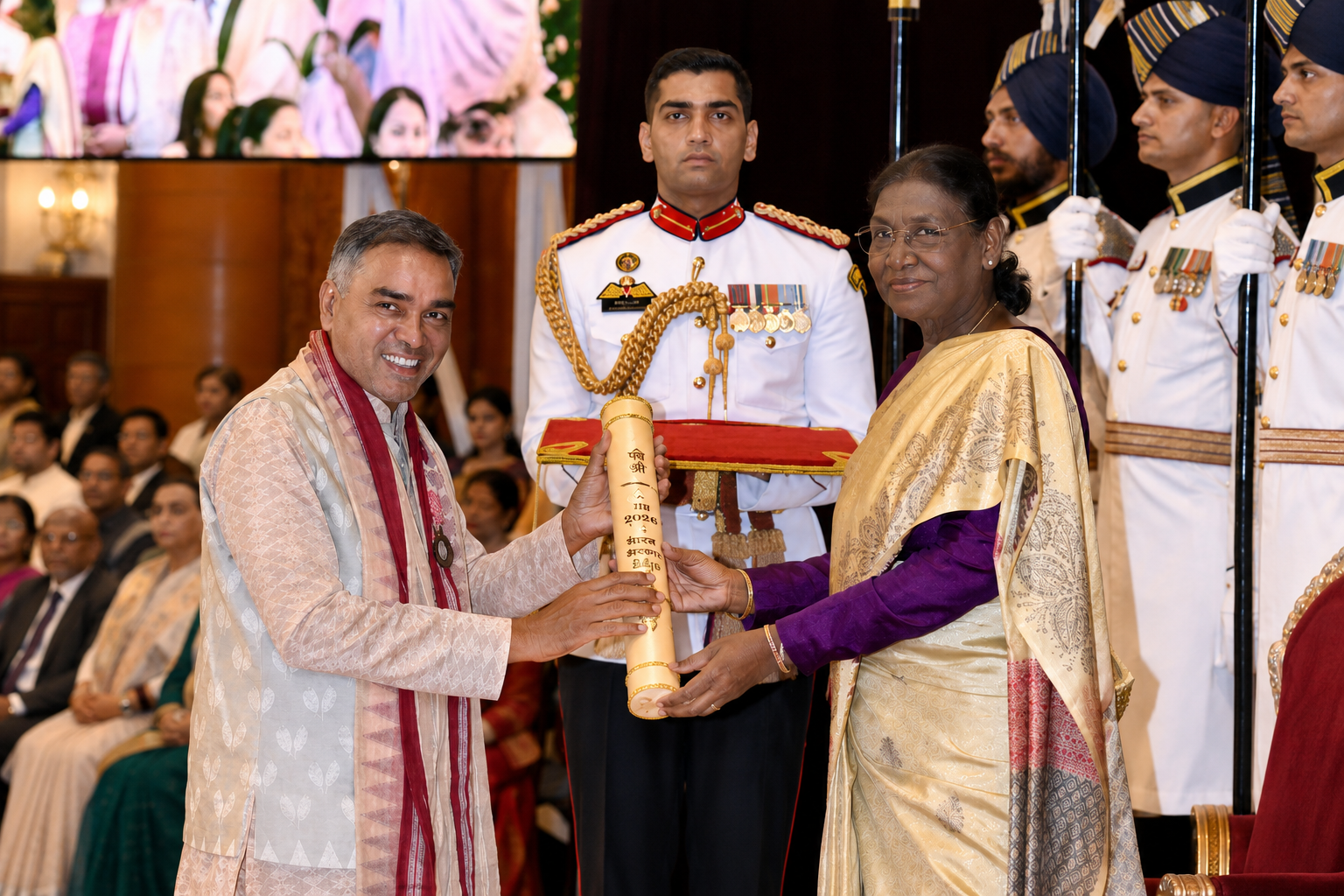
Patra’s contribution to traditional art and craftsmanship received national recognition in 2026 when he was selected for the Padma Shri in the field of Art.
President Droupadi Murmu conferred the Padma Shri on Sarat Kumar Patra on June 23, 2026, at Rashtrapati Bhavan in New Delhi, during the second Civil Investiture Ceremony.
The recognition brought national attention to Patra’s contribution to Odisha’s Bandha weaving tradition and the wider importance of preserving India’s traditional crafts.
His recognition is significant at a time when many traditional crafts face challenges from mechanised production and changing consumer preferences.
Keeping Traditional Skills Alive
The future of handloom depends heavily on the continuation of specialised skills among younger generations. Techniques such as Bandha require years of learning and practical experience.
Master artisans play an important role in keeping this knowledge alive by continuing to practise traditional methods and passing their skills to others.
Patra’s work demonstrates that traditional weaving does not have to remain limited to conventional designs. It can also become a medium for ambitious artistic and cultural projects.
A 52-Metre Tribute to Cultural Heritage
Sarat Kumar Patra’s Gita Govinda textile represents the coming together of literature, spirituality and Odisha’s handloom tradition.
The approximately 52-metre-long fabric, created using the Bandha technique over years of painstaking work, demonstrates the extraordinary level of precision that traditional Indian weaving can achieve.
His Padma Shri recognition on June 23, 2026, adds another important milestone to his contribution to Odisha’s artistic heritage.
Rather than simply measuring the achievement in metres, Patra’s work can be viewed as a cultural bridge connecting a 12th-century Sanskrit epic with the living handloom traditions of modern Odisha. It shows how the hands of a skilled artisan can preserve centuries-old literature while keeping a traditional craft relevant for future generations.