


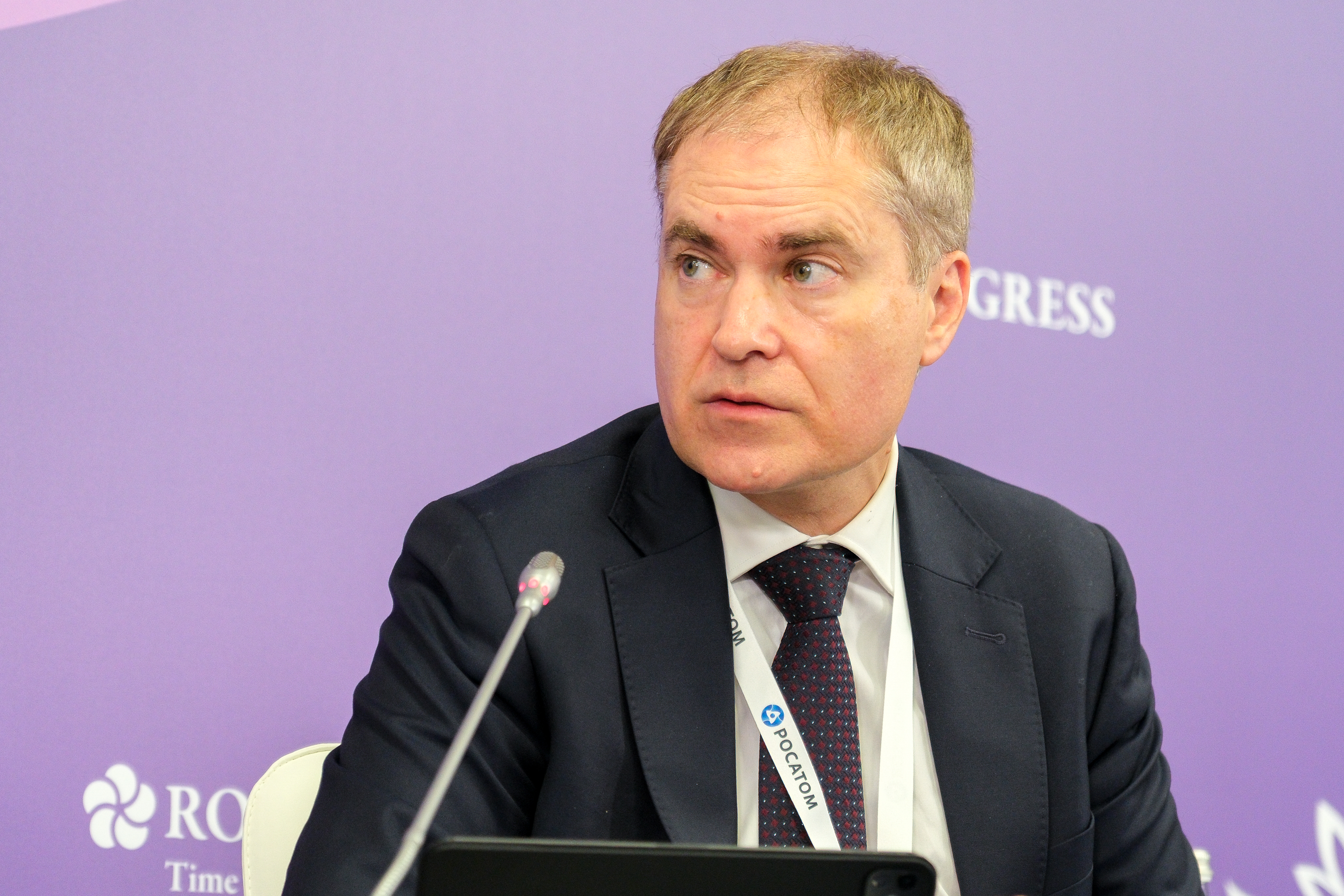
Moscow, Sept 22: At the session “International Cooperation in the Arctic: From Strategic Dialogue to Joint Projects” at the Eastern Economic Forum, Vladimir Panov, Director for the Development of the Northern Sea Route (NSR) and the Arctic and Director of the Arctic Directorate of the Rosatom State Corporation, presented a strategic vision for the development of the Northern Sea Route in today’s reality. Emphasizing the Arctic route’s competitive advantages for international shipping, he noted the route’s geographic and geopolitical stability.
” Predictability is critical for any business, and the events of the last year have brought security to the forefront. The NSR route runs along the borders of just six countries, and the fact that Russia is responsible for security along 70% of its length creates a unique competitive advantage ,” said Vladimir Panov.
The effectiveness of the system built by Rosatom State Corporation is confirmed by real economic indicators: container shipments along the NSR increased 2.5-fold last year, and another significant increase is predicted for this year. Following their Chinese partners, who have upgraded their pilot routes to regular service, South Korea is already operating its own pilot route, and India will join the route next year. To consolidate this success, Rosatom is moving to the next strategic stage: concluding long-term contracts with shipping companies, for which balanced financial and economic models are already being developed.
Alongside logistics, technological and infrastructure projects are being actively implemented. A joint venture with the Chinese company New New Shipping Line is underway to develop the world’s first high-ice-class container ships. These could be the first vessels of their kind to be built.
In conclusion, Vladimir Panov noted the Arctic’s high potential as a space for developing both individual initiatives and implementing projects jointly with international partners. ” The Arctic Council was formed on a geographical basis. And the new international format, for which all the necessary conditions have been created, based on pragmatism and economics, creates the preconditions for the emergence of a new international organization ,” he said.
For reference:
The Northern Sea Route is Russia’s main shipping route in the Arctic, stretching over 5,600 kilometers. It is part of the Trans-Arctic Transport Corridor (TTC). Travel time along the NSR from Asia to Europe is approximately 21 days, 1.5 times faster than via the Suez Canal (approximately 31 days). In recent years, the route has been developing dynamically: cargo traffic along the NSR has consistently exceeded 37 million tons over the past two years, and a new record for cargo volume is planned for 2026. Interest in international transit along the NSR is growing: during the 2025 summer-fall navigation season, 400,000 tons of containerized cargo passed along the route—2.3 times more than in 2024 (176,000 tons).
The Trans-Arctic Transport Corridor is a new international route being created at the direction of the President of the Russian Federation following the Murmansk Forum. The TTC will improve the efficiency and competitiveness of logistics by leveraging synergies from the integration of rail, road, river, and maritime infrastructure into a single complex linked to the NSR. The advantages of the TTC have also been recognized in other countries, and international container traffic along the NSR is growing: 7 container shipments were made along the NSR in 2023, 14 in 2024, and 24 in 2025.
The Eastern Economic Forum (EEF) is a key international platform for discussing the investment potential of the Russian Far East, presenting new projects, and exploring business conditions in the advanced development territories. Established by decree of Russian President Vladimir Putin on May 19, 2015, the EEF is held annually. It has become an effective platform for strengthening cultural and economic ties with countries friendly to Russia. The event is operated by the Roscongress Foundation.
The comprehensive development of the Russian Arctic zone is one of the state’s strategic priorities. Increasing the volume of traffic along the NSR is paramount to achieving the stated objectives in transportation and cargo delivery. The development of this logistics corridor is supported by establishing regular cargo transportation, building new nuclear-powered icebreakers, and modernizing the associated infrastructure. Rosatom State Corporation enterprises are actively participating in this effort.