


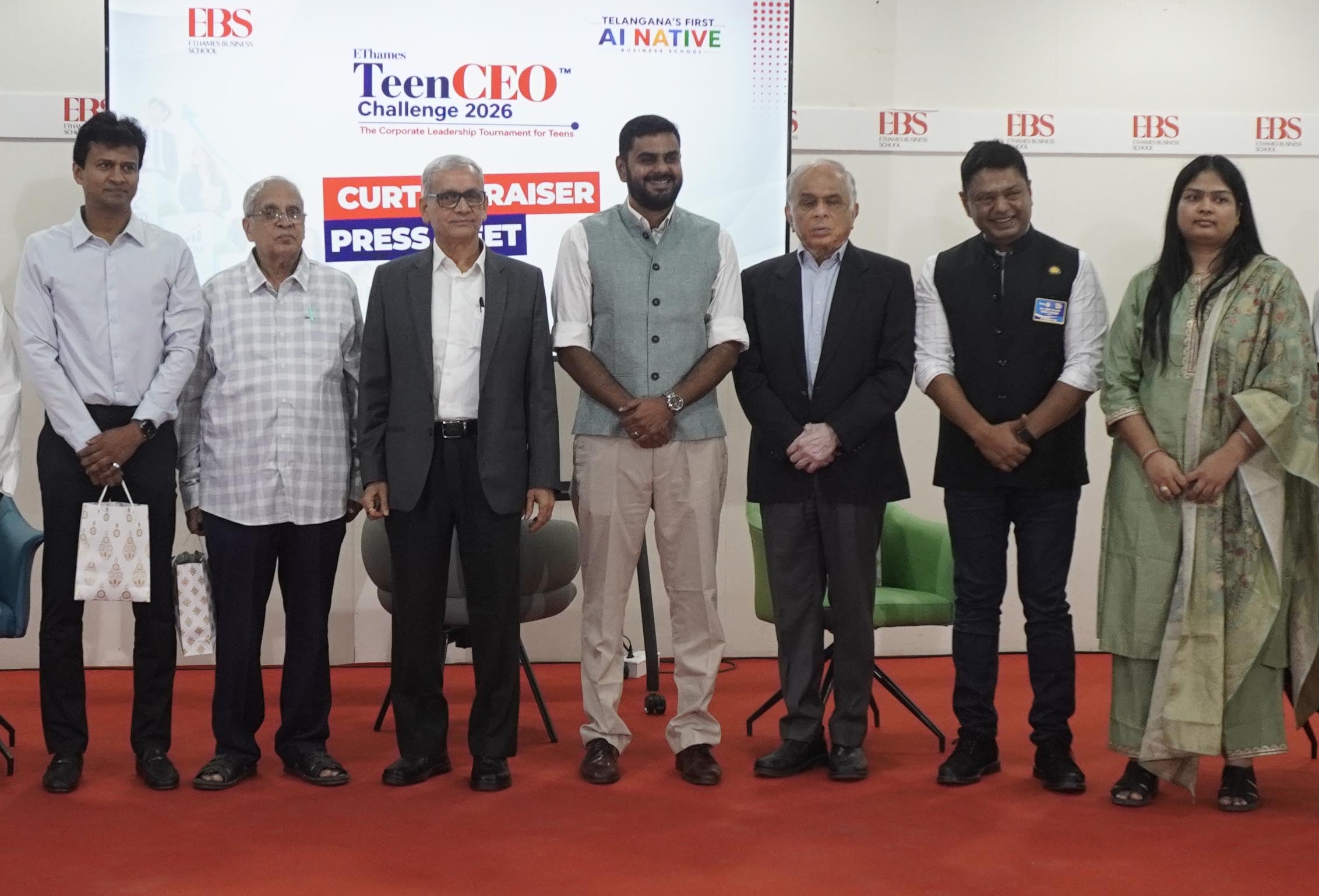
Hyderabad, Sept 16: EThames Business School, Hyderabad, announced the second edition of its flagship EThames TeenCEO Challenge 2026, an experiential leadership and business immersion programme for school and Intermediate students, at a press conference held at its campus in Khajaguda, Gachibowli, Hyderabad.
The initiative was formally launched by Mr. Ajit Rangnekar, Former Dean, Indian School of Business (ISB) and Advisor, EThames Business School, in the presence of more than 300 school principals, educators, education entrepreneurs, faculty members and students.
Speaking at the launch, Ajit Rangnekar described TeenCEO Challenge as more than a competition, calling it a potentially life-changing experience for young learners.
“Education is no longer only about studying subjects; it is also about learning how to live. Teaching today should not be limited to imparting knowledge, but should focus on developing life skills and preparing students for the larger roles they will play in the future,” he said.
He suggested that the initiative should become more inclusive by reaching out to a larger number of government schools and ensuring that students from diverse backgrounds get access to such experiential learning opportunities.
Rangnekar also unveiled the Student Guide Book prepared for participants of the TeenCEO Challenge.
Conceived as an experiential leadership and business immersion programme, the TeenCEO Challenge is positioned as an inter-school career-readiness initiative for students from Class VIII to Intermediate (Plus Two).
Moving beyond conventional academic competitions, the programme places students in simulated corporate environments where they take on roles such as CEO, CFO, CMO, CTO and CHRO.
Students are exposed to business scenarios requiring them to make strategic decisions, analyse problems, pitch ideas, work in teams and respond to pressure, followed by structured feedback from industry professionals.
The first edition saw participation from more than 3,000 students representing over 30 government and private schools. Of these, 300 students were shortlisted for the finals, with 12 students emerging as Teen Corporate Leaders.
The second edition is expected to expand the scope and reach of the initiative. The final round will be held on November 28, 2026, at the EThames Business School campus in Khajaguda, Gachibowli.
According to EThames, the objective is to introduce leadership development and career-readiness skills at the school level, giving students opportunities to understand their abilities, interests and potential career pathways before they enter higher education.
As part of the launch, EThames also organised a panel discussion titled “Catch Them Young, Train Them Hard—Preparing the Learners for the Careers of the Future.” The discussion was moderated by Kali Prasad Gadiraju.
The panel included Dittakavi Chakrapani, Retired Chairman, AMS Arts & Science College; Ajit Rangnekar, Former Dean, ISB and Advisor, EThames Business School; Praveen Raju, Founder Vice Chairman, Suchitra Academy and Former President, FICCI ARISE; Aditya Ramnath, Chair, Thalir Yi Hyderabad and Founder, AMMONITE Advisor; and Uday Pilani, Chairman, The Pilani Group and Governor, Rotary International, Telangana/North Andhra Pradesh.
Opening the discussion, the moderator questioned whether it is reasonable to expect teenagers of 14 or 15 to make informed career choices without first giving them adequate exposure to different professions, emerging opportunities and the changing nature of work.
Praveen Raju observed that career choices are often initiated as early as Class VII or VIII, with psychometric tests sometimes being used to suggest possible career paths. He said students should instead be encouraged to understand their own aptitude and interests and make informed choices.
“Career domains are changing rapidly. Even if a student prepares for one particular domain today, there is no guarantee that the same domain will remain unchanged by the time the student completes higher education. Young people therefore need adaptability and a broader way of thinking,” he said, adding that developing a CEO-like mindset from school could help students become more confident decision-makers.
Dittakavi Chakrapani, drawing on his experience in the education sector and public administration, spoke about the importance of overall personality development. He observed that government residential schools were seeing encouraging developments in this area and said parents often place excessive pressure on children to become doctors or engineers.
He also expressed concern over declining newspaper reading among teachers and students. “Newspaper reading is declining. Even among teachers, very few are reaching newspapers regularly. Reading a newspaper adds to the overall personality of a student by exposing them to the world beyond textbooks,” he observed.
Aditya Ramnath highlighted initiatives of Young Indians (Yi) and said education needs to move beyond an examination-centric approach towards problem-solving, decision-making and empowering students to take decisions.
Uday Pilani said entrepreneurship is an inherent human quality and that young people should be encouraged to identify and develop their entrepreneurial abilities from an early age.
The panel also discussed the need to encourage questioning, curiosity, excellence and competitive spirit among students and to expose them to emerging technologies and changing career opportunities.
In concluding message, Kali Prasad Gadiraju referred to international examples such as education system in Israel, South Korea and China where education systems have placed emphasis on questioning, excellence and innovation, arguing that India needs to develop stronger educational approaches that prepare students for a rapidly changing world.
Kali Prasad Gadiraju observed that Israel, despite being a relatively small country, has produced a significant number of Nobel laureates and has emerged as a global hub for breakthrough technologies. He said that a closer look at its education system reveals a fundamentally different approach, with students encouraged to question everything, think independently and strive for excellence.
“The second important aspect is excellence. Whatever they do, they aspire to be among the best in the world,” he said.
He said similar lessons could be drawn from the education systems of South Korea and China, which have contributed significantly to their economic and technological transformation.
“India’s challenge is that we do not yet have a distinctive character to our education system. We have CBSE, ICSE, IB, State Boards and several other systems, but we need to ask what kind of learner we ultimately want to create. Our children must be encouraged to question, think independently, compete and strive for excellence,” he added.
He also referred to projections on the impact of AI and emerging technologies on employment and stressed the need for students to develop skills that complement technological change.
The discussions at the launch highlighted a common theme: career readiness cannot begin only at the college level.
Through the TeenCEO Challenge, EThames Business School aims to give school students early exposure to leadership, business decision-making, teamwork, communication, problem-solving and professional environments.
The second edition will bring together students from across Telangana, providing them an opportunity to test their ideas, take decisions and experience the responsibilities associated with leadership roles at a much earlier stage of their educational journey.
Speaking further, Kali Prasad Gadiraju referred to the World Economic Forum’s projections on the impact of AI and emerging technologies on the future of work. He said that while AI and related technologies are expected to displace around 92 million jobs by 2030, they could also create approximately 170 million new roles, resulting in a net increase of about 78 million jobs.
He stressed that the changing employment landscape makes it essential for the education system to prepare students not merely for existing careers, but for new roles and opportunities that are likely to emerge with technological transformation.