


Sep 16: The global transition toward carbon-free, clean, and sustainable energy has accelerated the search for new hydrogen-producing technologies. However, making clean hydrogen by splitting water into hydrogen and oxygen is expensive due to its reliance on scarce metals such as platinum and iridium.
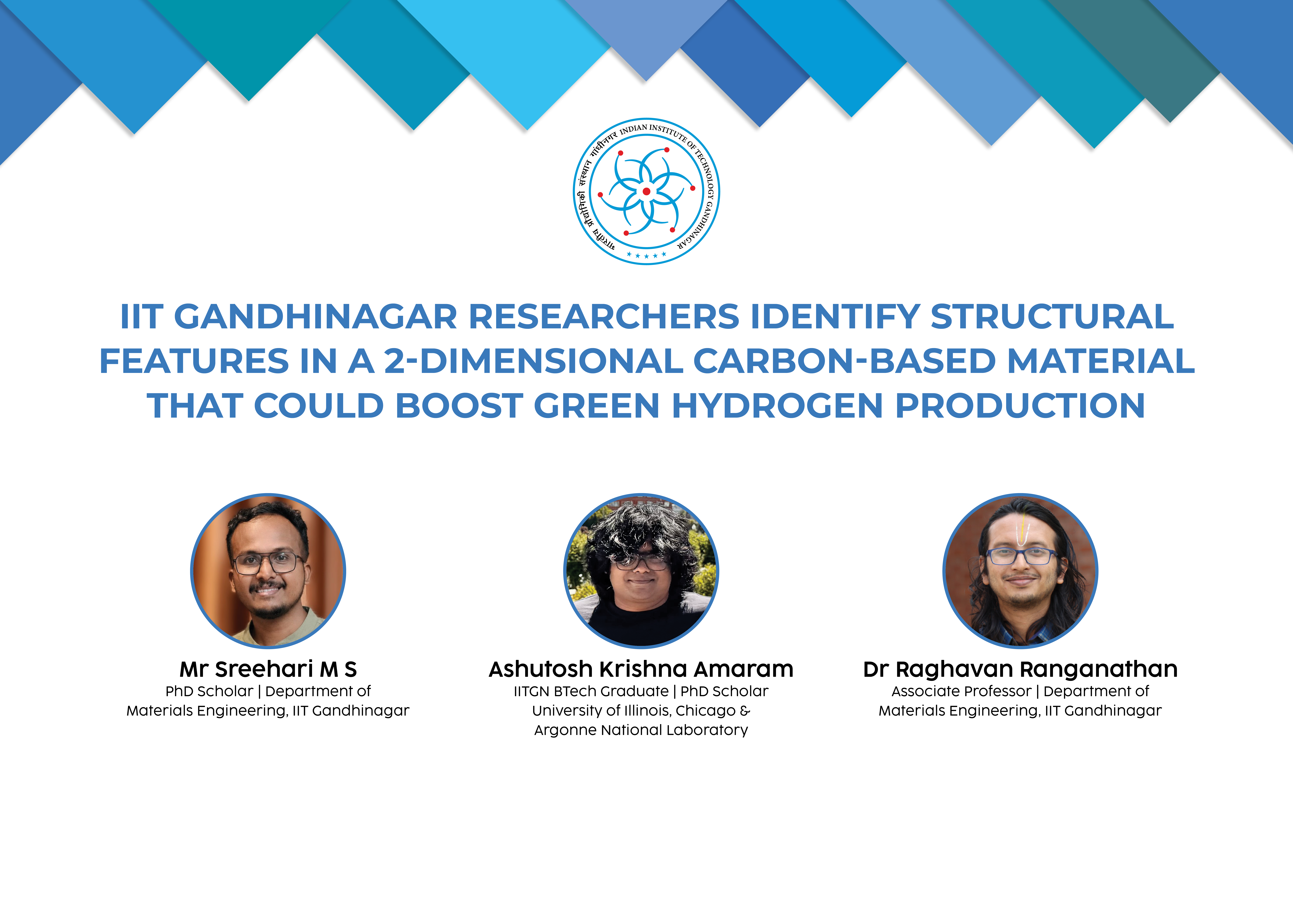
As an effort to tackle this issue, a new computational study from researchers at the Indian Institute of Technology Gandhinagar has explored an unusual form of carbon that could offer a metal-free route to this process. Their findings were published in npj 2D Materials and Applications.
The “Disordered” Hero
Known as the Monolayer Amorphous Carbon or MAC, this two-dimensional material is just one atom thick. The minuteness of this measurement is evident by the idea that it is roughly a million times smaller than the width of a human hair!
The thinnest material in the world, graphene, has carbon atoms arranged in a neat and regular hexagonal pattern. The downside of this geometry is the presence of limited active sites that can enhance hydrogen production. Enter MAC, which possesses a disordered arrangement of atoms. This lack of long-range order appears to function like a sponge catalyst and can give rise to many local coordination environments, ring configurations, and strain distributions, which may provide a broad range of active sites.
The Sweet Spot
According to Sreehari M S, “It is crucial to find the right balance. If the hydrogen from the raw material sticks too tightly to the surface of the catalyst, it becomes difficult to release hydrogen molecules. On the other hand, if it barely sticks at all, the reaction cannot proceed efficiently.” The first author of this study, Sreehari, is a third-year PhD scholar in the Department of Materials Engineering at IITGN.
This sticking-removal balance can be described in terms of the Gibbs free energy of hydrogen adsorption by the catalyst. “A value close to zero is considered desirable because it would represent an interaction that is neither too weak nor too strong,” he continued.
The calculations found that pristine graphene had a ΔGH of about +1.73 electronvolts, while β-graphyne, the best of the crystalline carbon materials examined, had a value of about +0.34 eV.
The team created their model of amorphous carbon, MAC, using a computer simulation called a melt-quench process. In simple terms, they took a carbon structure, heated it until its orderly arrangement became randomised and then cooled it down rapidly enough to preserve a disordered structure. The resulting sheet contained a mixture of five-, six-, and seven-membered carbon rings.
Understanding the usefulness of this material as a catalyst would require examining a huge number of possible hydrogen adsorption sites. But accurately calculating the properties of each site is computationally expensive and demanding.
Machine Learning to the Rescue
The researchers combined Density Functional Theory calculations with a machine-learned interatomic potential called MACE. They used DFT, a computational modelling method, to obtain high-quality results for selected sites and then fine-tuned the machine-learning model to explore many more sites, something that would not have been practical with DFT alone. Think of it like a chef tasting a carefully selected handful of dishes to understand what makes a recipe work, and then using that learning to identify the most promising combinations from thousands of possibilities.
“We employed the machine learning model to examine approximately 1,183 different sites on a larger MAC surface. We found that the surface behaved almost like a microscopic map of hills, valleys and neighbourhoods. The predicted ΔGH values stretched from −0.91 to +1.70 eV, with about 15% of the sites having values below +0.25 eV, suggesting potentially favourable catalytic behaviour,” explained Ashutosh Krishna Amaram. He graduated with a BTech in Materials Engineering from IITGN. He is currently a doctoral student at the University of Illinois, Chicago, and Argonne National Laboratory.
The Perfect Imperfections
Analyses revealed that imperfections such as greater bond distortion, irregular bond angles and greater surface ripples provided more favourable hydrogen adsorption. In contrast, sites retaining more graphene-like distribution show reduced catalytic efficiency. This is a reversal of intuition since defects are generally treated as issues to be removed!
In the words of Dr Raghavan Ranganathan,
“This research provides a possible design blueprint for next-generation catalysts. While we provide computational evidence that MAC can efficiently generate hydrogen, there is a need for further experimental validation.” Dr Ranganathan is an Associate Professor in the Department of Materials Engineering and the Principal Investigator at the Computational Molecular Engineering Group. “That said, machine learning could help researchers screen and design catalytic materials more efficiently, narrowing down promising structures before they are synthesised and tested experimentally,” he added.
This study, with its potentially low-cost, metal-free carbon catalyst, aligns with India’s National Green Hydrogen Mission, which focuses on strengthening the country in terms of producing, using and exporting green hydrogen with innovations that can improve the efficiency and cost-effectiveness of green-hydrogen technologies. The findings are also in resonance with the Clean Hydrogen Mission, which is focused on accelerating hydrogen technologies and aims to bring clean-hydrogen costs down to US$2 per kilogram by 2030.
The authors thank the use of IITGN’s Param Ananta supercomputing facility to carry out all the simulations reported in this work.