


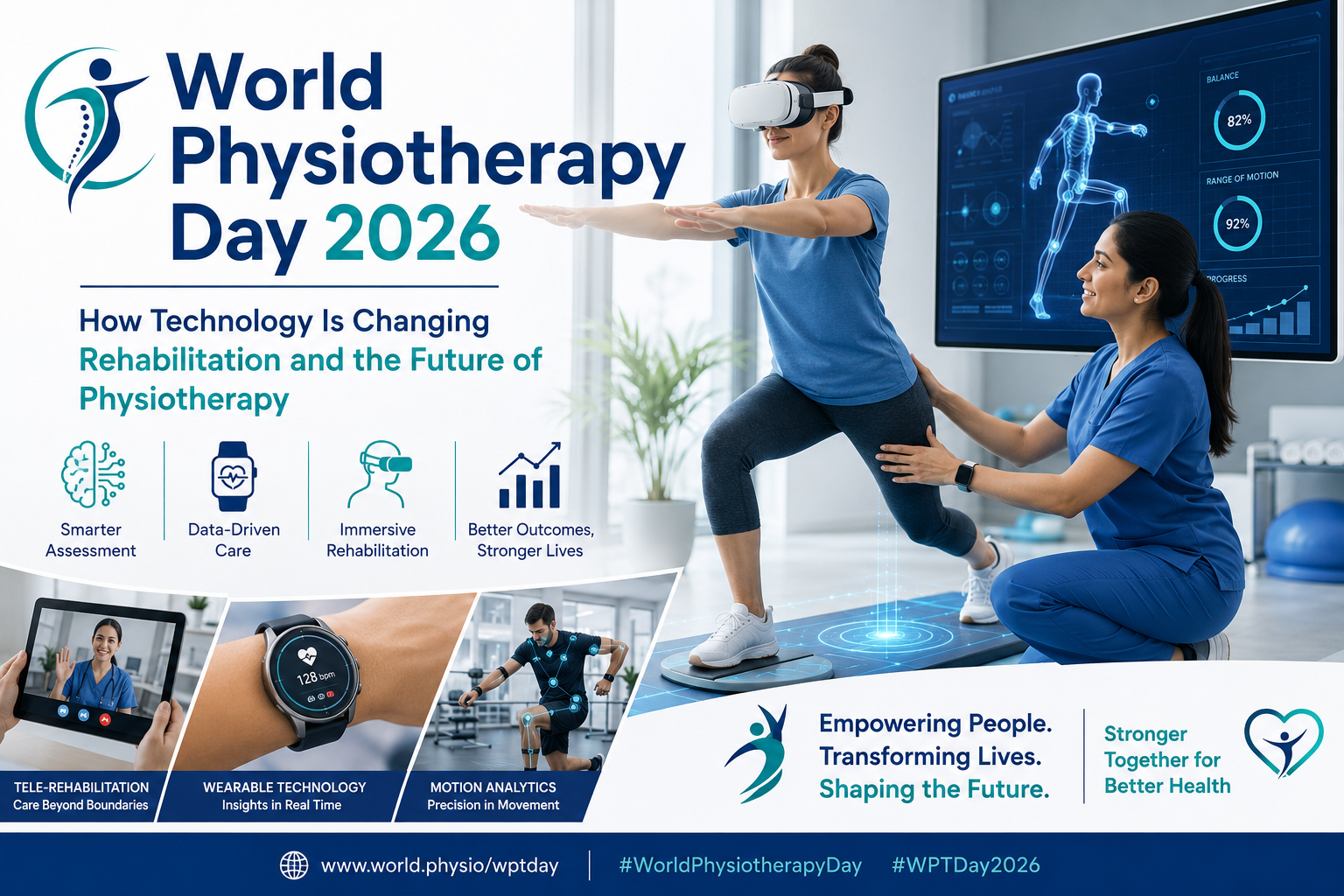
Sept 08: From virtual consultations and wearable devices to AI-assisted movement tracking, technology is making rehabilitation more connected, personalised and easier to continue beyond the clinic.
For many people, physiotherapy begins with a simple goal: to move better.
It could mean recovering from an injury, rebuilding strength after surgery, learning to walk again after a stroke or managing a condition that makes everyday movement difficult.
Traditionally, much of that journey has happened inside a physiotherapy clinic.
But that is changing.
Technology is gradually bringing rehabilitation into people’s homes and daily lives. Wearable devices can track activity, digital platforms can guide exercises, virtual consultations can connect patients with therapists, and newer technologies can help professionals understand movement in greater detail.
The need for rehabilitation is also significant. The World Health Organization estimates that around 2.4 billion people globally live with a health condition that could benefit from rehabilitation. As populations age and chronic health conditions become more common, that need is expected to grow.
Technology could help address part of this challenge by making rehabilitation more accessible and connected.
And India is beginning to see that shift too. A 2025 study of 455 people in Western Uttar Pradesh found that while only 40.7% were previously aware of telerehabilitation, 81.8% said they were willing to use it. The researchers highlighted the need for greater awareness and digital inclusion to make technology-enabled rehabilitation more accessible.
The technology may be changing, but the purpose remains the same: helping people recover, regain confidence and become more independent.
Rehabilitation Doesn’t Have to Stop at the Clinic
One of the biggest advantages of technology is that it can extend rehabilitation beyond the physiotherapy room.
A patient might meet their physiotherapist once or twice a week, but recovery continues every day.
What happens between those appointments matters.
Digital rehabilitation platforms can help patients follow exercise programmes at home, receive reminders and keep track of their progress. In some cases, virtual consultations can also make it easier for therapists to check in and adjust a programme without requiring another physical visit.
This can make rehabilitation feel less like a series of appointments and more like an ongoing process.
Wearable Technology Can Keep Patients Moving
Smartwatches, fitness trackers and specialised wearable sensors are becoming increasingly useful in healthcare.
For rehabilitation, they can provide information about activity levels, movement and other physical measures.
That information can help patients understand their progress.
It can also give physiotherapists a better idea of what happens outside the clinic.
For example, a patient may be completing exercises regularly but remaining largely inactive for the rest of the day. That broader picture can help a therapist decide whether the rehabilitation plan needs to change.
For patients, seeing progress on a screen can also be encouraging.
Sometimes recovery happens gradually, and improvements that are difficult to notice from one day to the next become much clearer over several weeks.
Virtual Physiotherapy Is Making Care More Accessible
Getting to a clinic regularly is not always easy.
For people living in remote areas, older adults, individuals with mobility difficulties or patients recovering from surgery, travelling for every appointment can be challenging.
Virtual physiotherapy can offer another option when clinically appropriate.
A therapist can guide exercises through a video consultation, discuss difficulties and monitor progress remotely.
It does not replace every form of face-to-face physiotherapy. Some conditions require physical assessment, hands-on treatment or close supervision.
But for follow-ups, exercise guidance and selected rehabilitation programmes, digital care can make professional support easier to access.
This could be particularly relevant in India, where access to specialised healthcare can vary significantly between urban and less-served areas.
AI Could Make Movement Analysis Smarter
Artificial intelligence is also beginning to find a place in rehabilitation.
One area of interest is movement analysis.
AI-powered systems can analyse video or sensor data and identify patterns in the way a person moves. This could potentially help therapists assess exercises, track changes and provide more personalised feedback.
Recent research into emerging technologies in physiotherapy has highlighted the growing use of telerehabilitation, wearable sensors, virtual and augmented reality, robotic systems and AI as part of the profession’s changing technology landscape.
For patients, this could mean receiving clearer information about how they are performing an exercise.
For therapists, it could provide another source of information when making clinical decisions.
But AI should remain a support tool.
A computer can analyse movement, but it cannot fully understand the person behind that movement.
Pain, fear, confidence, motivation and lifestyle can all influence recovery—and these are things that still require human understanding.
Virtual Reality Could Make Rehabilitation More Engaging
Rehabilitation exercises can sometimes become repetitive.
Doing the same movements again and again may be necessary for recovery, but it is not always exciting.
Virtual reality could change that experience.
Instead of simply performing an exercise, patients can interact with digital environments where movement becomes part of an activity or game.
This can make certain forms of rehabilitation more engaging and may encourage patients to participate more consistently.
The technology is particularly interesting for areas such as neurological rehabilitation, balance training and motor recovery.
The idea is simple: if rehabilitation feels more engaging, patients may be more willing to keep doing it.
Robotics Can Support Patients Who Need More Assistance
Robotic technology is another area developing within rehabilitation.
Robotic devices can assist with repetitive movements when patients have limited strength or motor control.
For someone recovering from a neurological condition, for example, repeated movement practice can be an important part of rehabilitation.
Robotic systems can provide structured assistance while allowing therapists to monitor performance and adjust treatment.
They are not intended to replace the therapist.
Instead, they can provide another tool for delivering intensive and repeatable movement practice.
Technology Can Help Patients Stay Motivated
There is another benefit that is easy to overlook: motivation.
Recovery can take time.
When progress is slow, it can be difficult for patients to stay committed to their exercises.
Digital platforms can turn rehabilitation into something patients can see and track.
They may be able to record completed exercises, monitor activity or see changes over time.
That sense of progress can make a difference.
A patient who can see that they are walking further than they were a month ago may feel more encouraged to continue.
Technology, in this sense, is not simply collecting data.
It can help patients see their own progress.
The Physiotherapist Still Makes the Difference
With all the discussion around AI, robotics and digital healthcare, it is important not to lose sight of the most important part of rehabilitation: the relationship between the patient and the physiotherapist.
Technology can measure movement.
A wearable can count steps.
An app can provide exercise instructions.
AI can identify patterns.
But a physiotherapist can ask a simple question:
“How are you actually feeling?”
That conversation can reveal things technology may miss.
Perhaps the patient is experiencing pain. Maybe they are afraid of falling. Perhaps an exercise is difficult to fit into their daily routine. Or maybe they have simply lost confidence.
Good rehabilitation is not only about numbers.
It is about understanding the person.
What Should Patients Look For?
Technology can make rehabilitation easier, but patients should not choose a digital rehabilitation service simply because it uses the latest technology.
A few questions are worth asking:
Is a qualified professional involved?
Technology should complement professional guidance rather than replace it.
Is the programme personalised?
An exercise programme designed for someone else may not be appropriate for your condition.
Is progress being monitored?
Good digital rehabilitation should have a clear way of tracking progress and adjusting care when needed.
How is personal data handled?
Health information is sensitive. Patients should understand what information is collected and how it is stored or used.
Can I access human support when needed?
Technology should not leave patients on their own when they have questions, pain or difficulties with an exercise.
The goal should always be better rehabilitation—not simply more technology.
The Future May Be a Combination of Human Care and Technology
The future of physiotherapy is unlikely to be completely digital.
Instead, it may become a combination of traditional care and technology.
A patient could have an in-person assessment with a physiotherapist, use a wearable device to monitor activity, follow exercises through a digital platform and have virtual follow-up sessions when appropriate.
The therapist could then use information collected between appointments to make future sessions more targeted.
This creates a more connected rehabilitation journey.
Making Rehabilitation Fit Real Life
Perhaps the biggest opportunity technology offers is convenience.
People do not live inside physiotherapy clinics.
They live at home, go to work, travel, care for their families and manage busy routines.
Rehabilitation needs to fit into that reality.
Technology can help bring parts of the rehabilitation process into everyday life—without removing the professional guidance that makes physiotherapy effective.
That could be especially valuable for people who need long-term rehabilitation rather than a short course of treatment.
Technology Should Solve Problems, Not Create Them
There is also a simple principle that should guide the future of digital rehabilitation:
Technology should make care easier, not more complicated.
Not every patient needs an AI-powered system.
Not every exercise requires a wearable sensor.
And not every rehabilitation programme needs virtual reality or robotics.
The right technology is the technology that genuinely helps the patient or the healthcare professional.
If it improves accessibility, motivation, monitoring or personalisation, it can add real value.
If it creates unnecessary complexity, it may do more harm than good.
A New Chapter for Physiotherapy
Technology is giving physiotherapy new possibilities.
Rehabilitation can increasingly extend beyond the clinic.
Patients can stay connected with therapists, monitor their progress and receive support at home.
Professionals can gain access to more information about movement and activity.
And emerging technologies such as AI, virtual reality and robotics could open new avenues for personalised rehabilitation.
But the future is not about technology replacing physiotherapists.
It is about technology helping physiotherapists provide better, more connected care.
Because behind every sensor, screen and algorithm is a person trying to take another step, regain strength, reduce pain or return to everyday life.
And that human goal will remain at the heart of rehabilitation—no matter how advanced the technology becomes.