


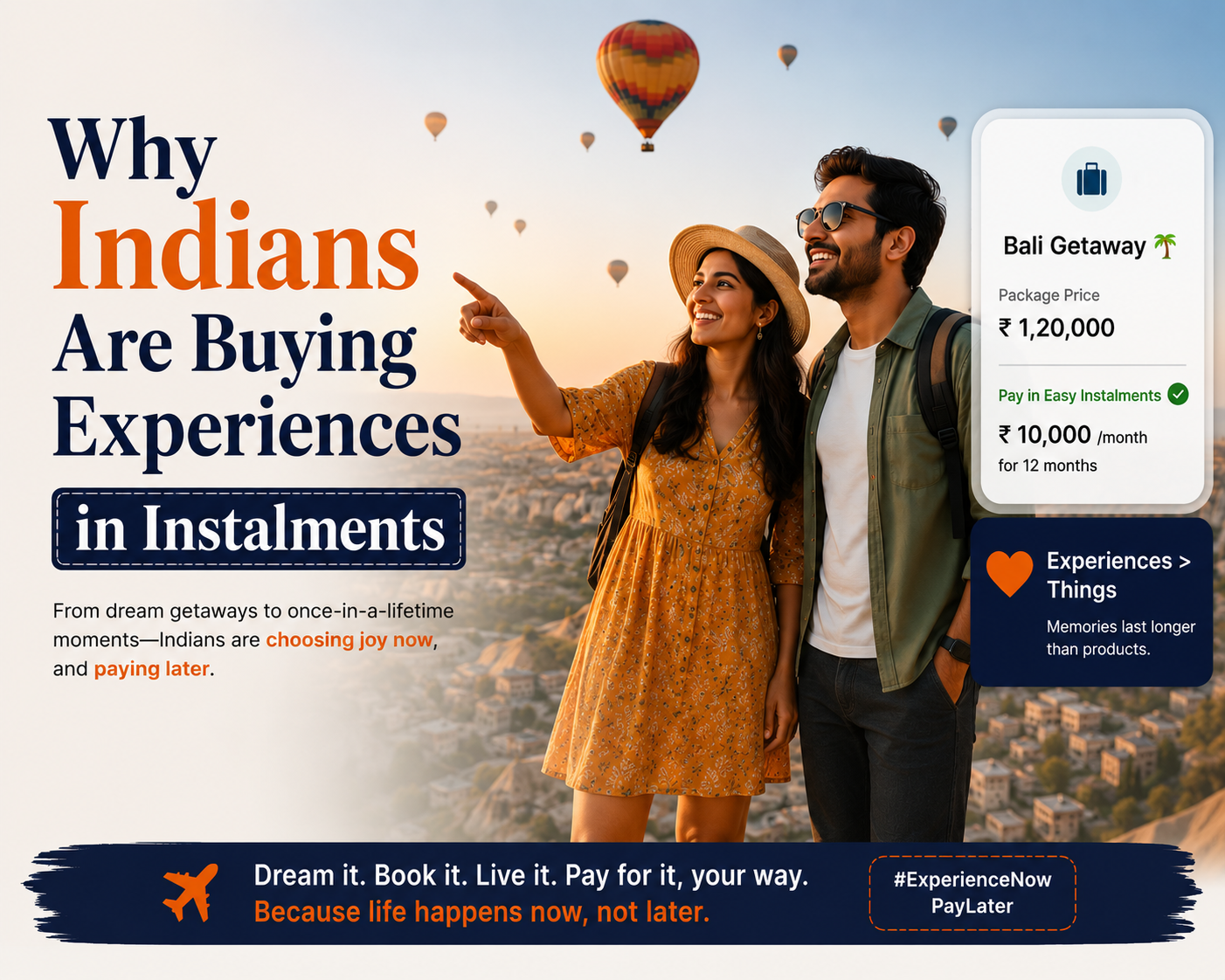
From international holidays and destination weddings to concerts and wellness retreats, Indians are increasingly willing to pay for memories now—and pay for them later.
The Rise of Experience-Driven Spending
The consumption scenario in India is evolving. In recent years, EMIs were inextricably linked to houses, vehicles, cell phones, and appliances. The same type of payment philosophy is now shifting to a completely new category: experiences.
Whether it be holidays abroad, destination weddings, concerts, adventure holidays, wellness holidays or high-end events, Indians are willing to pay for memorable experiences even if they can’t afford the whole deal. This is being made possible by credit cards, personal loans, travel financing and buy now pay later options.
This trend has been confirmed by recent consumer data. While there is a conscious effort to spend more on discretionary items, it is being done selectively, revealed Deloitte India in a study on consumer spending.
Why Indians Are Buying Experiences in Installments
An EMI in India used to symbolize a brand new car, a refrigerator or perhaps maybe a telephone. Today, the definition of an “EMI purchase” is becoming much broader. From a concert trip to an overseas holiday, a destination wedding or even a top-notch wellness getaway, all these can now be arranged on a monthly basis.
It’s the new and young Indian Experience Economy and easy access to consumer credit is driving it.
From Owning Things to Living Moments
Indian people are becoming more inclined to shift their thinking from ownership to “experiences that make memories, build social connections and define personal identity.”
According to recent report by EY-Parthenon and BookMyShow, 78% of Indian consumers prefer experiences over physical products. The live-events economy has emerged as a major industry: concerts, festivals, comedy shows and more have brought in consumers who have stepped outside the traditional entertainment spending envelope.
If it’s your favorite artist’s concert, it might be more significant to your youngster than to purchase another actual thing. A holiday can be considered more than just a trip, it can be a story to tell, some photos to share and a time to relax. The question now becomes, “Can I afford this now?” versus “Can I fit this into my monthly budget?”
The EMI Mindset Has Entered the Experience Economy
Expensive experiences usually involve paying a ticket fee, but that’s not the only cost. A concert may include flights, hotel stays, local transportation, food, concert t-shirts and other items. The costs of a destination wedding may involve travel, lodging, photography and event costs. International holiday may include flights, accommodation, activities, shopping and insurance.
Consumers can finance some of these costs with credit card or personal loans, or by using financing or deferred payments for travel. This gives a feel of a ₹1 lakh experience, when broken down into smaller chunks of monthly payments. However, there is a key difference: affordability and financeability are not interchangeable.
Why Consumers Are Willing to Borrow for Experiences
One factor is that experiences are now emotionally significant. A mobile phone can be replaced in a few years time. When it comes to a concert with a favourite artist or a once-in-a-lifetime international trip, it has a greater sense of urgency.
Social media is also a factor. The social value of experiences is becoming more tangible. Now people record concerts or vacations or food or weddings or adventures and make them public and aspirational.
In addition, there is a generational change. Young Indians are now more likely to save for leisure in addition to saving for their other goals, rather than saving for leisure on an “as-needed” basis. Recent reporting has highlighted how Gen Z spending is moving towards travel, live events, hobbies and other immersive experiences. In other words, concerts are turning into mini-holidays.
The evolution of live entertainment is a good example of that. Concerts don’t have to be two hours in length. For a person who comes from another city, it can turn into a weekend trip with flights, hotel and restaurants, sightseeing etc.
The Risk Behind “Small” Monthly Payments
There is, however, another side to the experience economy that’s not quite so comfortable. It is possible to make a large cost seem affordable, if it is split into monthly payments.
A ₹60,000 holiday may sound manageable at ₹5,000 a month. If the many such purchases are paid off together, however, the consumer may soon have to pay off multiple EMIs and credit-card bills.
There are already concerns on consumption-led borrowing, especially on credit cards, personal loans and buy now pay later products from recent reporting among younger Indians. The risk isn’t the borrowing, it’s the repayment. Being a good borrower can help control cash flow. The issue starts when credit becomes a life-long cycle of paying back.
What This Means for Indian Businesses
The opportunity is big for businesses. Travel companies, hotels, event planners, wellness brands and experience platforms can now be more creative in creating packages that fit into people’s budgets, budgets that are flexible and convenient. “Premium Experience” might not be the winning proposition anymore. It might be “high quality experience, affordable.”
Meanwhile, companies will need to be mindful of promoting irresponsible consumption. The transparency of pricing, financing costs and responsible credit partnerships are going to be more significant.
The New Indian Consumer Equation
It is not just a story of Indians’ growing penchant for the extravagant. It’s a change in the perception of value among consumers.
The old dream was to obtain something that one could own. The desire is to do something memorable.The trend is to want to do something memorable. But, the true question is whether the consumers can enjoy those experiences without sacrificing its financial future.
The Indian consumer will be able to travel, attend, explore and participate with more opportunities as experiences become easier to finance. The next hurdle will be knowing when to stop when you’re “I can pay for this” versus “I can afford this.This angle is perfect for an Indian business publication, as it links consumer behaviour, credit, Gen Z spending, travel, live events and the experience economy, instead of an EMI as a personal-finance story.