


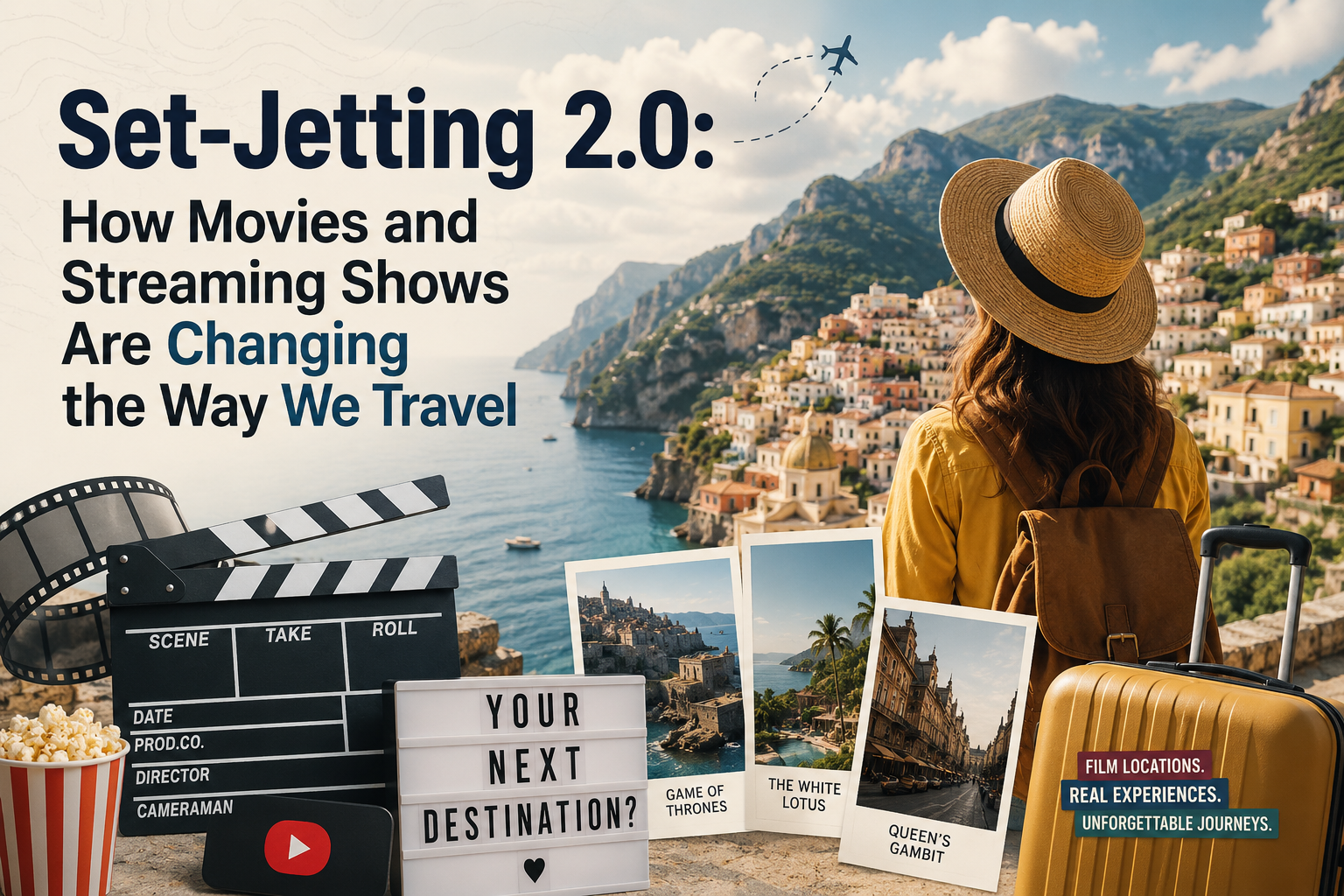
Aug 28: For many travellers, the next holiday destination may begin with a movie night rather than a travel search.
A sweeping mountain landscape, a charming European street, a tropical beach or even a quiet Indian town appearing on screen can leave a lasting impression. Before long, viewers are searching for the location, saving travel videos and imagining what it would be like to experience the place themselves.
This is the new age of set-jetting — travelling to places inspired by movies and television shows. While film tourism is not new, streaming platforms, social media and easier online travel planning have transformed the trend. A destination can now move from the screen to a traveller’s wish list almost overnight.
What Is Set-Jetting?
Set-jetting refers to travelling to destinations that people discover or become interested in through movies, television shows and streaming content.
Sometimes the attraction is an actual filming location. In other cases, it is the atmosphere of a place that captures the audience’s imagination. A romantic series can make a city feel irresistible, while an adventure film can turn a landscape into a bucket-list destination.
The trend has become significant enough for the travel industry to track it closely.
Expedia Group’s 2026 Set-Jetting Forecast, based on research among 24,000 travellers across 18 countries, found that 53% of travellers say their desire to take a set-jetting trip has increased, while 81% of Gen Z and Millennial travellers say they plan getaways based on what they have seen on screen.
The figures underline a broader change in how people discover destinations: travel inspiration is increasingly coming from entertainment.
Streaming Has Changed the Travel Inspiration Cycle
Movies have influenced travel for decades. But streaming has given the phenomenon a new dimension.
A film may introduce viewers to a destination for two hours. A streaming series can keep them there for an entire season, allowing them to become familiar with the streets, cafés, hotels, landscapes and neighbourhoods surrounding their favourite characters.
The destination effectively becomes part of the story.
That familiarity can create a stronger emotional connection than conventional destination advertising. Viewers may begin to associate a place with a favourite character, relationship or storyline, creating a desire to experience the setting in real life.
This is where Set-Jetting 2.0 differs from traditional film tourism. It is not simply about visiting a famous movie location. It is about travelling into a world that audiences have already emotionally explored through their screens.
From Streaming Screen to Search Bar
The distance between watching and booking is becoming shorter.
A traveller can discover a destination in an episode, search for it online moments later, watch videos from other visitors and begin comparing hotels and flights — all within the same evening.
Expedia’s 2026 summer data shows how quickly this can happen. Search interest for Yorkshire increased by 60% in the first six weeks following the release of Wuthering Heights. Muskoka, Canada, experienced a 110% increase in interest following Heated Rivalry, while Rome saw a 35% increase after Emily in Paris expanded its storyline to the Italian capital.
The numbers illustrate the commercial power of screen exposure. A successful production can introduce a destination to a global audience and create travel interest without relying entirely on traditional tourism advertising.
India Is Taking Film Tourism Seriously
The connection between cinema and tourism is particularly relevant for India, where films have long showcased the country’s landscapes, cities and cultural heritage.
From Rajasthan’s forts and palaces to the backwaters of Kerala, the ghats of Varanasi and the landscapes of the Northeast, Indian locations have frequently become part of the visual identity of films.
The Government of India is also recognising the potential of this relationship. The Ministry of Tourism has developed a National Strategy for Film Tourism, built around areas including destination branding, infrastructure development, financial incentives, post-film tourism outreach and coordination between different levels of government.
More recently, the Ministry of Tourism highlighted film tourism as part of India’s destination-branding strategy at the 6th Global Film Tourism Conclave in 2026, describing cinema as a way of turning locations into aspirations and supporting livelihoods and grassroots economic opportunities.
This gives India an opportunity to move beyond simply being a filming destination and become a destination that actively converts screen exposure into tourism.
Why India Has an Advantage
India’s diversity gives filmmakers an unusually broad range of settings.
A single country can offer Himalayan landscapes, tropical beaches, historic cities, desert architecture, forests, tea plantations and culturally distinctive towns.
That diversity also creates an opportunity for lesser-known destinations.
Instead of focusing tourism only around established hotspots, screen exposure can introduce audiences to places that may not otherwise appear on their travel radar. A film or streaming series can provide the initial discovery, while local tourism businesses can build experiences around the location.
This could be particularly valuable for domestic tourism, where travellers increasingly look for distinctive experiences without necessarily travelling internationally.
Gen Z and Millennials Are Driving the Change
Younger travellers are central to the growth of screen-inspired travel.
According to Expedia’s 2026 research, 81% of Gen Z and Millennial travellers plan getaways based on destinations they have seen in movies and television.
For these audiences, entertainment and travel discovery are already deeply connected.
A series may create the initial inspiration. Instagram and TikTok can provide destination ideas. YouTube can offer filming-location guides. Online search can answer practical questions, while booking platforms make it possible to turn the idea into an actual trip.
The entire process can happen without a traditional travel brochure ever entering the picture.
Social Media Turns Scenes Into Itineraries
Streaming may start the fascination, but social media can turn it into an itinerary.
Fans share filming locations, recreate famous scenes, recommend cafés and hotels, and post their own experiences. Content creators can effectively transform a fictional setting into a practical travel guide.
This creates a new discovery cycle:
Watch a show → discover a destination → search online → explore social media → save the location → plan the trip.
Once the traveller visits, the cycle continues as they share their own photographs and videos.
The destination therefore gains a second wave of exposure from the traveller themselves.
Filming Locations Can Become Tourism Experiences
Set-jetting also creates opportunities for businesses located around filming destinations.
A street featured in a series can become part of a walking tour. A hotel can promote its connection to a production. Restaurants can develop themed experiences, while local operators can create itineraries based on filming locations.
Expedia’s 2025 Set-Jetting Forecast highlighted the popularity of filming-location experiences in destinations such as the UK, including tours associated with Bridgerton, Harry Potter, Game of Thrones and Outlander.
The opportunity extends beyond the location itself. Hotels, restaurants, tour operators, transport companies and local retailers can all benefit when screen exposure translates into visitor interest.
The Trend Is Bigger Than Hollywood
Set-jetting is also becoming more diverse.
Streaming platforms have expanded the influence of television dramas, international productions, documentaries and smaller series. A destination no longer needs to feature in a major Hollywood blockbuster to attract attention.
Expedia’s 2026 forecast includes destinations such as Yorkshire, Tuscany, Samoa, the Dalmatian Coast, the Peloponnese, Wellington and Palawan, connected with productions ranging from Wuthering Heights and Jay Kelly to Moana, The Odyssey and Avatar: Fire & Ash.
For emerging destinations, this creates an important opportunity: the right story can sometimes be more powerful than an expensive advertising campaign.
A Growing Economic Opportunity
The commercial potential of screen-inspired travel is becoming increasingly difficult to ignore.
Expedia projects that set-jetting could represent a potential $8 billion impact on the U.S. travel industry alone. The company says the projection is based on survey findings in which 13% of U.S. travellers reported booking a trip after seeing a destination on screen.
This is an industry projection, rather than a measurement of the global set-jetting market, but it demonstrates why destinations and tourism businesses are increasingly interested in the connection between entertainment and travel.
A successful production can continue generating destination awareness long after filming has ended.
The Challenge of Sudden Popularity
There is another side to the trend.
A destination that suddenly becomes popular can face pressure on accommodation, infrastructure, natural sites and local communities. For smaller towns and environmentally sensitive areas, an unexpected influx of visitors can be difficult to manage.
That makes responsible destination planning essential.
Rather than directing every visitor towards one famous filming location, tourism authorities can promote nearby attractions, alternative routes and lesser-known destinations. This can spread visitor spending while reducing pressure on a single site.
For India, this could be particularly valuable in developing emerging destinations while ensuring that local communities participate in the economic benefits of film tourism.
From Watching Stories to Living Them
Set-Jetting 2.0 is ultimately about the growing relationship between storytelling and travel.
Movies and streaming shows give audiences an emotional reason to notice a destination. Social media allows them to explore it virtually. Search engines provide information, and travel platforms make booking increasingly seamless.
The result is a new travel-discovery journey in which entertainment can become the first step towards a real-world experience.
For tourism boards, filmmakers and travel brands, the screen is therefore becoming more than a place to tell stories. It is becoming a powerful gateway to destinations.
And for travellers, the next holiday may start in the simplest possible way: pressing play.
The next place on the travel wish list might not be discovered through a brochure or advertisement. It could be the city where a favourite character fell in love, the landscape behind an unforgettable scene or an Indian destination that suddenly becomes familiar because millions of people have seen it on screen.
In Set-Jetting 2.0, the journey can begin long before the suitcase is packed.