


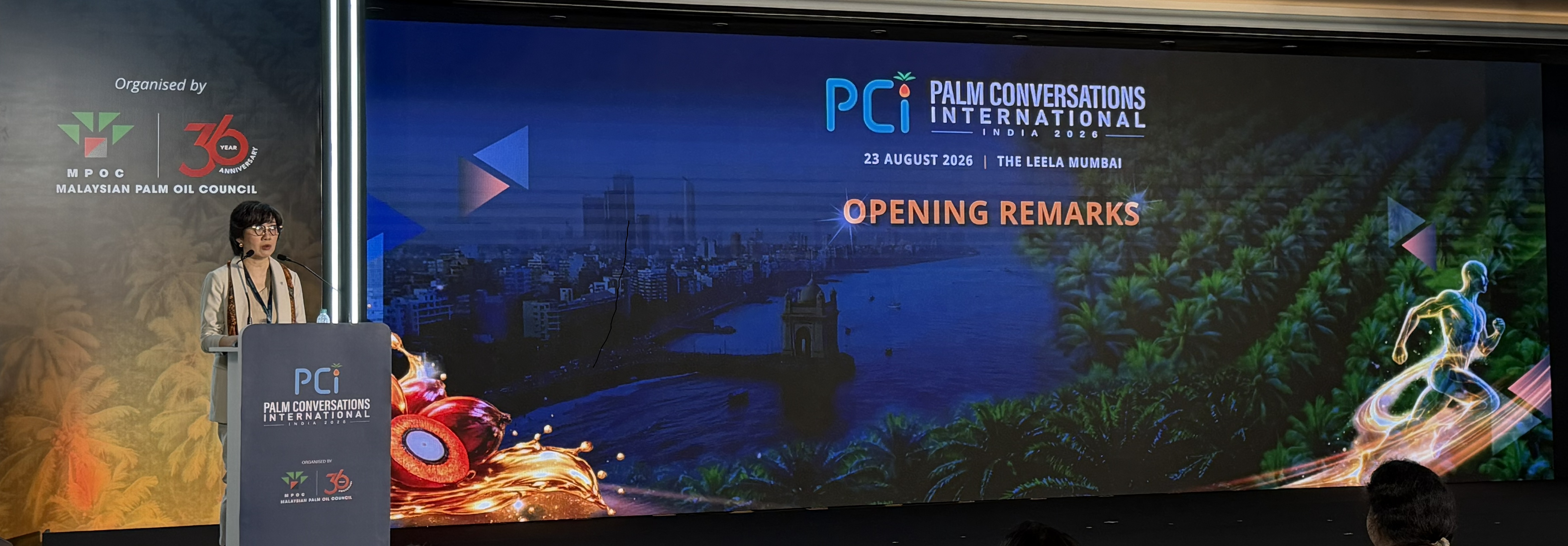
Mumbai, Aug 25: The Malaysian Palm Oil Council (MPOC) today hosted the inaugural India edition of Palm Conversations International India 2026 (PCI) under the theme “Bioactive Power from the Palm: Reimagining Health for a World Facing Non-Communicable Diseases (NCDs).” The initiative has brought together researchers, healthcare professionals, nutrition experts, policymakers and industry stakeholders to examine emerging evidence on Malaysian palm oil, its naturally occurring bioactive compounds and their potential relevance to health, as MPOC continues to build scientific and trade ties with India, one of Malaysia’s largest palm oil export markets. The event was held with the support of the Indian Medical Association, the International Association of Dietitians for Metabolic Health and Nutrition and the Oil Technologists’ Association of India.
The event brought together leading experts, including Dr. Ketan Mehta, Consultant Physician, Cardiopulmonologist & Diabetologist, Mumbai, India; Dr. Sudhir Mysore, Senior Consultant Gastroenterologist and Hepatologist, PACE Hospitals; Dr. A. Hannah Rachel Vasanthi, Professor, Department of Biotechnology, Pondicherry University; Dr. Sanjit Kanjilal, Chief Scientist, CSIR-Indian Institute of Chemical Technology and Dr. Raghavendra Rao, Vice President – Research & Integrative Medicine, HCG Hospitals and former Director, CCRYN, Ministry of Ayush, alongside senior researchers, clinicians, nutrition experts and specialists in oncology, cardiovascular health, gastroenterology and food science, to discuss emerging evidence on palm oil and palm-derived bioactives.
Commenting on the inaugural edition, Ms. Belvinder Sron, Chief Executive Officer, Malaysian Palm Oil Council (MPOC), said, “Palm Conversations International provides a platform for open, evidence based scientific dialogue, bringing together experts from different disciplines to exchange knowledge and explore how science and nutrition can contribute to healthier lives. For Malaysia and India, it also provides an opportunity to deepen collaboration in science, nutrition, healthcare and innovation.”
Scientific presentations at the conference called for a broader understanding of palm oil that goes beyond its fat content, taking into account overall dietary intake, molecular structure, cooking behaviour and health outcomes. Dr. Vishal Malhotra, Senior Consultant – Healthcare representing Makreo Research and Consulting, India, highlighted that India’s annual per-capita edible-oil consumption is around 23.5 kg, compared with an Indian Council of Medical Research (ICMR)-recommended level of around 12 kg, underlining the importance of balanced diets.
A review of cardiovascular evidence presented at the conference, which screened 4,515 citations, found no consistent association between palm oil consumption and heart disease, stroke or cardiovascular mortality, while acknowledging limitations in the available evidence. The presentation also highlighted that palm oil’s naturally semi-solid structure allows it to provide functionality without partial hydrogenation, distinguishing it from industrial trans fats. Its thermal and oxidative stability was also discussed as a relevant consideration in cooking.
The conference also examined the emerging science of palm-derived bioactives, particularly tocotrienols and palm phenolics, and their potential relevance to NCDs. Dr. Roger Clemens, Adjunct Professor, University of Southern California, USA, discussed early research exploring their potential role in areas including cardiovascular health and inflammation. Experts stressed that this remains an evolving area of research, with further studies needed to establish safety, dosage, bioavailability and clinical significance.
The oncology session, led by Dr. Raghavendra Rao, examined emerging research on tocotrienols. Early human studies have reported encouraging findings, including a 70% disease-stabilisation rate in a small Phase II study of recurrent ovarian cancer when delta-tocotrienol was combined with bevacizumab. However, larger clinical trials are needed before any therapeutic conclusions can be drawn.
Experts emphasised that palm-derived bioactives are an emerging area of research, not substitutes for established NCD prevention or treatment. The discussions called for moving beyond perceptions and labels to consider balanced diet, cooking practices and clinical evidence.