


Aug 22: Automation is moving into a new phase where robots are increasingly designed not only to perform tasks independently but also to work alongside people. Collaborative robots, commonly known as cobots, are emerging as an important part of this shift, helping businesses automate repetitive, precise and physically demanding processes while keeping human workers involved.
The growth of cobots is backed by data from the International Federation of Robotics (IFR). Its position paper on collaborative robots reported that cobots accounted for 10.5% of industrial robots installed worldwide in 2023, representing about 56,000 units out of 541,302 industrial robot installations. The IFR also says cobots are expected to complement, rather than simply replace, traditional industrial robots.
The wider robotics market is expanding rapidly as well. The IFR’s World Robotics 2025 report recorded 542,000 industrial robots installed globally in 2024, more than twice the number installed a decade earlier. Asia accounted for 74% of new deployments.
For India, the trend is particularly relevant. The IFR reported that India installed a record 9,100 industrial robots in 2024, a 7% increase from the previous year, with the automotive industry accounting for 45% of installations. India ranked sixth globally in annual industrial robot installations.
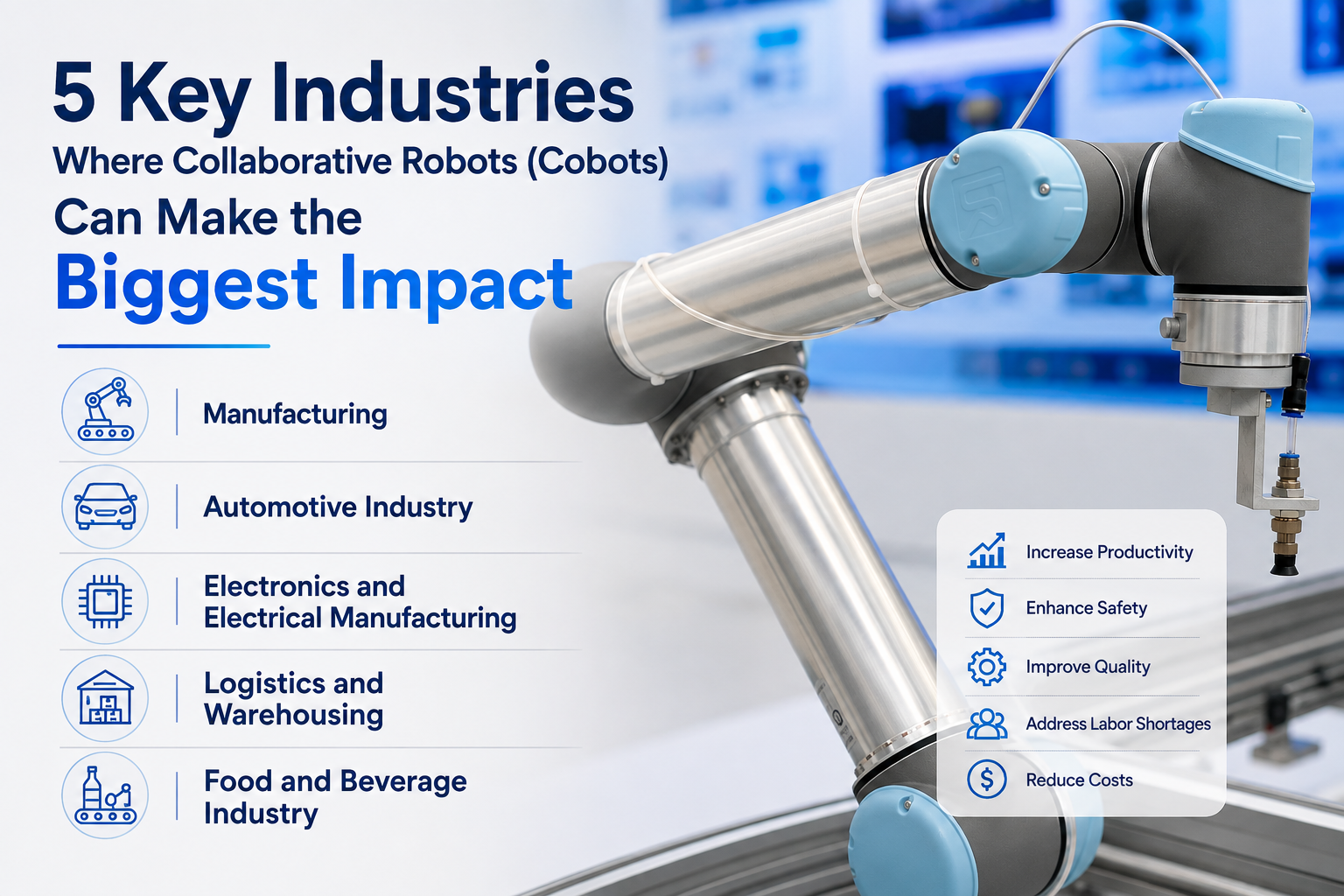
These developments show why collaborative robots are attracting attention from manufacturers and other businesses looking for flexible automation. Here are five industries where cobots can make the biggest impact.
1. Manufacturing
Manufacturing is one of the strongest applications for collaborative robots.
Factories depend on repetitive processes such as assembly, machine tending, inspection, packaging and material handling. These activities can require workers to perform the same movements hundreds or thousands of times, creating opportunities for robotic assistance.
A cobot can, for example, load and unload components from a machine while an employee focuses on quality checks, troubleshooting or more complex production decisions.
Cobots can be particularly useful in small-batch and high-mix manufacturing, where production requirements change regularly. Instead of installing highly specialized automation for every process, a programmable cobot can potentially be redeployed for different tasks.
How cobots can help manufacturing
- Automate repetitive assembly
- Assist with machine tending
- Support inspection and quality control
- Handle packaging and palletizing
- Reduce repetitive physical movements
- Provide flexible automation for changing production requirements
The IFR identifies applications including machine tending, welding, bin picking and end-of-line palletizing among established cobot uses.
2. Automotive Industry
The automotive sector has been using industrial robots for decades, but cobots can complement conventional automation by supporting tasks that still require human involvement.
Automotive production combines automated processes with skilled manual work. Cobots can assist with repetitive assembly, screwdriving, inspection, component handling and machine tending.
For example, an employee can position a component while a cobot performs a repetitive fastening operation. This allows the worker to remain involved while the robot takes care of a predictable task.
Potential applications include:
- Component assembly
- Screwdriving
- Inspection
- Material handling
- Machine tending
- Dispensing and adhesive applications
India’s growing adoption of industrial robotics also highlights the importance of automation to the country’s automotive manufacturing sector. According to the IFR, automotive production accounted for 45% of India’s industrial robot installations in 2024.
3. Electronics and Electrical Manufacturing
Electronics production requires precision, consistency and repeatability, making it another strong area for cobot adoption.
Production lines often involve small components and repetitive assembly or inspection tasks. Cobots can perform consistent movements while skilled technicians remain responsible for more complex operations and quality decisions.
Potential applications include:
- Component assembly
- Testing
- Inspection
- Packaging
- Screwdriving
- Pick-and-place operations
The flexibility of cobots can also be useful when manufacturers frequently introduce new products or change production volumes. Instead of relying entirely on fixed automation, companies can potentially reprogram or redeploy a cobot for different processes.
The broader electronics sector is already a major user of industrial robots globally, reinforcing the opportunity for flexible robotic automation.
4. Logistics and Warehousing
The growth of e-commerce and increasingly complex supply chains has created greater demand for efficient warehouse operations.
Cobots can assist employees with repetitive activities such as picking, packing, sorting and palletizing. They can also support material handling and other repetitive movements.
The objective does not necessarily have to be a fully automated warehouse. A more practical approach can be to automate selected tasks while employees focus on exceptions, quality control, inventory decisions and other activities requiring judgement.
Where cobots can help
- Packing orders
- Palletizing
- Picking assistance
- Sorting
- Material handling
- Repetitive lifting and movement
The IFR also identifies logistics and warehousing among areas benefiting from robotic automation, while its broader robotics data shows strong growth in transportation and logistics robots.
5. Food and Beverage Industry
The food and beverage sector presents another opportunity for collaborative robotics because many processes involve repetitive handling and packaging.
Cobots can assist with packaging, sorting, picking, palletizing and machine tending, allowing employees to focus on tasks requiring greater flexibility.
For manufacturers handling multiple products, the ability to program a cobot for different operations can also be useful.
Potential applications include:
- Packaging
- Pick-and-place operations
- Sorting
- Palletizing
- Machine tending
- Product handling
However, food-processing environments require careful consideration of hygiene, cleaning procedures, materials and relevant safety requirements before introducing robotic equipment.
Why Cobots Are Different From Traditional Automation
The biggest attraction of cobots is their flexibility.
Traditional industrial robots remain highly valuable for high-speed, high-volume production. Cobots are not designed to replace every conventional industrial robot. The IFR specifically notes that cobots can complement investments in traditional industrial robots, which remain important for applications requiring greater speed and productivity.
Cobots can be particularly attractive when businesses need automation that can be moved, reprogrammed or adapted to different tasks.
This can make them relevant to small and medium-sized businesses that may not have large engineering teams or the resources to completely redesign their production lines.
Cobots and Human Workers
The defining concept behind collaborative robotics is human-robot collaboration.
A worker can handle activities requiring judgement, dexterity and problem-solving, while a cobot performs repetitive and predictable tasks.
This does not mean that every cobot can operate safely next to a person without additional measures. Each application requires an appropriate safety assessment based on factors such as robot speed, tooling, materials, workspace and potential human interaction.
The goal is to create an environment where automation supports workers rather than treating humans and robots as competing resources.
What Is Changing in 2026?
The cobot market is evolving beyond its earlier focus on lightweight and relatively simple applications.
The IFR’s current robotics outlook highlights continued technological development in areas such as AI-powered robotics, humanoid robots and new approaches to industrial automation.
At the same time, ABB’s recent robotics materials point toward increasing interest in physical AI and more flexible robotic automation. Its work on physical AI with NVIDIA describes a transition toward robots that can better understand, adapt and respond to real-world environments.
This evolution could allow cobots to address a broader range of industrial applications in the coming years.
AI Could Make Cobots More Capable
Artificial intelligence could become one of the biggest factors shaping the next generation of collaborative robots.
Computer vision can help robots identify objects, while advanced sensors can help them understand their surroundings. AI can also make programming and task adaptation easier.
The combination of AI, machine vision, sensors and robotics could eventually make cobots more flexible and easier for businesses to deploy.
Instead of simply repeating a fixed sequence, future robotic systems could become better at responding to variations in products, environments and production requirements.
Why Cobots Could Matter for Indian Businesses
India’s manufacturing sector is increasingly focused on productivity, modernisation and globally competitive production.
The record 9,100 industrial robot installations in India during 2024 indicate that businesses are already investing more heavily in automation.
For Indian SMEs, cobots could offer an interesting route into automation because selected processes can potentially be automated without completely transforming an entire factory.
A business could begin with a repetitive task such as machine tending, assembly or packaging and expand its robotic applications as it gains experience.
This incremental approach could make collaborative robotics particularly relevant as Indian manufacturers seek to improve productivity while managing labour and production challenges.
What Businesses Should Consider Before Investing
Cobots can offer significant benefits, but they are not a universal solution.
Before investing, businesses should consider:
- The task being automated
- Safety and risk assessment
- Integration with existing machinery
- Tooling and sensors
- Employee training
- Maintenance requirements
- Cybersecurity
- Production volumes
- Expected return on investment
The robot itself is only one component of an automation project. Integration, software, tooling, safety measures and training can all affect the overall cost.
The Future of Collaborative Robots
The future of cobots is likely to be shaped by AI, machine vision, advanced sensors and easier programming.
Their role is also likely to expand as manufacturers seek more flexible automation. The IFR’s data shows that collaborative robots have already established a meaningful share of industrial robot installations, while the broader robotics market continues to grow.
For India, the increasing adoption of industrial robots suggests that the country’s manufacturing sector is also moving toward greater automation.
The next stage could see cobots become more capable, adaptable and easier to integrate into existing workplaces.
Conclusion
Collaborative robots are changing the way businesses think about automation.
Manufacturing, automotive, electronics, logistics and food and beverage are five industries where cobots can make a significant impact by supporting repetitive, precise and physically demanding tasks.
The numbers tell an important story. Cobots already represented 10.5% of industrial robots installed globally in 2023, while more than 542,000 industrial robots were installed worldwide in 2024. India alone recorded a record 9,100 industrial robot installations in 2024.
The biggest opportunity may not be replacing people with machines, but using machines to help people work more efficiently, safely and productively.
As AI, machine vision and robotics continue to advance, collaborative robots could become an increasingly important part of industrial automation—particularly for businesses looking for flexible technology that works alongside their human workforce.