


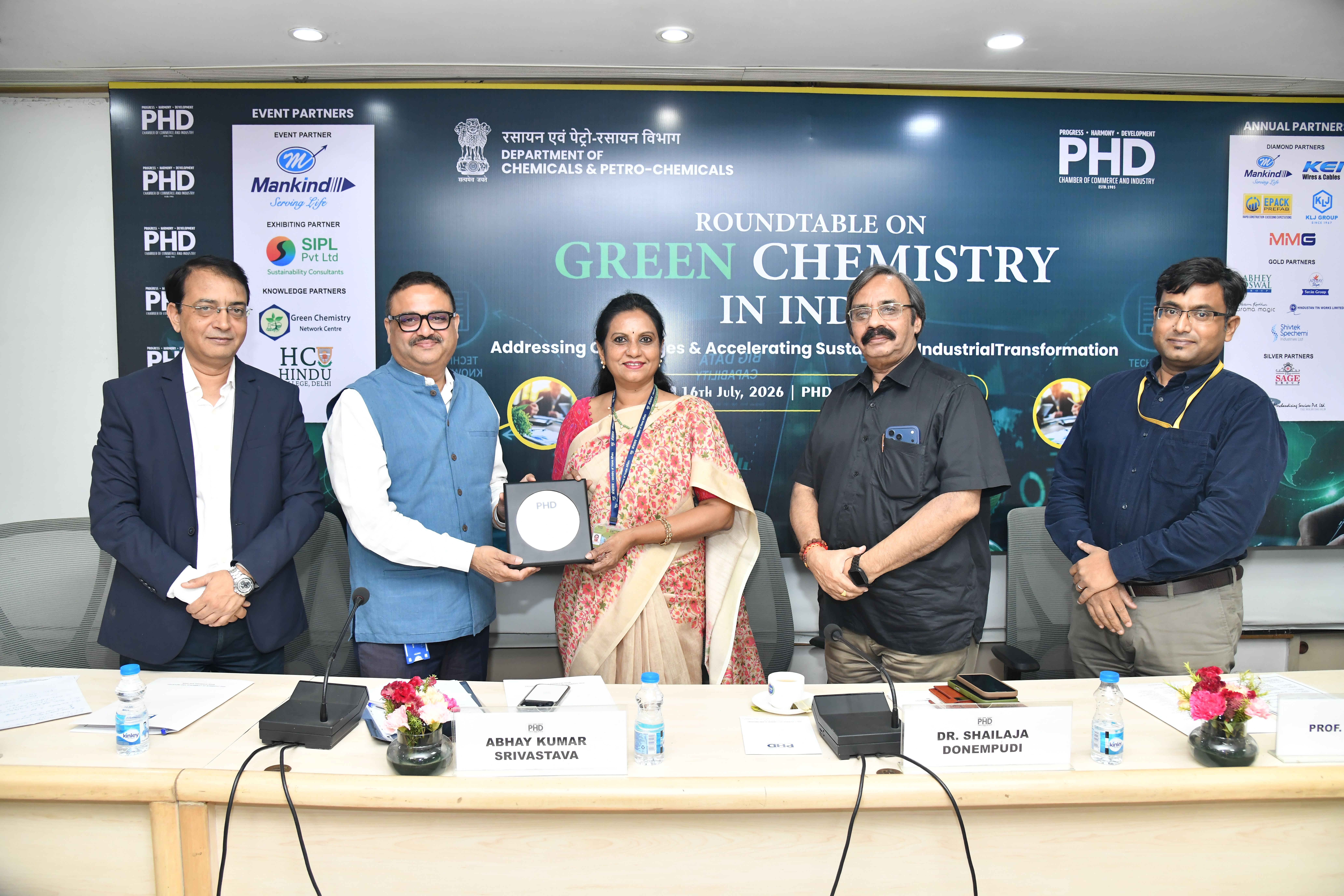
New Delhi, July 17: The PHD Chamber of Commerce and Industry successfully organized the National Roundtable on “Green Chemistry in India: Addressing Challenges and Accelerating Sustainable Industrial Transformation” at PHD House, New Delhi. The event brought together over 80 policymakers, scientists, industry leaders, academicians, researchers and innovators to deliberate on technological innovations, policy frameworks and collaborative strategies for advancing Green Chemistry in India.
A major highlight of the conference was the international keynote address by Professor John C. Warner, globally recognized as the Co-Founder of Green Chemistry and President, Beyond Benign, USA. Addressing the distinguished audience, Professor Warner emphasized that Green Chemistry is fundamentally about designing safer chemical products and processes that eliminate hazardous substances at the source rather than managing pollution after it occurs. He underscored that innovation, education and cross-sector collaboration are indispensable for creating sustainable industrial systems that deliver both environmental protection and economic prosperity.
Welcoming the gathering, Shri Abhay Kumar Srivastava, Chair, Pharmaceutical Manufacturing Committee and Senior President – Operations, Mankind Pharma, emphasized that Green Chemistry has evolved from an environmental aspiration into an industrial necessity. He highlighted that sustainable manufacturing enhances competitiveness, improves resource efficiency and strengthens India‘s position as a global manufacturing hub while stressing the importance of collaboration among industry, government and academia.
Dr. Shailaja Donempudi, Scientist & Head–BDG, CSIR, Ministry of Science & Technology, Government of India, underscored the need to accelerate Green Chemistry adoption through stronger industry–academia partnerships, technology commercialization and enabling policy support. She emphasized that financial incentives, standardized certification systems and scaling of innovative green technologies are essential to building a globally competitive and sustainable chemical manufacturing ecosystem.
Dr. Suman Mazumdar, Scientist ‘D’, Department of Scientific and Industrial Research, Ministry of Science & Technology, Government of India, highlighted the Government of India‘s initiatives to promote Green Chemistry through research funding, technology commercialization and collaborative innovation. He elaborated on flagship programmes such as PACE, PRISM and CRTDH, while showcasing successful innovations from CSIR–National Chemical Laboratory and IIT Patna in continuous flow manufacturing, sustainable oil spill remediation and PET plastic recycling.
The programme was further enriched by the presence of Prof. Rakesh Kumar Sharma, Former Professor, Department of Chemistry, University of Delhi, and Director, Green Chemistry Network Centre, who highlighted India‘s immense potential to emerge as a global leader in sustainable chemical sciences through innovation, interdisciplinary research and responsible industrial practices.
The inaugural session was moderated by Dr. Nasir Jamal, Director, PHDCCI, who emphasized the growing importance of Green Chemistry in driving sustainable industrial transformation and called for stronger collaboration among government, industry and academia to accelerate the adoption of environmentally responsible technologies.
The conference featured two technical sessions focused on technology and policy. The first session, “Green Chemistry Technologiesfor Sustainable Manufacturing,” moderated by Dr. Mymoona Akhter, Professor), Jamia Hamdard, featured Dr. Rohit Chakravarty , who showcased continuous flow chemistry for greener pharmaceutical manufacturing; Dr. G. S. Kapur, who highlighted India’s potential to become a global hub for sustainable bioplastics; Dr. Mohan Prasad , who discussed biocatalysis and advanced process technologies for environmentally responsible manufacturing; and Shri Prabodh Swain, who emphasized enzyme engineering and synthetic biology as key drivers of sustainable bio-based manufacturing.
The second technical session, “Enabling Green Chemistry Adoption: Policy, Standards and Market Drivers,
“moderated by Shri Namit Joshi, Chairman, Pharmexcil, featured Dr. Shilpi Gupta, who highlighted BIRAC’s support for startups, MSMEs and researchers through funding mechanisms and the BioE3 Policy, and Dr. Neeraj Kumar , who emphasized integrating Green Chemistry and ESG principles into pharmaceutical process design through solvent recycling, waste valorization and innovation in complex molecules.”
The Roundtable concluded with a collective commitment from government, industry, academia and research institutions to accelerate Green Chemistry adoption, promote sustainable innovation and strengthen India‘s leadership in environmentally responsible chemical manufacturing. Participants expressed confidence that the deliberations and recommendations emerging from the conference would contribute to future policy development and support India‘s transition towards a globally competitive, sustainable chemical industry.