


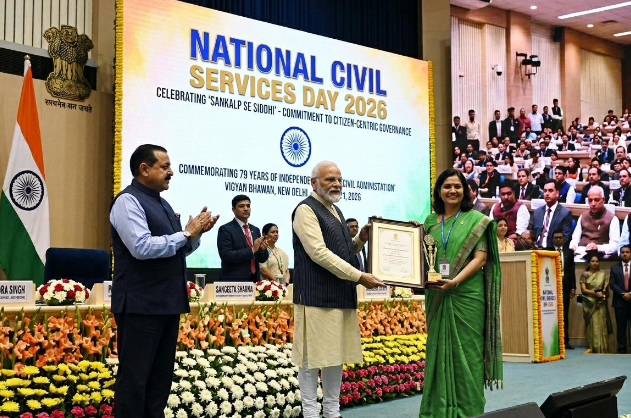
India observes National Civil Services Day 2026 today, marking a day dedicated to recognising the dedication, discipline, and consistent efforts of civil servants who form the core of the country’s governance system. Observed annually on April 21, the occasion highlights the essential role of administration in ensuring effective policy implementation and public service delivery across the nation.
A Day Rooted in History and National Significance
National Civil Services Day was first formally observed in 2006 at Vigyan Bhawan, New Delhi. The date holds historical importance as it commemorates April 21, 1947, when Sardar Vallabhbhai Patel addressed probationary civil service officers and referred to them as the “Steel Frame of India.”
This phrase continues to symbolise the strength, stability, and continuity of India’s administrative structure.
Over the years, the day has evolved into a national occasion to acknowledge the contribution of civil servants and to reflect on the functioning of governance in a diverse and complex democracy.
The Backbone of Governance
India’s civil services include key institutions such as the Indian Administrative Service (IAS), Indian Police Service (IPS), Indian Foreign Service (IFS), along with several central and state administrative services.
Together, these services form a coordinated system that ensures government policies are implemented effectively at all levels.
From rural development and welfare schemes to urban planning, law enforcement, disaster response, and international representation, civil servants play a critical role in maintaining administrative continuity and service delivery.
Much of their work takes place behind the scenes, yet its impact is visible in every aspect of public life.
Recognition of Excellence in Public Service
A key highlight of National Civil Services Day is the presentation of the Prime Minister’s Award for Excellence in Public Administration.
The award recognises innovative and impactful governance initiatives across the country. It includes a medal, certificate, and a cash prize of ₹1 lakh, and aims to encourage efficiency, innovation, and citizen-centric governance practices.
It also helps identify successful administrative models that can be replicated across different regions for improved governance outcomes.
Evolution of the Civil Services System
The civil services in India have evolved significantly over time. During the colonial era, administrative structures were formalised under British rule, with early reforms associated with figures such as Lord Charles Cornwallis, who introduced merit-based systems and structured administration.
After independence, India transformed this framework into a democratic institution guided by constitutional values, accountability, and public welfare objectives.
Today, the civil services represent a balance between administrative continuity and democratic governance.
Adapting to a Changing Governance Landscape
Modern governance is becoming increasingly complex. Digital transformation, economic shifts, climate change, urbanisation, and technological advancement have significantly expanded administrative responsibilities.
Civil servants are now required to integrate traditional administrative expertise with modern tools such as data analytics, digital governance platforms, and real-time monitoring systems.
The focus has gradually shifted toward outcome-based governance and measurable public impact.
A Moment of Duty and Reflection
National Civil Services Day also serves as a moment of reflection for officers across the country.
It reinforces the importance of core values such as integrity, neutrality, efficiency, and accountability in public service. These principles are essential for maintaining public trust and ensuring effective governance.
In a system serving a population of over a billion people, responsible administration plays a crucial role in sustaining development and stability.
Conclusion
National Civil Services Day 2026 stands as a reminder of the vital role civil servants play in shaping India’s governance system. While their contributions often remain behind the scenes, they form the foundation upon which public administration operates.
As India continues to grow and evolve, the civil services remain central to ensuring that governance is efficient, inclusive, and responsive to the needs of its citizens.