


April , 2: The inherent dispersion of laser beams limits their effectiveness in precision applications. Researchers at Chiba University, with collaborators in the USA and India, developed a compact approach combining a Bessel lens and a flat multilevel diffractive lens to generate sharply defined, robust nondiffracting optical bottle beams. These beams feature alternating high-contrast regions and remain propagation-invariant over distances beyond 5 cm, enabling applications in advanced imaging, optical trapping, harmonic generation, micromachining, and high-fidelity quantum operations.
Most laser sources produce Gaussian beams that diverge as they propagate. This natural spreading limits their effectiveness in applications that require light to remain concentrated over long distances. To overcome this challenge, structured light beams have been developed, whose amplitude, phase, and polarization can be carefully controlled.
Among these are Bessel beams, which are generated by the self-interference of laser beams as they propagate through space. However, ideal Bessel beams possess complex ring structures that complicate their practical use. Additionally, existing methods for generating advanced beam shapes, such as optical bottle beams, often involve complex and expensive setups that necessitate precise alignment.
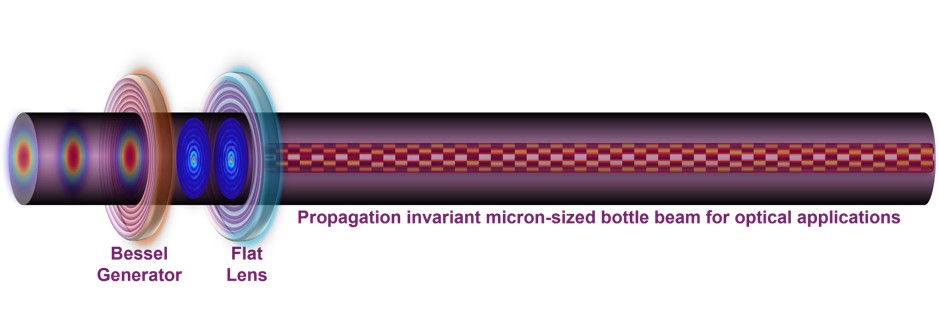
Now, researchers at Chiba University, Japan, have developed a simple and compact method to generate a laser chain beam that remains nondiffracting during free-space propagation. In this system, a Gaussian beam is first transformed into a modified zero-order Bessel beam using a binary axicon. This modified Bessel beam with suppressed sidelobes is then focused using a flat multilevel diffractive lens (MDL) to form a sharply defined, high-quality optical bottle beam.
The study was led by Assistant Professor Andra Naresh Kumar Reddy from the Molecular Chirality Research Center, Chiba University, who is also affiliated with the Quantlight and High Harmonics Lab Pvt. Ltd., India. Additional contributors included Prof. Rajesh Menon from the Department of Electrical and Computer Engineering, University of Utah, USA, and Oblate Optics, USA; Dr. Srinivasa Rao Allam and Prof. Takashige Omatsu from the Graduate School of Engineering, Chiba University; and Dr. Vishwa Pal from the Department of Physics, Indian Institute of Technology Ropar, India.
This paper was made available online on February 18, 2026, and was published in Volume 13, Issue 5 of the journal ACS Photonics on March 4, 2026.
“Our experimental research introduces a novel, efficient method for producing high-quality, micron-sized optical bottle beams that remain nondiffracting over long distances in free space, providing significant advantages for advancing optical applications and light-matter interactions,” says Dr. Reddy.
An optical bottle beam contains a series of dark regions surrounded by bright regions, forming a kind of “light cage” that can trap and manipulate particles and atoms. In the proposed method, a Gaussian beam is first reshaped into a Bessel beam by the binary axicon. This Bessel beam is then directed toward the multilevel diffractive lens, where it is tightly focused and dynamically reshaped in free space.
As the beam propagates through the MDL, it forms alternating bright and dark regions along its path due to controlled longitudinal interference. These regions gradually combine to create a high-quality, three-dimensional optical bottle beam. This process begins at a working distance of ~20 cm from the lens and remains invariant over a long distance in free space, demonstrating strong nondiffracting, self-healing characteristics.
The MDL is composed of concentric rings with a width of 7 μm and heights ranging from 0 to 1.7 μm. Using an inverse-design approach, the flat lens precisely imposes its functionalities on the incoming light, enabling the transformation of the incoming Bessel beam into a propagation-invariant optical bottle beam with sharply defined bright and dark regions.
Compared with conventional lenses, the MDL-based approach provides optimized control over the focusing and diffraction efficiencies of the output beam. This experimental approach can be demonstrated with ultrafast lasers, enabling high-harmonic generation of an optical bottle beam through intense non-perturbative light-matter interactions.
By combining a compact design with precise beam control and extended propagation distance, this work presents a practical and scalable method for generating nondiffracting optical bottle beams, advancing next-generation optical and photonic technologies.
“The experimental findings reported in this research work are potentially useful for real-time applications such as high-resolution biological imaging in random media, particle trapping or manipulation, micromachining, and driving high-harmonic generation processes,” says Dr. Reddy.
