


Coimbatore, Mar 30: Supported by the German Federal Ministry for Economic Cooperation and Development in partnership with KKS Germany, the Karl Kübel Foundation for Child and Family along with its training arm, KKID, successfully hosted the inaugural edition of the Karl Kübel Lecture Series Critical Dialogues for Sustainable and Inclusive Futures at its campus in Anaikatti, Coimbatore. The event also marked a step towards strengthening sustainable infrastructure, with the inauguration of a solar rooftop plant and an open gym.
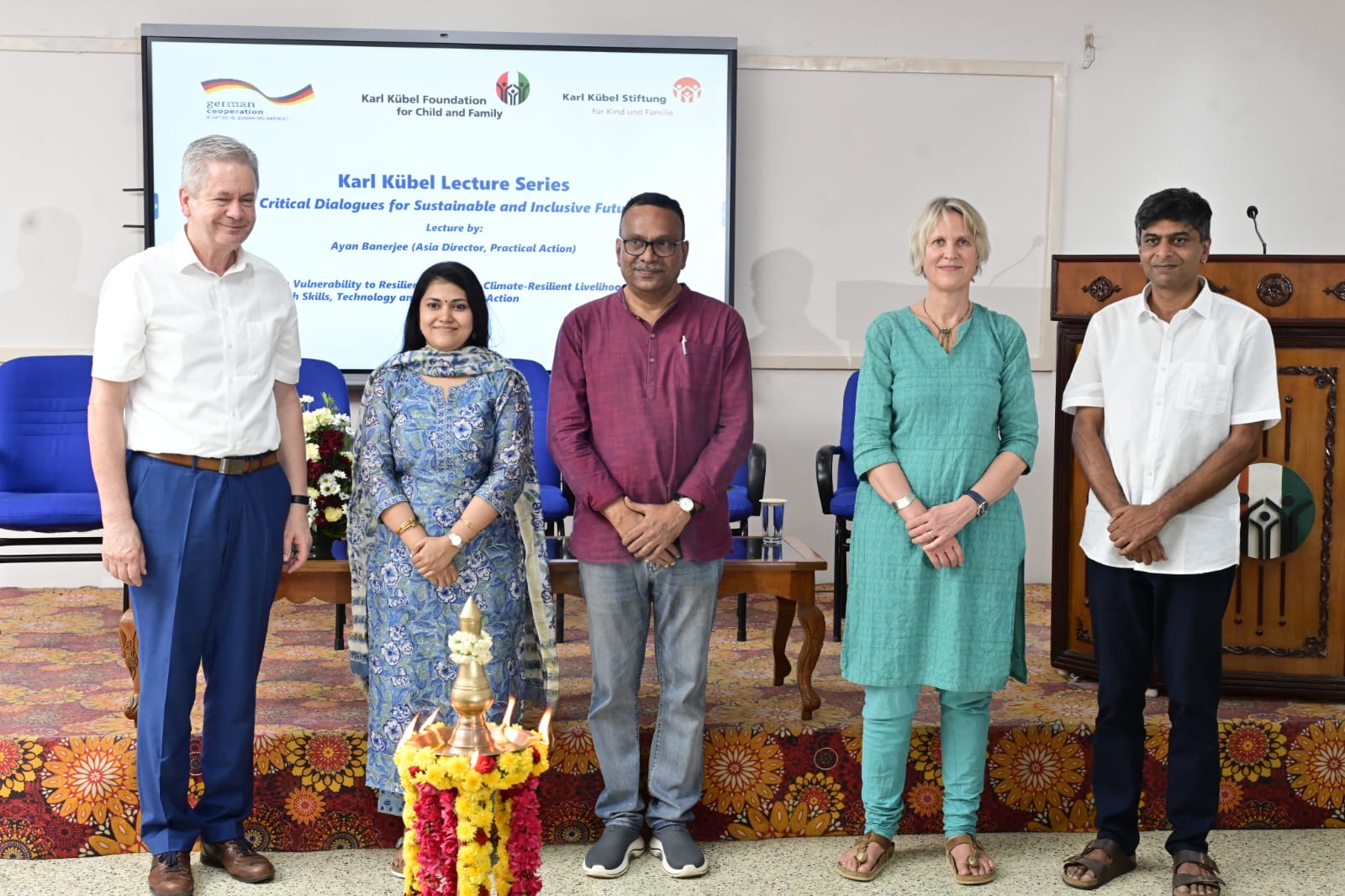
The lecture series is envisioned as a long-term knowledge platform bringing together global and Indian experts from academia, civil society, government, and the private sector to engage in dialogue on sustainable development, institutional innovation, and future skills particularly in ecologically fragile regions.
The first lecture on “Building Climate-Resilient Livelihoods through Skills, Technology and Community Action” addressed challenges faced by rural and tribal communities in regions like the Nilgiris. Delivering the keynote, Dr. Ayan A. Banerjee, Asia Regional Director at Practical Action, emphasised integrating local knowledge, appropriate technology, and market-linked skills to enable communities to transition from vulnerability to resilience. He highlighted that sustainable solutions must be rooted in community participation and supported by enabling ecosystems.
The session was followed by a panel discussion on “Strengthening Skills and Livelihood Resilience in Fragile Rural Communities,” moderated by Mr. Kailash Iyer, Executive Director, KKF Coimbatore. The panel featured Dr. A. Anandraja, Director Extension, Tamil Nadu Agricultural University; Ms. Prema Rangachari, Director, Bhuvana Foundation & Vidya Vanam; Mr. Bhoopendra Singh, Head Programme Management Unit, Reliance Foundation; and Ms. Ilonka Boltze, Executive Director International Programmes, KKS, Germany. Panelists shared insights on practical approaches to strengthening rural livelihoods through skilling, climate-adaptive practices, institutional partnerships, and community-led models, while also addressing on-ground challenges and opportunities.
As part of its focus on practical, community-led sustainability, the foundation also threw light on its Zero Dumping Waste Management Project. Launched in 2025 under the Making More Health initiative, the project has been piloted at the KKID campus and extended to institutions in Kerala, including a Tribal Speciality Hospital in Palakkad and two Anganwadis. The initiative converts nearly 300 kg of daily food waste into nutrient-rich compost within 21 days, demonstrating a scalable, circular waste model that improves hygiene while promoting sustainable resource use.
Set in the Anaikatti region of the Western Ghats, the KKID campus sits at the intersection of challenges such as climate variability, agricultural distress, youth migration, and human–wildlife conflict. The lecture series responds to these complexities by fostering cross-sector dialogue and systems thinking that connects local realities with global insights.
Speaking on the occasion, Mr. Kailash Iyer, Executive Director, KKF Coimbatore said,
“With the Karl Kübel Lecture Series, we are creating a platform that brings together diverse perspectives to reflect on the future of development in fragile regions. Our aim is not just to discuss challenges, but to enable meaningful dialogue that connects knowledge, practice, and partnerships to drive sustainable and inclusive change at the community level.”
Adding an international perspective, Ms. Ilonka Boltze, Executive Director International Programmes, KKS, Germany, said,
“Green skills are often seen as technical capabilities, but they begin much earlier in childhood. The ability to understand natural systems, think in cycles, and use resources responsibly is built over time. This creates a valuable opportunity for Indo-German collaboration, especially in early childhood education, where institutions like KKID can play a key role in fostering knowledge exchange and shaping future-ready communities.”
Mr. Matthias Wilkes, Chairman of the Board of Karl Kübel Stiftung (KKS), Germany further added,
“Global climate change is one of the biggest challenges for all people, especially the very poor and their families. It is for this reason that we support green skills to benefit communities most affected by climate change. When we work for children and families, green skills must remain an important part of our work going forward.”
The Karl Kübel Lecture Series will continue as an annual flagship initiative, positioning the KKID campus as a regional and global hub for development discourse. By bridging grassroots experience with global expertise, the foundation aims to contribute to more integrated, inclusive, and sustainable development pathways.
