

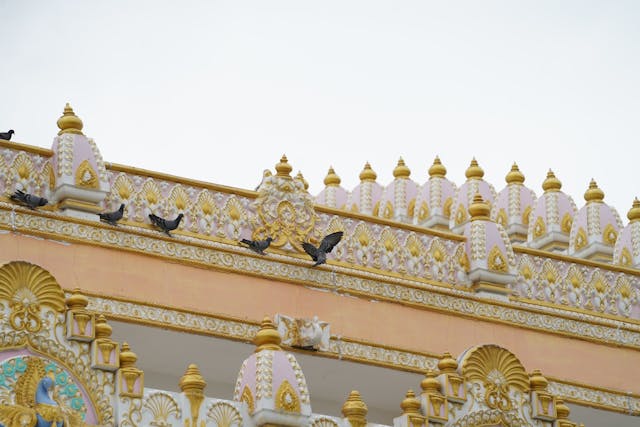
A landmark moment in Franco-Indian cultural relations unfolded this week as the first sacred stones from India reached France for the construction of the country’s first traditional Hindu temple. The arrival of these stones marks the beginning of a historic spiritual and architectural journey—the creation of the BAPS Swaminarayan Hindu Mandir in Bussy-Saint-Georges, near Paris.
Carved in India using time-honoured techniques, the stones symbolise more than the foundation of a temple. They represent the transmission of centuries-old craftsmanship, philosophy, and devotion across continents, reinforcing India’s enduring cultural dialogue with Europe.
A Temple Rooted in Tradition, Rising in Europe
The BAPS Swaminarayan Hindu Mandir is being built in accordance with classical Hindu architectural principles, reflecting the Nagara style of temple design. Unlike modern concrete structures, the mandir will be assembled entirely from hand-carved stone, following ancient shilpa shastra traditions that have guided temple construction in India for millennia.
The first block of stone was ceremonially sanctified in India before its journey to France, underscoring the spiritual continuity between its place of origin and its final destination. Once assembled, the mandir will stand as the first fully traditional Hindu temple of its kind in France.
A Symbol of Cultural Bridge-Building
The project highlights the growing cultural synergy between India and France, extending beyond diplomacy into shared values of pluralism, heritage preservation, and spiritual harmony. The mandir is envisioned not only as a place of worship, but also as a centre for cultural exchange, community service, and interfaith dialogue.
Situated in Bussy-Saint-Georges—home to a diverse international population—the temple is expected to serve as a spiritual anchor for the Hindu diaspora while welcoming people of all backgrounds to experience Indian culture, philosophy, and values.
Craftsmanship Without Borders
The stones were intricately carved by skilled artisans in India, many of whom belong to families that have preserved temple-building traditions for generations. Each piece has been shaped with precision, ensuring that the structure can be assembled in France without the use of steel or concrete reinforcements.
This method reflects a sustainable and spiritually aligned approach to construction, where every stone fits into a larger sacred geometry. Once completed, the mandir will embody a seamless fusion of art, engineering, and devotion.
Spiritual Vision in a Global Setting
The temple is dedicated to Bhagwan Swaminarayan and will reflect the spiritual ideals of harmony, service, and compassion. Its presence in France signals the global resonance of these values and the growing recognition of Hindu philosophy as a universal spiritual tradition.
Beyond religious functions, the mandir is expected to host educational programmes, youth initiatives, and cultural events that promote understanding and unity in an increasingly interconnected world.
A Milestone for the Hindu Diaspora in Europe
For the Hindu community in France, the arrival of the first stones is deeply symbolic. It marks the transition from vision to reality—a tangible beginning to a sacred space that will preserve identity while embracing multicultural coexistence.
As construction progresses, the mandir is poised to become a prominent landmark in Europe’s religious and cultural landscape, standing as a testament to peaceful cultural expression and timeless tradition.
Looking Ahead
The dispatch of the first sacred stones from India to France is not merely a logistical achievement—it is a moment of civilisational continuity. It reflects how ancient traditions can find new life in modern societies, carrying messages of faith, craftsmanship, and unity across borders.
When completed, the BAPS Swaminarayan Hindu Mandir in Paris will stand as a symbol of shared heritage, spiritual universality, and the enduring bonds between India and France—built stone by stone, belief by belief.