

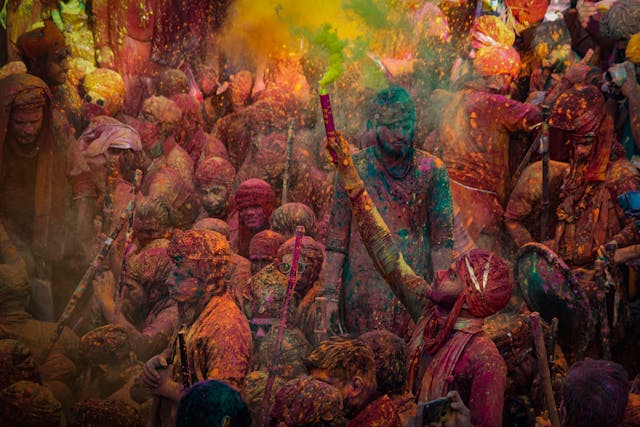
Holi, often called the festival of colours, is one of India’s most vibrant and widely celebrated festivals. Observed on the last full moon day of the Hindu month of Phalguna, it marks the arrival of spring and celebrates the victory of good over evil. The festival is known for joyous gatherings, playful smearing of coloured powders (gulal), and splashes of water, accompanied by music, dance, and festive feasts that last throughout the day.
The evening before Holi is marked by Holika Dahan, a ritual bonfire that symbolizes devotion, righteousness, and the triumph of virtue. Families and communities gather around the flames, offering prayers and seeking blessings for prosperity and well-being.
While Holi is popularly associated with colour play, its celebrations vary widely across India, reflecting regional customs, spiritual practices, and historical traditions. From devotional temple rituals to martial displays and artistic performances, the festival embodies India’s cultural richness.
This year, Holi falls on March 4, offering an opportunity for travellers to witness unique celebrations across the country. Here’s a closer look at some distinctive regional Holi traditions:
1. Lathmar Holi – Barsana and Nandgaon, Uttar Pradesh
Lathmar Holi is one of the most dramatic Holi traditions. Rooted in mythology linked to Radha and Krishna, women playfully strike men with sticks (lathis), while the men protect themselves with shields. The festivities take place days before the main Holi event and attract thousands of domestic and international visitors, creating an energetic, colorful atmosphere in these towns.
2. Hola Mohalla – Anandpur Sahib, Punjab
Hola Mohalla is a Sikh festival established by Guru Gobind Singh. Unlike traditional Holi celebrations, it emphasizes martial skills, featuring mock battles, horseback riding, and martial arts displays. The event also includes communal meals (langars) and reflects values of courage, discipline, and community spirit.
3. Kumaoni Holi – Uttarakhand
In the Kumaon region, Holi is celebrated through music and devotion. Classical ragas, devotional songs, and community gatherings define the festival in towns like Almora and Nainital. The celebrations can stretch over several weeks, blending cultural heritage with spirituality.
4. Dola Purnima – Odisha and Assam
In eastern India, Holi is observed as Dola Purnima, where temples organize grand processions. Idols of Lord Krishna are carried in beautifully decorated palanquins, accompanied by songs, rituals, and celebrations that are more temple-centric than the street-based festivities of North India. Cities such as Puri and Guwahati showcase vibrant religious observances.
5. Basant Utsav – Shantiniketan, West Bengal
Inspired by Rabindranath Tagore, Basant Utsav in Shantiniketan celebrates the arrival of spring with cultural performances, songs, dance, and poetry. Participants often wear yellow, the colour of spring, creating an artistic and graceful atmosphere that highlights the festival’s cultural essence.
6. Ukuli or Manjal Kuli – Kerala
In Kerala, Holi is celebrated in select temples as Ukuli or Manjal Kuli, using turmeric water instead of colored powders. Observed mainly in districts like Kozhikode, the celebration emphasizes local traditions and spiritual devotion, offering a unique take on the festival compared to North Indian practices.
7. Rang Panchami – Maharashtra and Madhya Pradesh
Rang Panchami occurs five days after Holi and extends the festival’s spirit. Cities like Indore host vibrant street processions with coloured water, bringing communities together in playful and energetic celebrations that continue beyond the main Holi day.
8. Phoolon Wali Holi – Vrindavan, Uttar Pradesh
In Vrindavan, Phoolon Wali Holi replaces synthetic colours with flower petals. Celebrated at temples such as the Banke Bihari Temple, devotees are showered with petals while singing devotional songs. This form of Holi emphasizes spirituality and provides a serene and immersive experience.
9. Royal Holi – Rajasthan
Rajasthan celebrates Holi with regal grandeur. In cities like Jaipur and Udaipur, royal families and heritage hotels host ceremonial processions, cultural performances, and controlled Holika Dahan rituals. The celebrations combine history, culture, and hospitality, offering a structured and luxurious festival experience.
10. Masan Holi – Varanasi, Uttar Pradesh
One of the most unique Holi observances is Masan Holi in Varanasi, celebrated near the Manikarnika Ghat. Unlike conventional celebrations, this ritual involves the use of ash from funeral pyres, reflecting the city’s spiritual philosophy of life and death as interconnected cycles.
A Celebration of Diversity
Holi is more than a festival of colours; it is a reflection of India’s regional, spiritual, and cultural diversity. Whether through music, devotion, playful revelry, or royal ceremonies, Holi brings communities together and creates lasting memories.
For travellers and enthusiasts, experiencing Holi in different regions provides insight into India’s history, mythology, and cultural vibrancy. From the playful streets of Barsana to the tranquil temples of Kerala, each celebration offers a unique lens into the heart of Indian tradition.
Holi reminds us that while the festival may be celebrated with colours, music, and dance, its true essence lies in unity, joy, and the triumph of good over evil.