

New Delhi, Feb 27: The consensus around women-led development is pivoting, away from merely being a social obligation, towards an economic and strategic imperative for a truly developed India. PM Modi has hailed this transformative role of women across India, as he states “…the mantra of Women-Led Development is giving India a new direction, a new future. Our mothers, sisters and daughters are today changing not only their own lives but also that of the society at large…”.
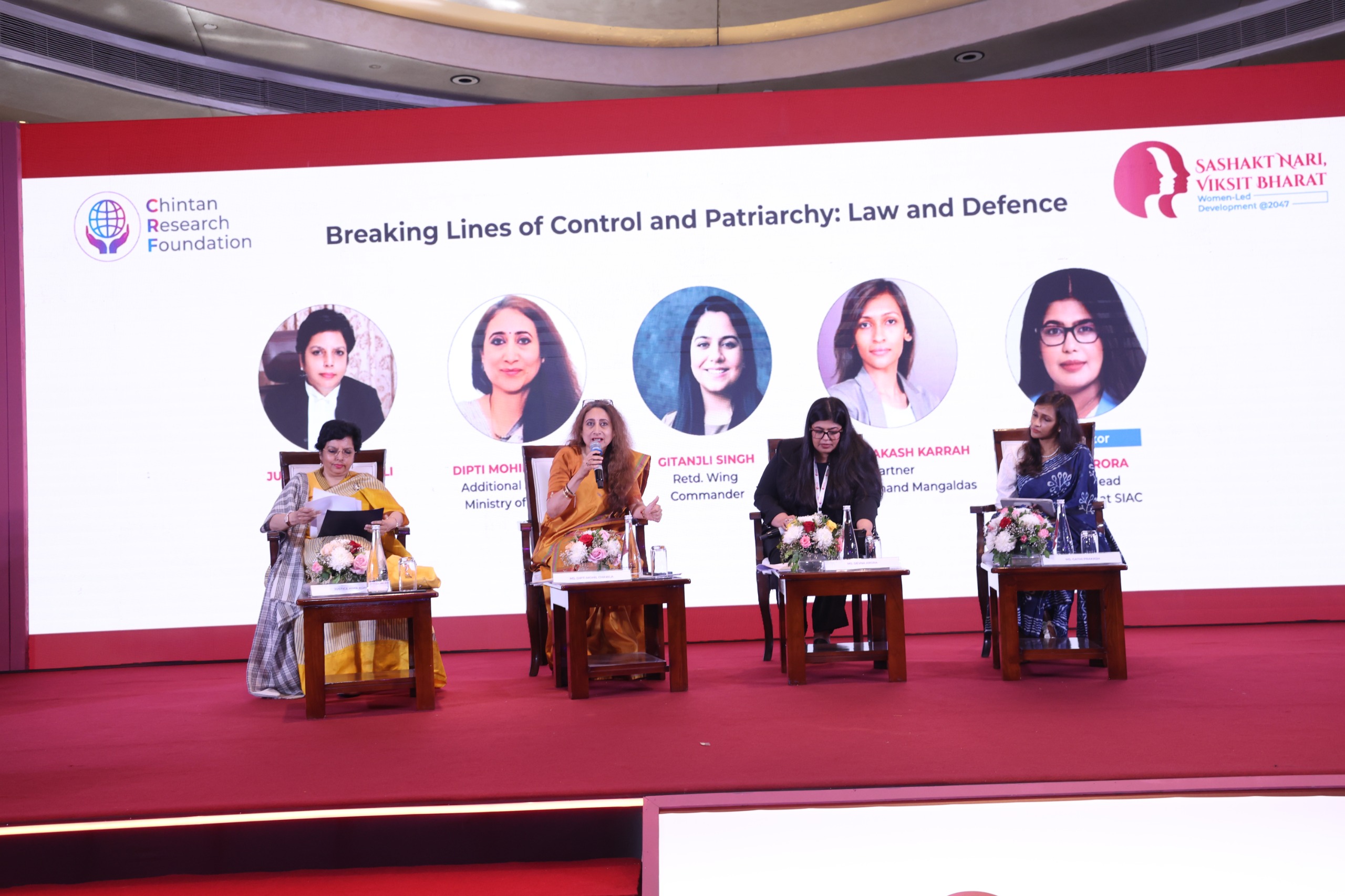
Under this backdrop the Chintan Research Foundation (CRF), Delhi convened the “Sashakt Nari, Viksit Bharat: Women-Led Development @2047” Conference 2026 on February 26, 2026, in New Delhi. The conference advanced a solution-oriented national dialogue on women-led development and its centrality to India’s vision of becoming a developed nation by 2047. The day-long conference brought together constellation of policymakers, industry leaders, jurists, diplomats, media voices, grassroots changemakers, and women from various sectors to deliberate on the evolving role of women in India’s socio-economic and political transformation. The conference translated the national momentum around women’s empowerment into structural, measurable, and policy-relevant outcomes, aligned with India’s long-term developmental vision.
Delivering the keynote address, Dr. Priti Adani reiterated “a deeper question—Viksit Bharat—for whom, and by whom?” Drawing from her extensive practical experience in scaling social impact initiatives and advancing community-led development models, Dr. Priti underscored that “women empowerment is not about giving power,” rather it is about giving opportunities and unlocking power that already exists.
Smt. Annapurna Devi, Minister for WCD, Govt of India while delivering her special address articulated the government’s perspective on women development. While highlighting policy priorities and institutional commitments towards strengthening women-led development in India, she further emphasised that “Sarkar, Samaj, and the corporate sector must come together to build an ecosystem where every woman’s dream finds opportunity, every talent finds a stage, and every effort earns respect. This is the right time”.
Earlier welcoming the delegates, Mr Shishir Priyadarshi, President, CRF, asserted that Viksit Bharat is about GDP, but it is also about who participates, who benefits and who shapes the direction of the growth of a society.
Over the past decade, policy initiatives aimed at expanding women’s access to finance, education, digital tools, and entrepreneurship have laid the groundwork for a more inclusive growth model. Yet, persistent structural barriers—ranging from low labour force participation to the invisibility of unpaid care work—continue to constrain the full realisation of women’s economic potential. In this context, the idea of women-led development represents a strategic shift towards harnessing Nari Shakti as a foundational pillar of India’s journey toward becoming a developed nation by 2047. The daylong conference also featured launch of the book “Sashakt Nari, Viksit Bharat: Women-Led Development @2047,” a compilation of contributions on India’s evolving gender-development scholarship.
The discussion explored institutional pathways for expanding women’s presence in strategic sectors, whereby it was reinstated that growth was the strongest when women are equal stakeholders, innovators and decision-makers. One of the special features of the day was grounded insights shared by women from rural India during the session ‘Daughters of the Soil: Voices from Rural India.’ It was highlighted that grassroots transformation in villages is achievable with appropriate professional support, while underscoring that rural women are converting local skills into sustainable livelihoods.
During the special panel ‘Listen to Her,’ celebrated author and director Shri Nandita Das explored the responsibility of the artist in turbulent times; the intersection of gender, identity, and storytelling; and the role of empathy in shaping public discourse.
A panel of Women Ambassadors deliberated on the pathways to leadership, the evolving role of women in foreign policy decision-making, inclusive diplomacy, and how gender perspectives enrich strategic thinking in trade, development cooperation, peacebuilding, and climate action.
The day’s rich discussion highlighted both the urgency of dismantling persistent structural barriers and the immense opportunity that lies in unlocking the full potential of Women.
The conference rounded off with the evening keynote address delivered by Smt. Rekha Gupta, Chief Minister, NCT of Delhi, who participated as the Guest of Honour.