

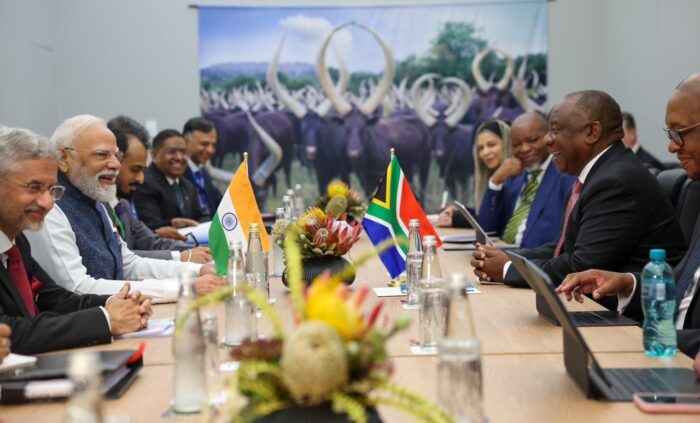
The Johannesburg G20 Summit became a defining moment for India’s global engagement this year. Against the backdrop of rapid technological transformation, shifting geopolitical landscapes, and rising developmental challenges, India emerged as a proactive voice shaping conversations around security, innovation, economic resilience, and equitable global growth. Prime Minister Narendra Modi’s series of bilateral meetings and policy proposals demonstrated India’s growing role as a connector, collaborator, and catalyst for global progress.
What Was the Objective of the Johannesburg G20 Summit?
The 2024 Johannesburg G20 Summit aimed to address some of the most pressing global priorities. The central objectives included:
1. Strengthening global economic stability
Leaders focused on strategies to ensure resilient supply chains, sustainable growth, and fair global trading systems amid economic uncertainties.
2. Accelerating digital transformation and skills development
The summit emphasised preparing nations for the AI-driven future through innovation, digital infrastructure, and talent readiness.
3. Advancing climate action and clean energy transitions
Member countries explored ways to secure critical minerals, boost renewables, and create circular, sustainable ecosystems.
4. Promoting global security and cooperation
Discussions included combating terrorism financing, enhancing information-sharing, and reinforcing multilateral cooperation.
5. Supporting the Global South
The summit aimed to bridge developmental gaps by improving access to technology, satellite data, and international financing for developing nations.
These objectives framed the backdrop against which India advanced its strategic proposals and strengthened bilateral ties.
India’s High-Impact Diplomacy
A Strong Partnership with Italy
Prime Minister Modi’s meeting with Italian Prime Minister Giorgia Meloni was marked by energy and purpose. Both leaders reaffirmed their commitment to expanding cooperation across defence, trade, innovation, AI, space, and education.
A defining moment was the unveiling of a Joint Initiative against terrorism financing, signalling a shared stance on safeguarding global security.
Elevating India–Canada Relations
In talks with Canadian Prime Minister Mark Carney, the leaders welcomed renewed momentum in bilateral ties. Their conversation spanned trade, investment, energy, innovation, space, defence, and education—areas central to shaping a modern India–Canada partnership.
Deepening Strategic Ties with Japan
Prime Minister Modi’s engagement with Japanese Prime Minister Sanae Takaichi focused on strengthening collaboration in innovation, talent mobility, defence cooperation, and trade. The dialogue highlighted both nations’ shared focus on technological progress and regional stability.
Engagements with Global Leaders and Institutions
A Dialogue with IMF Leadership
On the sidelines of the summit, PM Modi interacted with Kristalina Georgieva, Managing Director of the International Monetary Fund. Their discussions explored global financial stability, development financing, and the role of emerging economies in shaping economic policy frameworks.
Strengthening the Global Trading System
A meeting with WTO Director-General Dr. Ngozi Okonjo-Iweala highlighted India’s commitment to fair, transparent, and inclusive global trade. The engagement reinforced the need to modernise trading rules while protecting the developmental priorities of emerging economies.
Partnerships with Jamaica and Sierra Leone
Prime Minister Modi’s meetings with Jamaican Prime Minister Andrew Holness and Sierra Leone President Julius Maada Bio focused on people-centric development, talent partnerships, and expanding opportunities across education, health, and economic cooperation. Both interactions underscored India’s longstanding relationship with Africa and the Caribbean.
India’s Forward-Looking Proposals at the G20
A Global Framework for Talent Mobility
During the third session, PM Modi presented India’s vision for a G20 Global Framework for Talent Mobility. The proposal aims to equip nations for the AI era through future-ready skills, cross-border mobility, and deeper knowledge collaboration—aligning talent development with emerging technological landscapes.
The Critical Minerals Circularity Initiative
Recognising the world’s need for resilient clean-energy supply chains, India proposed the G20 Critical Minerals Circularity Initiative. The framework focuses on enhancing recycling, reducing supply chain vulnerabilities, and promoting joint research on essential minerals vital to clean technologies.
The Open Satellite Data Partnership
PM Modi also advanced a proposal for a G20 Open Satellite Data Partnership, a vision to make satellite data more accessible and interoperable. This initiative particularly supports the Global South, helping countries improve disaster management, agriculture, climate monitoring, and development planning.
Conclusion: India as a Driver of Global Transformation
The Johannesburg G20 Summit showcased India’s dual approach—strengthening bilateral ties while shaping global frameworks for a more secure, inclusive, and technologically advanced world. Through bold proposals, meaningful diplomatic engagements, and a clear focus on future-ready development, India reinforced its role as a trusted global partner.
As nations collectively navigate the complexities of the AI era, climate transitions, and global economic shifts, India’s leadership at Johannesburg offered both vision and momentum—a roadmap toward a more collaborative and equitable global future.