

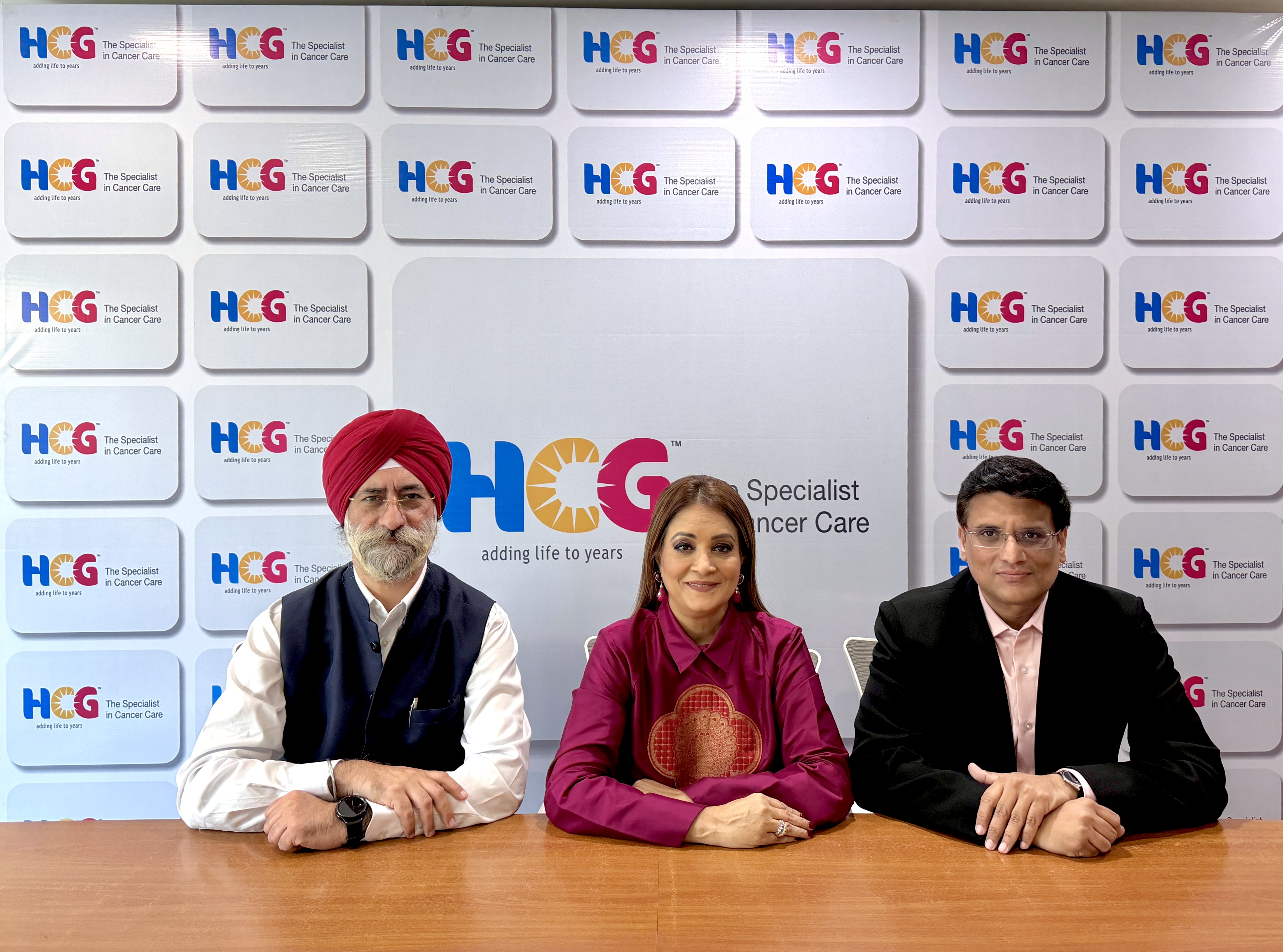
Kolkata, Apr 07: A team of doctors at HCG Cancer Hospital successfully treated a 62-year-old patient with Stage T2 penile cancer using organ-preserving surgery combined with robotic-assisted lymph node dissection. The procedure was led by Dr. Gaurav Aggarwal, HOD and Senior Consultant – Uro-Oncology and Robotics at HCG Cancer Hospital, Kolkata.
The patient approached the hospital after noticing a slowly growing lump on the penis for nearly a year. He was also experiencing phimosis, a condition in which the foreskin becomes tight and cannot be pulled back over the head of the penis. Despite the symptoms, the patient was otherwise healthy and active, with an ECOG (Eastern Co–operative Oncology Group) performance status of 1, meaning he was able to carry out normal daily activities.
To determine how far the cancer had spread, doctors advised a CECT (Contrast-Enhanced Computed Tomography) scan of the chest and abdomen. The scans confirmed Stage T2 penile cancer, indicating that the tumour had spread to the corpus spongiosum, the sponge-like tissue surrounding the urethra, the tube through which urine exits the body.
During clinical examination, there were no palpable inguinal lymph nodes, (implying: there were no enlarged lymph nodes detectable in the groin region). However, as per standard international uro-oncological guidelines (viz.European Association of Urology (EAU)), patients with Stage T2 disease may still have microscopic spread of cancer cells to the regional lymph nodes.
To treat the condition, surgeons first performed a partial penectomy, a surgery where only the cancer-affected portion of the penis is removed while preserving the remaining healthy part. This organ-sparing approach allows effective tumour removal while maintaining as much function as possible.
Subsequently,based on the histopathology report of the Partial Penectomy, the team performed abilateral inguinal lymph node dissection, a procedure in which lymph nodes from both sides of the groin are removed and examined.
Instead of the traditional open surgery, doctors used a minimally invasive robotic technique called RA- VEIL (Robotic Assisted- Video Endoscopic Inguinal Lymphadenectomy). This novel approach uses small incisions(8mm) and robotic instruments to improve surgical precision, reduce blood loss and minimise complications.
Explaining the significance of the procedure, Dr. Gaurav Aggarwal, HOD & Senior Consultant – Uro-Oncology and Robotics said,
“Penile cancer, although relatively rare, can significantly affect a patient’s physical and emotional well-being. Early diagnosis is extremely important because it allows doctors to treat the disease effectively while preserving function whenever possible. In this case, the robotic minimally invasive approach helped us remove the affected lymph nodes safely while reducing surgical trauma, general post operative complications of open lymph node dissection and enabling faster recovery.”
According to experts, penile cancer remains relatively uncommon but continues to be a public health concern in India, with about 3.3 cases per 100,000 men and nearly 10,000 new cases reported annually. Risk factors often include poor genital hygiene, phimosis and infection with HPV (Human Papilloma Virus).
Doctors advise men not to ignore warning signs such as persistent lumps, sores that do not heal, unusual discharge, bleeding, skin colour changes or difficulty in retracting the foreskin, as early medical consultation can significantly improve treatment outcomes.
Sharing his experience, the patient said,
“I was worried when I first noticed the symptoms and did not fully understand what was happening. The doctors at HCG Kolkata guided me through every step of the treatment. The surgery went well, and I am recovering steadily. I am doing better now, and walking is not a problem for me.”
Dr. Rupali Basu, Regional Business Head, HCG Cancer Centre, Kolkata.
“At HCG Cancer Centre, our constant effort is to make advanced cancer care more accessible while keeping the patient’s comfort, dignity, and quality of life at the centre of everything we do. This highlights how timely diagnosis, combined with the right clinical approach and technologies such as robotic-assisted surgery and precision medicine can significantly improve treatment outcomes while preserving function. We are continuously working towards strengthening our capabilities in minimally invasive oncology and bringing global standards of care closer to patients in Eastern India. Our focus remains on delivering personalised, evidence-based treatment with compassion, ensuring that every patient feels supported and confident throughout their cancer journey.”
At HCG Cancer Centre, doctors continue to focus on advanced, minimally invasive treatments and personalised cancer care, aiming to improve recovery outcomes while ensuring patients receive timely diagnosis, precise evidence based treatment and comprehensive support throughout their cancer journey.
HCG Cancer Centre, Newtown, Kolkata
HCG Cancer Centre, Kolkata, is equipped with state-of-the-art facilities, including modular operation theatres, the latest da Vinci 4th generation Robot, BMT Units, high-end radiation therapy facilities, Nuclear Medicine, Interventional Radiology.
HCG has a full-fledged organ-specific onco-surgery program, which allows its specialists to devise tailor-made treatment solutions for different types of cancer by Medical, Surgical & Radiation Oncology.
HCG was the first private hospital in Eastern India to have the Radixact TomoTherapy platform for customized radiation therapy. The hospital has a dedicated bone marrow transplant and haematology department and Nuclear Medicine department. With the newly available facilities of Robotic Surgery and CAR T-cell therapy, HCG makes cancer care personalized and patient-friendly.
At HCG Kolkata, patients have access to modern diagnostic and treatment approaches, namely PSMA PET scans, DOTA advanced radioactive scans, scar less throat surgery, minimally invasive surgeries, Interventional Radiology and more.
HCG Cancer Centre, Kolkata, follows a holistic approach to the management of all types of cancer, encompassing all facilities, including screening and prevention, diagnosis, staging, treatment, and follow-up of a cancer patient. With its 360-degree approach to cancer care, HCG makes cancer management more holistic and patient-focused.
