

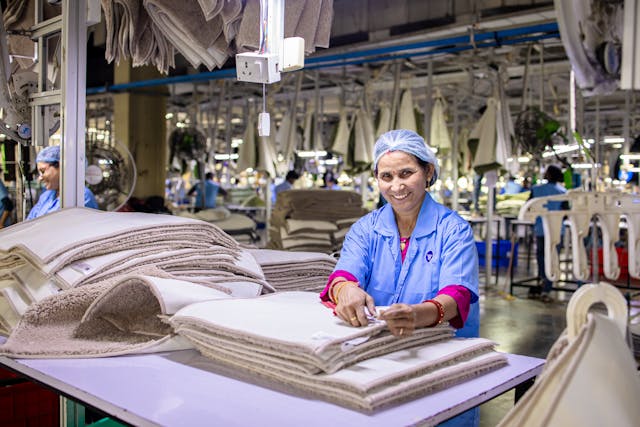
For decades, India’s growth story has been shadowed by a persistent paradox: a young population but limited participation of women in the workforce. While education levels among women have steadily improved, paid employment opportunities have not kept pace. Today, however, a quiet transformation is taking shape — led by apprenticeships, skills training, and state-level empowerment initiatives.
Over the last three years, women’s participation in apprenticeship programmes across India has risen sharply. The number of women apprentices has grown from just over 1.2 lakh in 2021–22 to nearly 2 lakh in 2023–24, marking an increase of more than half in a short span. In a labour market where female participation remains among the lowest globally, this trend stands out as a rare and promising breakthrough.
Why Apprenticeships Are Working for Women
India’s workforce challenge is not only about creating jobs — it is about enabling women to access them. Social norms, lack of work experience, safety concerns, and the disconnect between education and industry needs have long kept millions of women outside formal employment.
Apprenticeships are helping bridge this gap. By combining classroom learning with paid, hands-on experience, they offer women a structured entry into the workforce without the risks typically associated with first-time employment. Employers, too, benefit by developing talent aligned with real workplace requirements.
What makes this shift particularly significant is the range of sectors now absorbing women apprentices. Participation is rising across information technology, banking and financial services, electronics, automotive manufacturing, retail, healthcare, logistics, hospitality, tourism, food processing, and life sciences — fields once considered difficult to access for women at scale.
A Persistent Gender Gap Still Remains
Despite this progress, challenges remain deep-rooted. A large proportion of working-age women in India are still not part of the formal labour force. Many who do work are concentrated in informal, unpaid, or self-employed roles with limited income security.
While female labour force participation has improved gradually over recent years, much of the growth has come from rural women entering subsistence or family-based work rather than stable wage employment. This underlines the importance of skill-linked pathways — such as apprenticeships — that lead to long-term careers rather than temporary engagement.
Odisha’s Skill-Led Model of Women’s Empowerment
Among Indian states, Odisha has emerged as a strong example of how targeted policy and investment can accelerate women’s workforce participation.
The state’s World Skill Center (WSC) in Bhubaneswar has become a flagship institution for advanced technical training. Women’s enrolment at the centre has consistently increased, with graduates securing placements in leading Indian and global companies. For many young women from rural and tribal areas, the programme has opened doors to careers once considered unreachable — including employment abroad.
Complementing this is the Skilled-in-Odisha initiative, which aligns training programmes with real industry demand, ensuring that women are not only trained but employable.
From Skill Development to Entrepreneurship
Odisha’s approach goes beyond formal employment. Through schemes such as Lakhpati Didi and Subhadra Shakti Yojana, the state is enabling rural women to become entrepreneurs and income generators.
The Lakhpati Didi initiative supports women from self-help groups in building enterprises capable of earning sustainable annual incomes. Women are running businesses in food processing, agriculture-linked activities, handicrafts, animal husbandry, and local services — strengthening both household incomes and local economies.
The Subhadra Shakti Yojana further reinforces this ecosystem by supporting women through skill development, access to finance, and enterprise mentoring. Together with Mission Shakti, which has organised millions of women into self-help groups, these programmes create a pathway from skills to financial independence.
Apprenticeships as a Growth Strategy
Economists widely agree that India cannot fully realise its economic potential without significantly higher female workforce participation. Apprenticeships offer a scalable solution — one that lowers entry barriers, builds confidence, and creates a direct link between education and employment.
Odisha’s experience demonstrates that when apprenticeships are embedded within a broader empowerment framework — including entrepreneurship support, institutional training, and community-based programmes — the impact is both economic and social.
The Road Ahead
The rise in women apprentices is an encouraging signal, but it is only the beginning. Sustaining this momentum will require continued investment in skills, workplace safety, flexible work models, access to credit, and supportive infrastructure.
As women move from training rooms to factory floors, offices, and entrepreneurial ventures, they are reshaping India’s workforce from the ground up. If replicated and scaled, models like Odisha’s could help turn this quiet shift into a nationwide transformation — one where women are not just participants in growth, but leaders of it.