

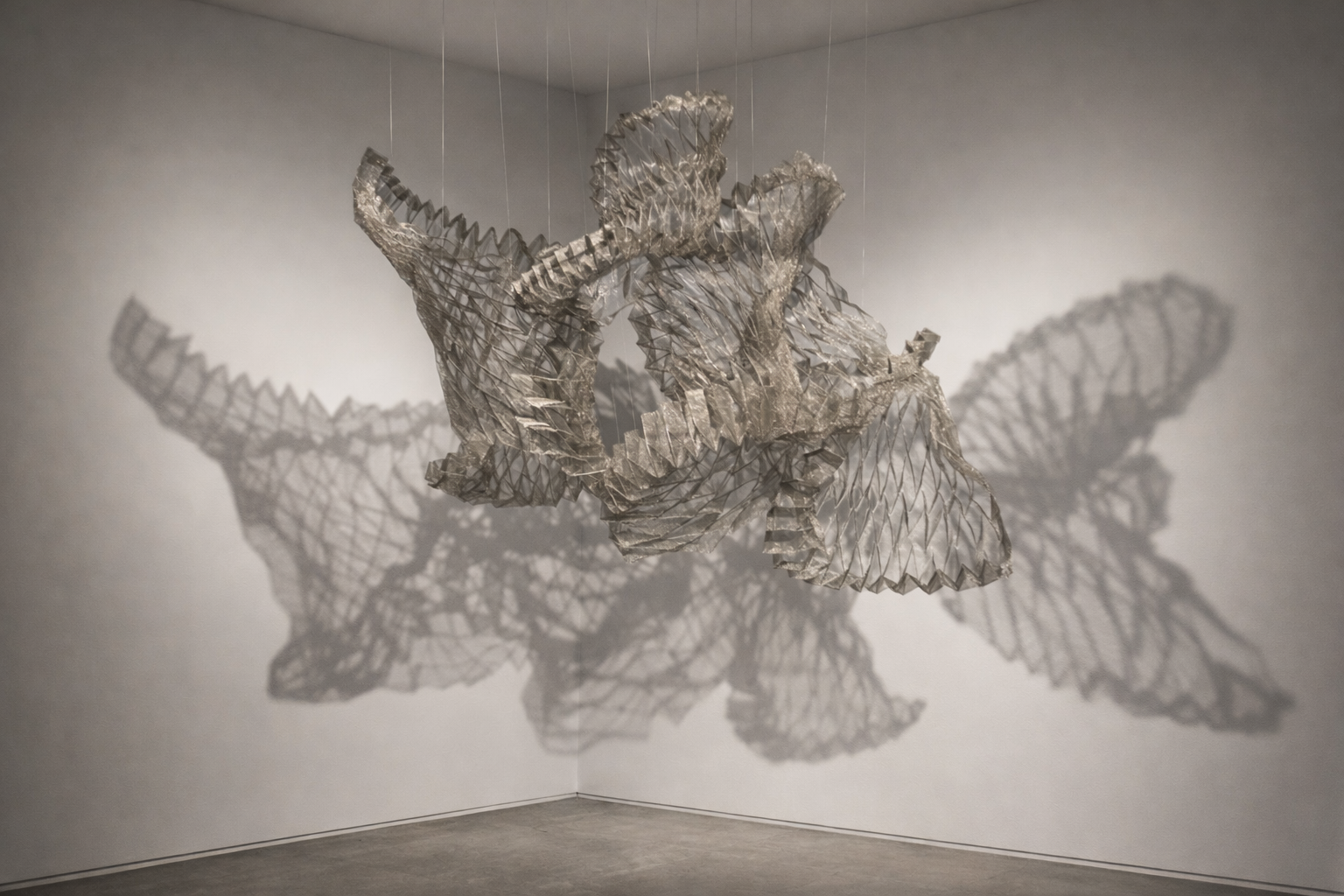
The Lexicon Art’s upcoming exhibition ‘Dvaita (द्वैत) : Dualities’ presents the philosophical concept of dualism as a curation of opposites. In this show we look at many dualities – black and white, gold and silver, blue and red, shiny and rough, squares and circles, precise geometries and amorphous shapes, heavy and light, wall and ceiling, canvas and steel, and through these dualities, we try to uncover how this complexity of opposites resolves into Advaita (अद्वैत), a oneness. In India dualities jostle on the street side by side, big mansions and slums coexist on the same street, a beautiful avenue of Gulmohar trees keeps company of overflowing drains and broken pavements, humans and cows both cross the road (and not at the zebra crossing). We have accepted and internalized this way of things in our country. We do not call it chaos, we know it to be diversity and a complex order. What if this kind of complexity had to be addressed in an art exposition?
Title of the Show: Dvaita or Dualities
Curator Name: Mr. Ankon Mitra
Exhibition Date: 18th April 2026
Exhibition Open till: 18th May 2026
Timings: Monday to Saturday, 11:00 AM – 7:00 PM
Venue: The Lexicon Art, M-12, Connaught Place, New Delhi – 110001
There are 11 artists in the show exhibiting a diversity of opposites. From paintings to sculptures and installations to murals, the works speak of one and the other. The space of the gallery itself is planned as a dance of playful dualities. The show opens on the 18th of April at The Lexicon Art’s gallery at the M-12, Outer Circle, Connaught Place and continues for a month thereafter.
In alphabetical order the list of Artists being presented – Ankon Mitra, Divyendu Anand, Keshari Nandan, Meenakshi Jha Banerjee, Naman Mahipal, Neerja Chandna Peters, Nimesh Patel, Pratap Chandra Chakraborty, Shovin Bhattacharjee, Vinod Daroz.
From Mamta Nath, Founder-Director:
At The Lexicon Art, our upcoming exhibition Dvaita (द्वैत): Dualities invites viewers into the vibrant heart of Indian philosophy and lived reality. Drawing from dualism’s interplay of opposites, we celebrate how these tensions mirror our streets, where grand mansions neighbor slums, Gulmohar avenues embrace overflowing drains, and humans share the road with cows. Far from chaos, this is our complex order—our diversity. Our artworks clash and blend on canvas, steel, walls, and ceilings, leading to Advaita (अद्वैत)—that profound moment of oneness. In defying the sterile white cube, we move beyond the conventional gallery aesthetic to make art feel alive, much like the act of creating it, urging a synthesis that echoes creation itself.
From Ankon Mitra, Curator:
Trained as an architect and practicing as a landscape designer, sculptor, and installation artist, Ankon Mitra has navigated dualities across two decades. From brick and concrete to folded paper, his four-year curation journey explores how we traverse life’s complexities in mosaic-like India: Epicurians alongside Stoics, cows outside Gurugram malls, rich and poor cheek-by-jowl, traffic jams at verdant Sunder Nursery. Indians seamlessly shift—from street-side abuses in a Mercedes to billion-dollar deals over fine dining. Dvaita (द्वैत): Dualities visualizes these contrasts, echoing Eastern philosophies where opposites fuel meaning—maximalism with minimalism, yin and yang, inseparable. Dualities must be lived, to understand and absorb the dualities in art.
Concept Note:
Dvaita (द्वैत) : Dualities
The philosophical concept of dualism suggests separation and opposite entities. In this show we look at many dualities – black and white, gold and silver, blue and red, shiny and rough, squares and circles, precise geometries and amorphous shapes, heavy and light, wall and ceiling, canvas and steel, and through these dualities, we try to uncover how this complexity of opposites resolves into Advaita (अद्वैत), a oneness. In art curations dualities may be celebrated or completely dispensed with. In a white cube gallery works are placed at great distances from each other with white spaces in-between. There is no cause to compare and no complexity to deal with. Our viewing of art is anaesthetized. The real world is not like this, and India is definitely not like this. Here dualities jostle on the street side by side, big mansions and slums coexist on the same street, a beautiful avenue of gulmohar trees keeps company of overflowing drains and broken pavements, humans and cows both cross the road (and not at the zebra crossing). We have accepted and internalized this way of things in our country. We do not call it chaos, we know it to be diversity and a complex order. What if this kind of complexity had to be addressed in an art exposition? This is the heart of the matter as far as the act of creation itself is concerned. There are dualities everywhere we see. How do we synthesize the viewers experience of diametrically opposite ways of creation – ultimately the show hopes to illuminate resonance and dissonance, their interplay and the eventual ‘aha’ moment – when dualities resolve into a coherent oneness.– Ankon Mitra, Curator – Artist
