

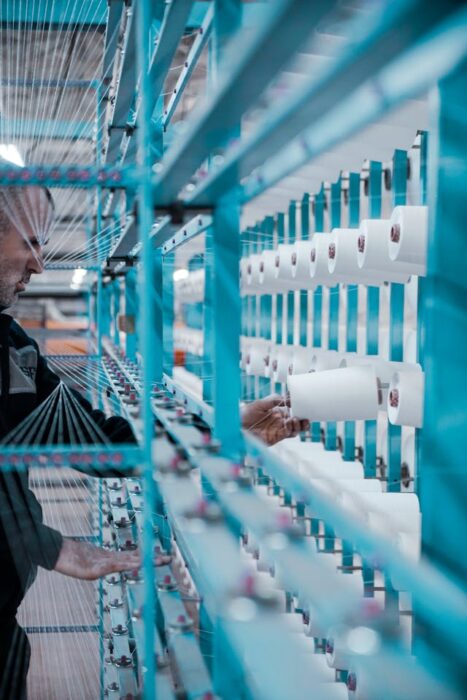
India’s textile industry—one of the country’s oldest economic pillars—is in the midst of a structural reset. Beyond technology upgrades and sustainability goals, a quieter but equally powerful force is driving this change: policy reform. Targeted government schemes, simplified taxation, and labour reforms have collectively created an environment where textile businesses can scale faster, operate more transparently, and generate better-quality employment.
Over the last decade, these reforms have helped the sector move from fragmented, informal operations toward integrated, globally competitive manufacturing.
Government Schemes: Building Scale, Speed and Competitiveness
At the heart of the sector’s transformation are production- and infrastructure-focused schemes designed to address long-standing bottlenecks.
The PM MITRA (Pradhan Mantri Mega Integrated Textile Region and Apparel) Parks scheme is reshaping the industry’s physical backbone. By creating large, plug-and-play textile hubs with common infrastructure—such as power, water treatment, logistics, and testing facilities—the scheme allows companies to operate at scale while reducing costs and turnaround times. For manufacturers, this means fewer supply-chain disruptions and better alignment with global buyers’ expectations.
The Production-Linked Incentive (PLI) Scheme for Textiles has shifted focus toward high-growth segments like man-made fibre apparel and technical textiles. By rewarding incremental production, the scheme encourages companies to invest in modern machinery, automation, and advanced materials—helping India move up the value chain rather than competing purely on price.
Complementing these are schemes like the Amended Technology Upgradation Fund Scheme (ATUFS), which lowers the cost of capital for machinery upgrades, and SAMARTH, which supports skill development and workforce readiness. Together, they strengthen both the supply side and the human capital needed for modern manufacturing.
Labour Reforms: Formalising Work, Empowering Workers
Labour reforms have played a crucial role in improving productivity and worker well-being—two factors critical to long-term competitiveness.
The introduction of four labour codes—covering wages, industrial relations, social security, and occupational safety—has simplified compliance for businesses while expanding protections for workers. For the textile sector, which employs millions across factories, MSMEs, and home-based units, this has encouraged formalisation.
Formal employment brings tangible benefits: access to social security, safer working conditions, predictable wages, and greater workforce stability. For employers, streamlined labour laws reduce administrative complexity, improve industrial relations, and support scale-driven growth.
Women, who make up a significant portion of the textile workforce, stand to gain the most. Improved workplace standards, maternity benefits, and skill training initiatives are helping women move into more secure and skilled roles—boosting both job satisfaction and productivity.
GST Reforms: Simplifying Trade and Strengthening Supply Chains
The introduction of the Goods and Services Tax (GST) marked a turning point for the textile industry’s complex tax structure.
Before GST, multiple indirect taxes created inefficiencies, blocked working capital, and fragmented supply chains. GST replaced this with a unified, transparent tax system, making inter-state movement of goods smoother and faster.
For textile businesses, GST has reduced logistics costs, improved input tax credit availability, and increased accountability across the value chain. While initial rate-related challenges existed, the long-term impact has been a cleaner, more organised industry, better aligned with global compliance standards.
GST has also encouraged smaller players to enter the formal economy, enabling easier access to bank credit, export incentives, and government schemes—key drivers of MSME growth.
How Reforms Are Helping Business and the Economy
Together, policy initiatives, labour reforms, and GST have changed the way the textile sector functions:
-
Lower cost of compliance allows companies to focus on innovation and expansion
-
Better infrastructure and incentives support scale and export competitiveness
-
Skilled and protected labour improves productivity and reduces attrition
-
Formalisation and transparency attract global buyers and investors
The impact extends beyond factories. Stronger value chains benefit cotton farmers, artisans, logistics providers, and women entrepreneurs, creating a more inclusive growth model.
The Bigger Picture
India’s textile sector is no longer relying on legacy strengths alone. By aligning policy reform with technology, sustainability, and skills, the country is laying the foundation for a globally competitive, socially responsible textile economy.
For businesses, the message is clear: the operating environment is becoming more predictable, efficient, and growth-oriented. For workers, it promises better jobs, greater security, and rising aspirations. And for India, it marks a decisive step toward leadership in the global textile and apparel market.
As reforms continue to mature, India’s textile story is being woven not just with threads and fabric—but with policy, people, and purpose.