

PHDCCI organized a Roundtable on “Future of India’s Shipbuilding and Ship Recycling: Decoding Budget Announcements to power India’s Maritime Future”
New Delhi, Mar 13: Shri Susanta Kumar Purohit, IRSEE, Chairperson of V.O. Chidambaranar Port Authority, addressed a high-level Roundtable on the “Future of India’s Shipbuilding and Ship Recycling,” outlining a transformative roadmap to elevate India’s maritime standing. Speaking to distinguished delegates and industry leaders, Shri Purohit detailed how the visionary leadership of Hon’ble Prime Minister Shri Narendra Modi and the strategic direction provided by the Union Minister for Ports, Shipping and Waterways, Shri Sarbananda Sonowal, have created the fiscal architecture necessary to shift India into a dominant maritime power.
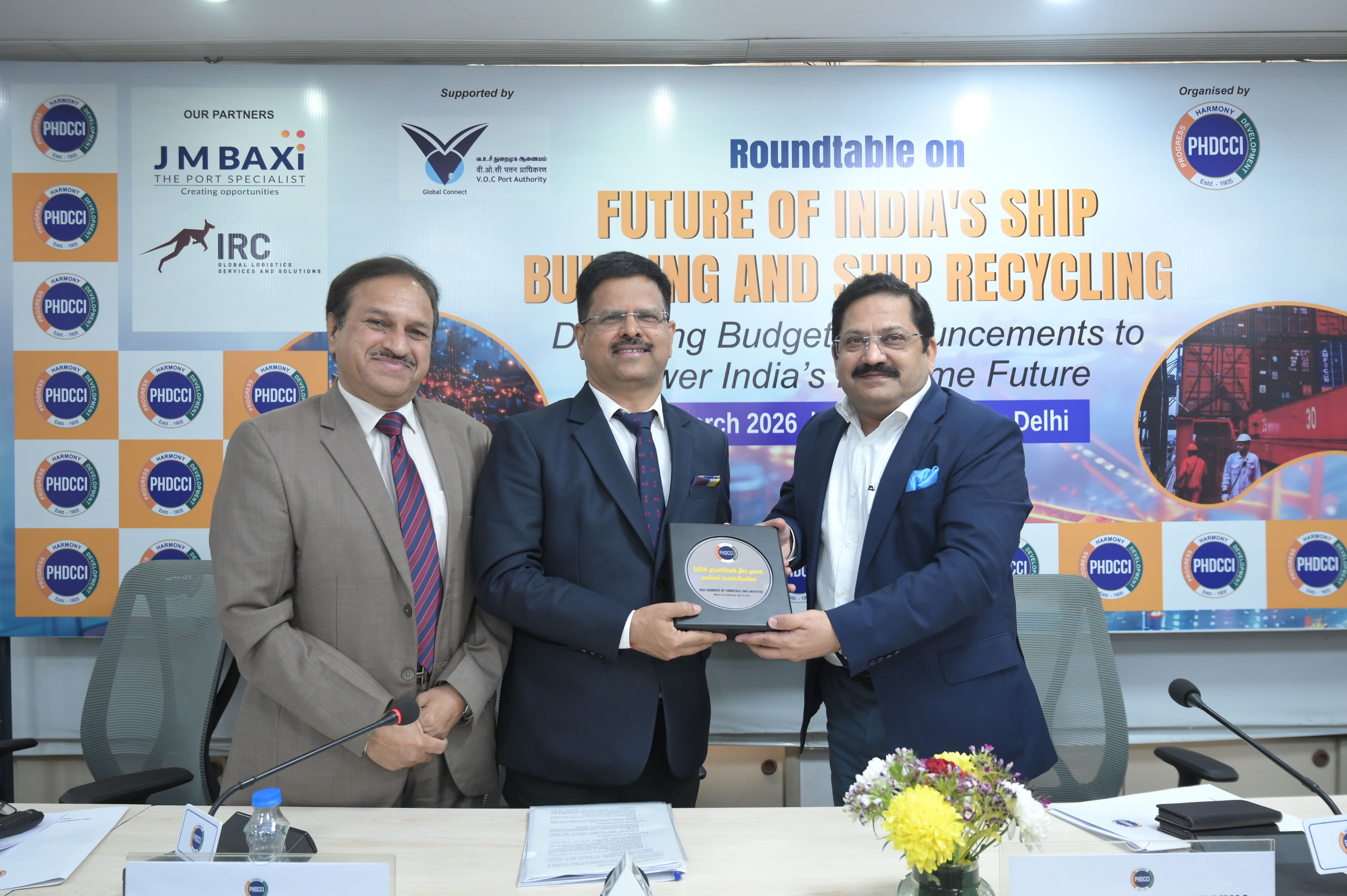
The Chairperson highlighted that the comprehensive policy framework, championed by the Ministry of Ports, Shipping and Waterways, is built upon four strategic pillars: financing, capacity expansion, policy reform, and skill development. Central to this vision is the ₹69,725 crore Maritime Revitalisation Package, the ₹25,000 crore Maritime Development Fund, and the extension of the Shipbuilding Financial Assistance Scheme through 2036. Shri Purohit emphasised that the 48 per cent surge in the Ministry’s budget allocation to ₹5,164.8 crore signals a clear sovereign intent to reduce the ₹6 lakh crore annual freight drain to foreign shipping lines, fulfilling the Prime Minister’s vision of an Aatmanirbhar Bharat in the maritime sector.
A cornerstone of this industrial expansion is the newly announced Shipbuilding Project, to be executed through a Special Purpose Vehicle (SPV) named the ‘National Shipbuilding & Heavy Industries Park, Tamil Nadu’. This ambitious project is a 50:50 Joint Venture between the V.O. Chidambaranar Port Authority and the State Industries Promotion Corporation of Tamil Nadu (SIPCOT). With an estimated project cost of ₹30,000 crore and spanning a total land area of 2,000 acres, this facility will serve as a primary engine for India’s domestic maritime manufacturing and heavy engineering.
Significant focus was also placed on the integration of the circular economy through the Shipbreaking Credit Note Scheme. This innovative policy offers vessel owners a credit note equivalent to 40 per cent of the scrap value of ships recycled at Indian yards, redeemable against the cost of new domestic construction. Shri Purohit noted that under the guidance of Minister Sarbananda Sonowal, India has positioned itself as the world’s most responsible and regulation-ready recycling destination, with 106 yards at Alang already compliant with the Hong Kong International Convention.
The Chairperson also showcased V.O. Chidambaranar Port as a model for the Maritime Amrit Kaal Vision 2047. As India’s first port to produce green hydrogen and the first to exceed one megawatt of rooftop solar generation, the port is currently executing a ₹15,000 crore Outer Harbour project. This expansion is set to establish Southern India as a premier transhipment hub capable of competing with major international ports such as Singapore and Colombo.
In his concluding remarks, Shri Purohit extended his gratitude to the PHDCCI for its catalytic role in bridging policy intent with industry action. He urged all stakeholders to move from deliberation to execution, seizing the global moment of supply-chain realignment to propel India into the top five shipbuilding nations by 2047.
