

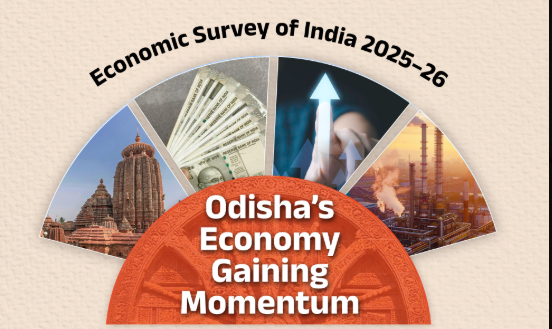
When the Economic Survey of India 2025–26 was tabled in Parliament on January 29, Odisha emerged not just as a fast-growing state, but as a reference point for how inclusive growth, institutional reform, and sustainability can move together. Across multiple chapters, the survey repeatedly draws attention to Odisha’s policy choices and ground-level outcomes, presenting the state as a model for India’s next phase of economic transformation.
From agriculture and tribal livelihoods to semiconductors, skilling, climate resilience, and clean energy, Odisha’s development trajectory reflects a deliberate shift from dependence on natural resources to a more diversified, future-ready economy.
The Economic Survey of India (2025–26) reaffirms the steady progress #Odisha is making towards inclusive and sustainable growth.
I am pleased to note that Odisha’s Net State Domestic Product has increased from ₹6.99 lakh crore in 2023–24 to an estimated ₹7.90 lakh crore in… pic.twitter.com/v41zG9woby
— Mohan Charan Majhi (@MohanMOdisha) January 29, 2026
Growth Momentum and Rising Incomes
At the core of the survey’s assessment is Odisha’s accelerating economic growth. The state’s Net State Domestic Product (NSDP) is estimated to have risen from ₹6.99 lakh crore in 2023–24 to about ₹7.90 lakh crore in 2024–25, registering a strong growth rate of 13.04 per cent. This expansion places Odisha among the faster-growing large states in the country.
The benefits of growth are increasingly visible at the household level. Per capita NSDP has reached ₹1,68,966, pointing to rising incomes and improved living standards. The survey underlines that Odisha’s growth is not narrowly concentrated, but supported by a combination of agriculture, industry, and public investment.
Agriculture and Tribal Livelihoods: The Foundation of Inclusion
Agriculture continues to receive significant emphasis in the survey’s Odisha narrative. The state has strengthened its position as one of India’s leading sunflower producers, signalling successful crop diversification and improved farm practices.
More importantly, the survey highlights Odisha’s targeted interventions in tribal and rural regions. Initiatives such as integrated farming systems in districts like Gajapati have combined indigenous knowledge, low-cost technology, and market access to dramatically raise household incomes. Incomes that were once subsistence-level have increased many times over, while distress migration has declined.
Climate resilience has been closely linked with livelihood security. Programmes like Climate Resilient Villages are cited as examples of how adaptation measures can be mainstreamed into local governance, rather than remaining isolated pilot projects.
From Minerals to Manufacturing: The Industrial Shift
One of the strongest themes in the Economic Survey is Odisha’s strategic shift from a resource-driven economy to an industrial and manufacturing-oriented one. The survey gives special attention to the state’s role in the India Semiconductor Mission and the Semicon India programme.
Odisha is among a small group of states hosting semiconductor manufacturing and packaging projects, with investments worth around ₹1.6 lakh crore. The state’s Semiconductor Manufacturing and Fabless Policy is noted for aligning closely with national priorities while offering state-level facilitation. The survey suggests that these efforts will strengthen domestic manufacturing capacity, reduce supply-chain vulnerabilities, and position India more firmly in the global electronics ecosystem.
Skilling and Education: Building Human Capital
Human capital development is another area where the survey repeatedly references Odisha. The state’s reforms in skilling, led by the Odisha Skill Development Authority, are presented as a template for revamping Industrial Training Institutes (ITIs).
The ‘Fix, Scale, Accelerate’ approach—focused on correcting infrastructure gaps, expanding short-term training, and establishing advanced institutes—has addressed long-standing issues of under-utilisation and perception around vocational education.
In higher education, initiatives such as the Mo College programme and the Higher Education Programme for Excellence and Equity are highlighted for strengthening alumni networks, encouraging research internships, and promoting centres of excellence. The survey views these measures as essential for linking education outcomes with employability and innovation.
Urban Governance, Environment and Clean Energy
The survey also places Odisha among states experimenting with innovative urban and environmental solutions. The ‘Garbage-Free Urban Odisha’ mission, launched in 2023, is cited for its use of bio-mining and material recovery facilities to convert legacy waste into usable economic resources.
In infrastructure and regulation, Odisha is recognised for simplifying building bye-laws and development norms, contributing to improved ease of doing business.
The state’s environmental leadership is further reinforced by the identification of Paradip Port as one of India’s green hydrogen hubs, alongside ports in Gujarat and Tamil Nadu. This positions Odisha as a key player in India’s clean energy transition.
Financial Inclusion and Fiscal Stability
Financial deepening forms a quiet but important backdrop to Odisha’s growth story. The survey notes that bank deposits in the state have risen to ₹5.83 lakh crore, reflecting increased savings and wider access to formal banking.
A strong fiscal position has enabled Odisha to sustain public investment in infrastructure, education, health, and social welfare, even while maintaining macroeconomic stability. The survey links this fiscal discipline to the state’s ability to pursue long-term development goals without compromising inclusion.
Why Odisha Stands Out in the Survey
What distinguishes Odisha in the Economic Survey 2025–26 is not a single sector, but the coherence of its approach. The survey consistently emphasises:
-
Execution-oriented reforms
-
Integration of sustainability with livelihoods
-
Alignment of state policies with national missions
-
Focus on human capital and institutional capacity
Chief Minister Mohan Charan Majhi described the survey’s assessment as a validation of Odisha’s development path, reaffirming the state’s commitment to translating growth into quality employment and broader opportunities.
As the Economic Survey makes clear, Odisha’s experience offers valuable lessons for states seeking balanced growth—where economic momentum, social inclusion, and environmental responsibility advance together rather than in isolation.