


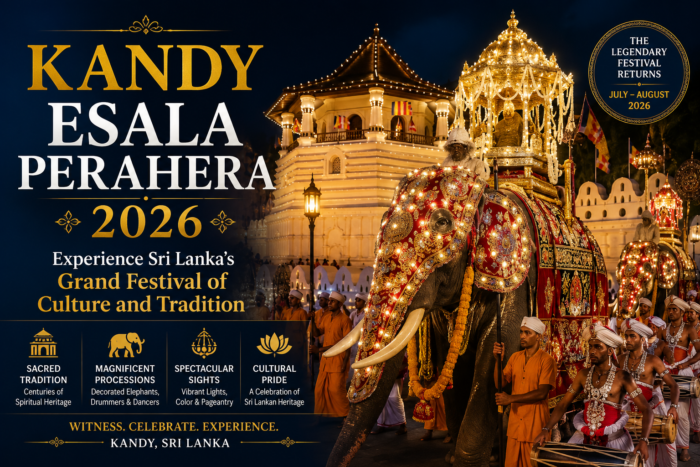
For a few special nights each year, the historic city of Kandy in Sri Lanka takes on a completely different character. The streets fill with music, lights, dancers and beautifully decorated elephants as thousands of people gather for the Kandy Esala Perahera, one of Sri Lanka’s most celebrated cultural and religious festivals.
The 2026 edition is scheduled from August 18 to August 27, followed by the traditional Day Procession on August 28. For travellers visiting Sri Lanka during this period, the festival offers an opportunity to experience the country’s heritage through music, dance, religious ceremonies and centuries-old traditions.
At the centre of the celebrations is the Sacred Tooth Relic of the Buddha, preserved at the Sri Dalada Maligawa, or Temple of the Sacred Tooth Relic, in Kandy.
When Is Kandy Esala Perahera 2026?
The dates of the Kandy Esala Perahera change each year because the festival follows the traditional lunar calendar.
According to the official schedule, the 2026 celebrations begin with the Kumbal Perahera from August 18 to August 22. The more elaborate Randoli Perahera follows from August 23 to August 27, with the final Randoli procession scheduled for August 27.
The festival concludes with the Day Procession on August 28. A traditional water-cutting ceremony, known as Diya Kapeema, is also part of the closing ceremonies.
For visitors who want to see the festival at its grandest, the final Randoli Perahera is likely to be the biggest attraction. Those who prefer to avoid the heaviest crowds may find the earlier processions more comfortable.
More Than a Colourful Procession
It is easy to think of the Kandy Esala Perahera simply as a spectacular parade. But for Sri Lankans, it represents something much deeper.
The festival has strong links with Buddhism and the veneration of the Sacred Tooth Relic. The relic has been an important part of Sri Lanka’s religious and cultural history for centuries.
During the Perahera, a ceremonial casket associated with the relic is carried through the streets on a richly decorated tusker. The procession is accompanied by traditional dancers, drummers, musicians and other performers.
This combination of devotion and celebration is what makes the Kandy festival particularly distinctive.
A Night Filled With Music, Dance and Elephants
One of the most memorable sights for visitors is the procession of elephants dressed in elaborate ceremonial decorations.
As they move through the streets, they are surrounded by Kandyan dancers, drummers, torchbearers, acrobats and fire performers. The sound of traditional drums carries through the city while performers in colourful costumes add movement to the procession.
For travellers seeing the festival for the first time, the experience can be overwhelming in the best possible way. It is loud, colourful and energetic, but also deeply connected to Sri Lanka’s cultural traditions.
The performances are not simply staged for tourists. Traditional dance and music continue to play an important role in the country’s cultural life.
From Kumbal to Randoli
The Perahera builds gradually over its ten main nights.
The Kumbal Perahera, held from August 18 to 22 in 2026, marks the beginning of the main processions. It introduces visitors to the atmosphere of the festival before the celebrations become increasingly elaborate.
The Randoli processions then take place from August 23 to 27. The final Randoli Perahera is traditionally the grandest and attracts large numbers of devotees, local residents and international visitors.
Anyone planning to attend the final night should expect significant crowds and plan ahead.
Why the Festival Matters to Sri Lanka Tourism
The Kandy Esala Perahera is also important from a tourism perspective.
Sri Lanka’s tourism industry has been experiencing strong growth. According to the Sri Lanka Tourism Development Authority, the country recorded 2.36 million international tourist arrivals in 2025, compared with about 2.05 million in 2024. That represented growth of 15.1%.
August 2025 recorded more than 198,000 tourist arrivals, up 20.4% compared with August 2024.
The country’s tourism sector has continued to attract international visitors in 2026, strengthening the importance of major cultural attractions and festivals in encouraging travellers to explore destinations beyond the traditional beach circuit.
The Kandy Esala Perahera is particularly valuable because it brings attention to the cultural side of Sri Lanka. Visitors arriving for the festival can also spend time exploring Kandy and other destinations in the central highlands.
A Boost for Kandy’s Local Economy
Large cultural festivals can have an impact well beyond the event itself.
Hotels, restaurants, taxis, tour operators, guides, shops and handicraft businesses can all benefit when visitor numbers increase. Travellers attending the Perahera may also extend their stay to explore Kandy’s temples, gardens, markets and surrounding landscapes.
For local businesses, this creates an opportunity to reach visitors who may otherwise spend most of their Sri Lanka holiday in coastal destinations.
The festival therefore serves not only as a cultural celebration but also as an important showcase for Kandy as a heritage and tourism destination.
Planning Your Kandy Perahera Visit
Travellers should plan early if they want to attend the festival.
Accommodation in Kandy can become difficult to secure during the busiest nights, particularly around the final Randoli procession. Booking well in advance is advisable.
Visitors should also reach their preferred viewing area early. Crowds can gather several hours before the procession begins, and road restrictions may affect movement around the city.
Comfortable clothing and footwear are useful because visitors may spend considerable time standing or walking. Since the event has religious significance, appropriate and respectful clothing is recommended, particularly when visiting the Temple of the Sacred Tooth Relic.
Photography is encouraged in many public areas, but visitors should be considerate and avoid disrupting religious ceremonies or performers.
Discover Kandy Beyond the Perahera
The festival can easily become the centrepiece of a wider Sri Lanka holiday.
The Temple of the Sacred Tooth Relic is essential for understanding the religious significance of the Perahera. Kandy Lake, located close to the temple, is another well-known landmark and offers a quieter way to experience the city.
Travellers can also visit the Royal Botanic Gardens at Peradeniya, explore local handicrafts and sample Kandyan cuisine.
Those with more time can travel into Sri Lanka’s central highlands, where tea-growing landscapes, mountain scenery and smaller towns provide a different perspective on the country.
Why Kandy Esala Perahera Is Worth Experiencing
Sri Lanka is often associated with beaches, wildlife and tea plantations, but its cultural traditions are equally compelling.
The Kandy Esala Perahera brings those traditions together in one extraordinary celebration. The elephants, dancers, drums and lights may be what first catches a visitor’s attention, but the deeper appeal lies in the history and religious significance behind the spectacle.
For anyone planning a Sri Lanka trip in August 2026, the Kandy Esala Perahera offers a chance to experience the island at its most vibrant.
It is a festival where history is not confined to monuments or museums. Instead, it moves through the streets, carried by music, dance, faith and generations of tradition — making the journey to Kandy an experience that travellers are unlikely to forget.