

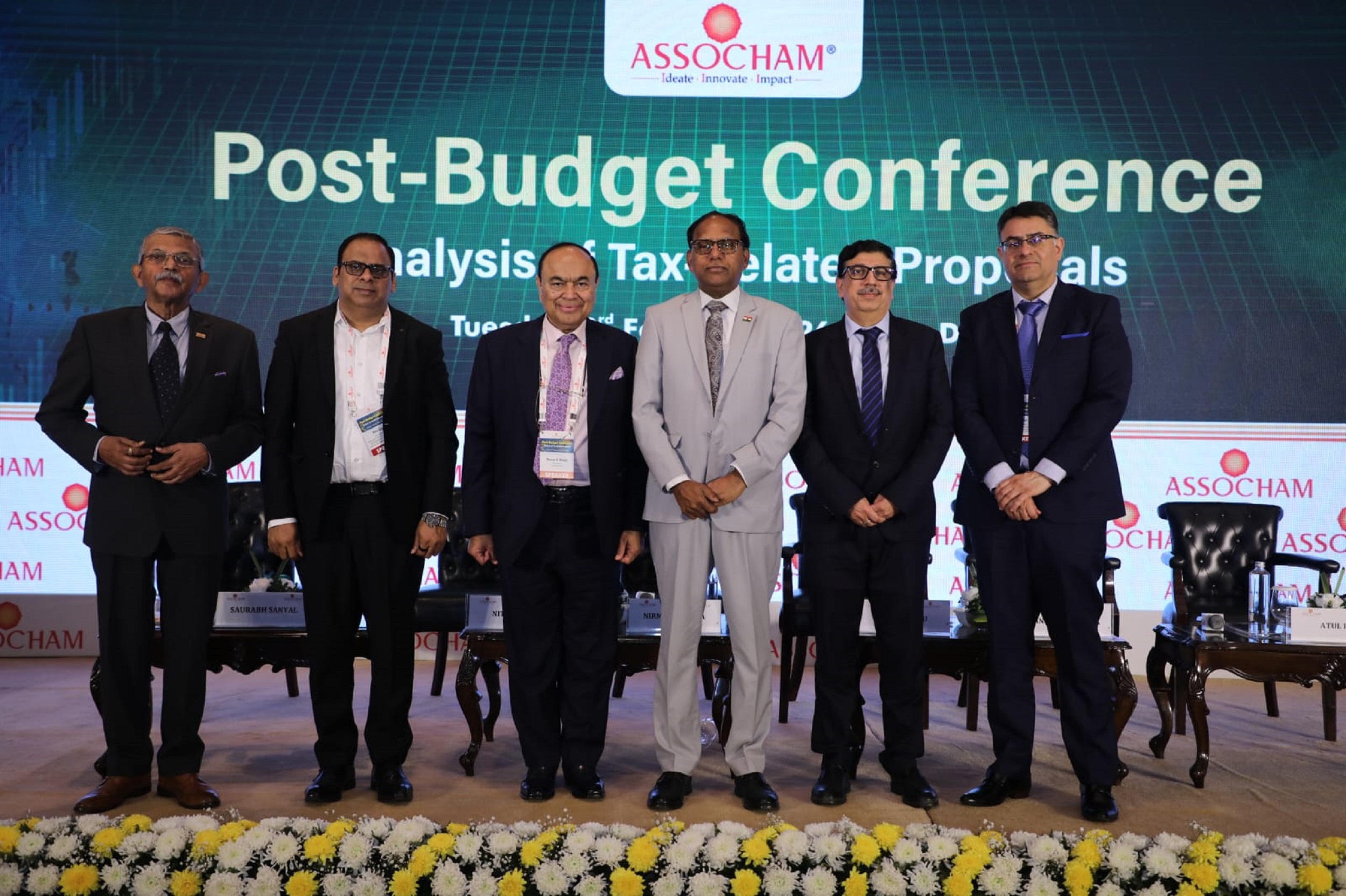
New Delhi, Feb 04: ASSOCHAM today organised the Post-Budget Conference to discuss and analyse of tax-related proposals at Le Meridian, New Delhi. The conference was attended by senior policymakers, tax experts, industry leaders, and financial sector stakeholders to deliberate on key provisions of the Union Budget and their implications for growth, investment, and competitiveness.
The conference was attended by key leaders along with Nirmal K Minda, President ASSOCHAM, Mr. Saurabh Sanyal, Secretary General, ASSOCHAM; Mr. Prasenjit Singh, Member (Legislation), CBDT, Ministry of Finance; and Shri M. Nagaraju, IAS, Secretary, Department of Financial Services (DFS), Ministry of Finance, Government of India.
Delivering the Keynote Address, Shri M. Nagaraju, Secretary, DFS highlighted that easing global trade uncertainties and improving India–US trade dynamics are positive signals for Indian industry, especially exporters and MSMEs. He noted that Indian companies have already demonstrated resilience by diversifying export markets and are now well-positioned to expand capacity as trade conditions improve.
“With global trade conditions showing signs of improvement and India’s financial system on strong footing, this is the right time for industry to step up investments and capacity creation. The banking sector is well-capitalised and ready to support growth across MSMEs, infrastructure, and sunrise sectors,” Shri Nagaraju said.
He underscored the strength of India’s banking system, pointing out that asset quality has improved significantly, with net NPAs at low levels, while credit growth remains robust across sectors, particularly MSMEs and industry.
“Our MSME sector continues to be a key driver of employment and exports. Expanded credit guarantee support, improved access to finance, and new growth-oriented schemes announced in the Budget will help high-performing MSMEs scale up and integrate into global value chains,” he added.
Shri Nagaraju also emphasised the importance of sustained public capital expenditure in infrastructure—roads, railways, and urban development—which is crowding in private investment and creating long-term growth multipliers. He encouraged corporates to deploy available cash reserves into emerging opportunities such as energy transition, data centres, electronics manufacturing, and other sunrise sectors.
Furthermore, Mr. Prasenjit Singh (Member – Legislation, CBDT), in his address said, “This Budget reflects a clear shift toward a trust-based, taxpayer-friendly administration built on clarity, certainty, and simplification. The focus is on improving ease of living and ease of doing business through streamlined provisions and smarter, more integrated compliance systems. Rationalisation and decriminalisation of several procedural aspects signal a move away from an adversarial framework toward one that encourages voluntary compliance.”
He added. “Measures to reduce litigation and ease financial burden during appeals further demonstrate a balanced and pragmatic approach. The strong response to updated return provisions shows that when trust is placed in taxpayers, they respond responsibly. Continued stakeholder consultation will remain key to building a simpler, transparent, and globally competitive tax ecosystem.”
Welcoming the address, Mr. Nirmal K. Minda, President, ASSOCHAM, said, “The industry deeply values the government’s continued focus on financial stability, credit flow to productive sectors, and policy support for MSMEs”.