

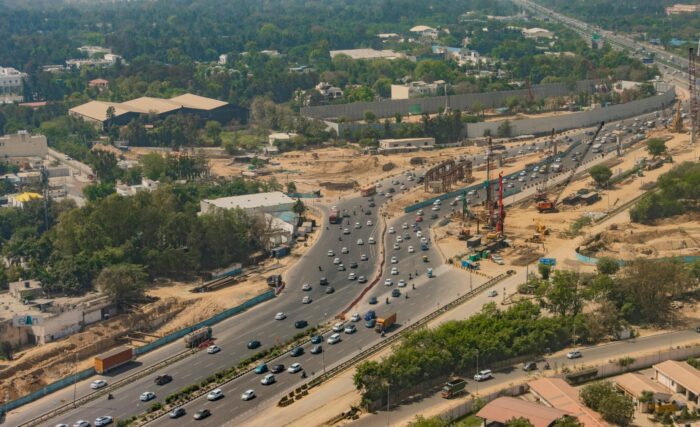
India is currently witnessing one of the largest infrastructure expansions in its history. Massive investments in highways, railways, ports, airports, logistics corridors, and clean energy are transforming the country’s economic landscape. Through initiatives such as the PM Gati Shakti National Master Plan and the National Infrastructure Pipeline, the government aims to integrate infrastructure planning and accelerate development across sectors.
By 2030, several mega projects currently under construction or development are expected to reshape connectivity, trade, and urban growth in India. Here are 10 landmark infrastructure projects along with their current status and expected impact.
1. Delhi–Mumbai Expressway
The Delhi–Mumbai Expressway is India’s longest greenfield expressway, stretching around 1,386 km and connecting the national capital with Mumbai. Designed as an 8-lane access-controlled highway, it will pass through Haryana, Rajasthan, Madhya Pradesh, Gujarat, and Maharashtra.
Current Status:
-
-
Around 875 km of the Delhi–Mumbai Expressway is already operational, with several major stretches open across Haryana, Rajasthan, Madhya Pradesh, and Gujarat.
-
Overall construction progress has crossed 82%, with significant portions already handling regular traffic and reducing travel time between major cities along the corridor.
-
The remaining sections—particularly key stretches in Gujarat and connectivity links near Delhi—are currently under construction and are expected to open in phases between 2026 and 2028, gradually completing the entire expressway network.
-
Impact:
Once fully completed, the expressway will reduce travel time between Delhi and Mumbai to about 12 hours while strengthening industrial corridors and logistics networks.
2. Mumbai–Ahmedabad High-Speed Rail
India’s first bullet train project will connect Mumbai and Ahmedabad through a 508 km high-speed rail corridor with trains operating at speeds up to 320 km/h.
Current Status:
-
-
Major civil works are progressing steadily across the corridor, including viaduct construction, tunnels, bridges, and station infrastructure.
-
Structural work for several stations in Gujarat has been completed, with finishing and systems installation underway.
-
Track laying, overhead electrification, and signalling installations have begun in multiple sections, particularly across the Gujarat stretch where construction is more advanced.
-
The first operational segment in Gujarat is expected to begin service around 2027, while the entire Mumbai–Ahmedabad high-speed rail corridor is likely to become fully operational by 2029.
-
Impact:
The project will significantly reduce travel time to about 2-3 hours and introduce advanced high-speed rail technology in India.
3. Dedicated Freight Corridor
The Dedicated Freight Corridor (DFC) is a railway project designed exclusively for freight movement across two main routes:
-
Western Corridor (Dadri–Jawaharlal Nehru Port)
-
Eastern Corridor (Ludhiana–Dankuni)
Current Status:
-
-
Most sections of both the Eastern and Western Dedicated Freight Corridors have already been commissioned, with the majority of the network now operational.
-
Freight trains are actively running on the completed stretches, significantly improving cargo movement efficiency and reducing transit time between major industrial hubs, ports, and logistics centers.
-
Impact:
The DFC will dramatically increase freight train speeds, reduce logistics costs, and decongest passenger rail lines.
4. Navi Mumbai International Airport
The Navi Mumbai International Airport is one of India’s most important aviation infrastructure projects aimed at easing pressure on Chhatrapati Shivaji Maharaj International Airport.
Current Status:
-
-
Construction of terminal buildings, runway infrastructure, and supporting connectivity projects has largely been completed, with final systems integration and operational readiness activities carried out in phases.
-
Phase-1 operations are expected to begin in the mid-2020s, with trial operations and system integration currently underway.
-
Impact:
Once fully operational, the airport could handle more than 60 million passengers annually, strengthening India’s aviation capacity and boosting tourism and trade.
5. Bharatmala Pariyojana
The Bharatmala Pariyojana is a large-scale highway development program aimed at building and upgrading 34,000 km of highways across India.
-
More than 18,000 km of highways under the Bharatmala programme have already been completed and opened to traffic, including several economic corridors and expressway stretches.
-
Numerous highway projects remain under construction across different states, with new greenfield corridors, bypasses, and connectivity routes currently being developed to strengthen India’s national road network.
Impact:
The project aims to improve connectivity between major economic centers, border regions, ports, and rural areas, while significantly reducing transportation costs.
6. Sagarmala Programme
The Sagarmala Programme focuses on port-led development to strengthen India’s maritime infrastructure.
Current Status:
-
Hundreds of port modernization and connectivity projects are underway.
-
Several projects related to coastal economic zones and logistics parks are in different phases of development.
Impact:
Sagarmala aims to reduce logistics costs, increase export competitiveness, and boost coastal shipping and inland waterways.
7. Chennai–Bengaluru Industrial Corridor
The Chennai–Bengaluru Industrial Corridor (CBIC) is designed to create a major manufacturing hub in South India.
Current Status:
The corridor is expected to attract global investments in electronics, automobiles, and advanced manufacturing.
8. Udhampur–Srinagar–Baramulla Rail Link
The Udhampur–Srinagar–Baramulla Rail Link (USBRL) aims to connect Kashmir with the rest of the Indian railway network.
Current Status:
-
-
Several sections of the rail link, including Udhampur–Katra and Banihal–Baramulla, are already operational, providing rail connectivity within the region.
-
The remaining stretches—particularly the Katra–Banihal section involving complex tunnels and bridges—are in the final stages of construction and testing.
-
The project features the Chenab Rail Bridge, the world’s highest railway bridge, which represents a major engineering milestone of the corridor.
-
Impact:
Once completed, the project will transform tourism, trade, and connectivity in Jammu and Kashmir.
9. GIFT City
The Gujarat International Finance Tec-City (GIFT City) is India’s first operational smart financial hub designed to compete with global financial centers.
Current Status:
-
-
Numerous international banks, fintech firms, and financial institutions have already established operations within the International Financial Services Centre (IFSC), strengthening the city’s position as a global financial hub.
-
Infrastructure development and commercial expansion are progressing rapidly, with new office towers, financial service facilities, and supporting urban infrastructure being developed to accommodate growing business activity.
-
Impact:
GIFT City aims to position India as a global financial services hub, boosting international finance and fintech innovation.
10. National Hydrogen Mission
India’s National Hydrogen Mission is focused on building large-scale green hydrogen infrastructure to support the energy transition.
Current Status:
-
-
Several pilot projects and large-scale green hydrogen production facilities are currently being planned and developed across the country.
-
Major energy companies are investing in renewable energy–powered hydrogen production, along with infrastructure for electrolyser manufacturing, storage, and distribution to support the emerging hydrogen economy.
-
Impact:
By 2030, India aims to become a global leader in green hydrogen production and exports, helping decarbonize industries such as steel, cement, and heavy transport.
Infrastructure: The Backbone of India’s Economic Transformation
Infrastructure development is central to India’s long-term economic ambitions. With massive investments across transportation, logistics, urban development, and clean energy, the country is building the foundation for sustained growth.
These mega projects are expected to:
-
Reduce logistics costs and improve trade competitiveness
-
Accelerate industrial growth and manufacturing investment
-
Strengthen connectivity between cities and rural regions
-
Create millions of jobs across sectors
As these transformative projects move toward completion, India’s infrastructure landscape is being reshaped—laying the groundwork for a more connected, efficient, and globally competitive nation by 2030.