

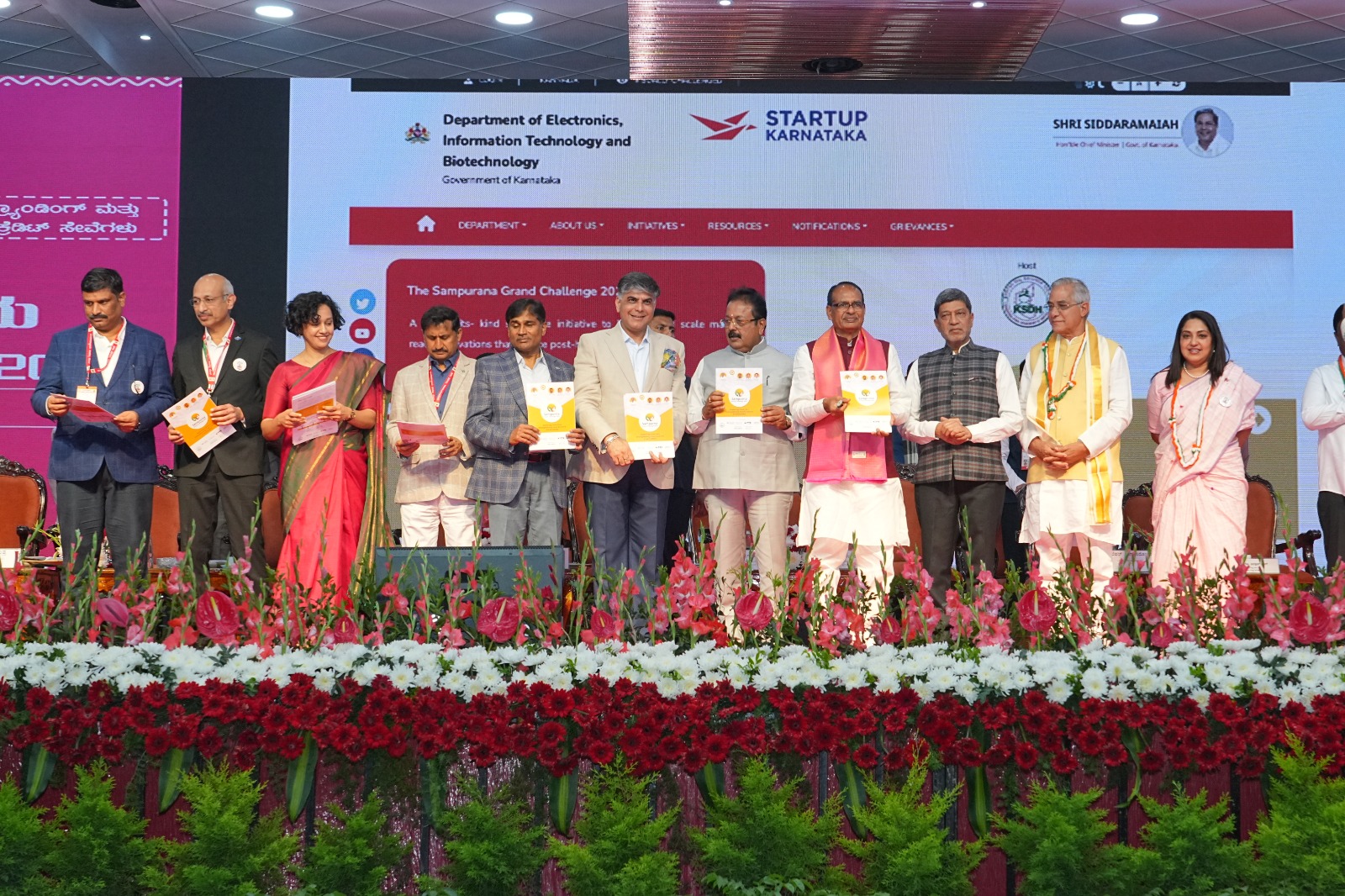
Bengaluru, India, Feb 10: The Government of Karnataka in partnership with GAIN, Nutrition Connect, ABWCI, Thinkthrough Consulting, and others announced the Sampurna Grand Challenge 2026, an innovation challenge focused on reducing food loss across agricultural and horticultural value chains. The initiative aims to strengthen Karnataka’s food systems by addressing post-harvest losses through scalable, market-ready solutions.
Minister Shivraj Singh Chouhan, Minister of Agriculture and Farmers’ Welfare and Minister of Rural Development, Government of India, flagged off the initiative at ITF 2026 in the eminent presence of the Hon’ble Minister of State for Micro, Small & Medium Enterprises, Labour & Employment, Government of India, and Dr. Ashwath Narayan C. N., Hon’ble Member of the Karnataka Legislative Assembly, Malleshwaram Constituency, alongside other eminent dignitaries from government, industry, and the innovation ecosystem.
The Sampurna Grand Challenge 2026 has been designed as a collaborative platform that brings together government, innovators, Farmer Producer Organisations (FPOs), markets, research institutions, and investors. The objective is to identify actionable and scalable innovations that can meaningfully reduce food loss across key agricultural and horticultural value chains in the state.
The challenge builds on and complements Karnataka’s ongoing efforts to modernise agri-horticulture through initiatives such as the Unified Market Platform, the Public–Private Partnership–Integrated Horticulture Development (PPP-IHD) programme, Raitha Siri, and the Centre of Excellence for FPOs.
Speaking about the initiative, Dr. Shalini Rajneesh, IAS, Chief Secretary, Government of Karnataka, highlighted, “Karnataka has been a pioneer in driving innovations and investments in agriculture. Aligned with our commitment to institutional excellence, I am delighted that the Government of Karnataka is launching the Sampurna Grand Challenge 2026. We are poised to mobilise investments and innovations in agriculture and horticulture to build a strong, collaborative ecosystem for reducing food loss across Karnataka. By bringing innovators and multi-sector partners together with government, leveraging data, technology, and existing agri-horticulture value-chain infrastructure, we can unlock higher farmer incomes, accelerate value-added innovations, and scale impactful, technology-driven solutions. Together, we move with new purpose to build a more resilient food system aligned with Karnataka’s vision.”
Shri Grish R., IAS, Secretary, Department of Horticulture, emphasised, “Reducing food loss requires fresh thinking and bold solutions. Through the Sampurna Grand Challenge 2026, the Department of Horticulture is inviting entrepreneurs, researchers, and innovators to bring forward new ideas to address food loss challenges across the value chain by drawing on global and local best practices. Our commitment to supporting farmers remains steadfast as we advance data-driven, technology-assisted solutions through effective partnerships.”
Highlighting the urgency of the issue, Dr. Bhuvaneswari Balasubramanian, Country Director, GAIN India, stated, “Too much good food is lost before it ever reaches a plate. Reducing food loss is not just about efficiency; it is about protecting farmer incomes, improving nutrition outcomes, and reducing pressure on our natural resources. Through the Sampurna Grand Challenge 2026, we are working closely with the Government of Karnataka and ecosystem partners to support solutions that are practical, sustainable, and scalable.”
Emphasising the need to bring together the tri-sector, Dr. Parul Soni, Founder, ABWCI and Thinkthrough Consulting, said, “Bringing together Samaaj, Sarkaar, and Bazaar is imperative for the success of this initiative. Collaboration is embedded by design, bringing policy, markets, and capital into the same conversation, thereby ensuring that innovation is augmented with a comprehensive execution architecture.”
The initiative reflects Karnataka’s long-term vision of aligning innovation, sustainability, and partnerships, and represents a significant step towards building efficient, climate-smart, and nutrition-sensitive food systems across the state.