

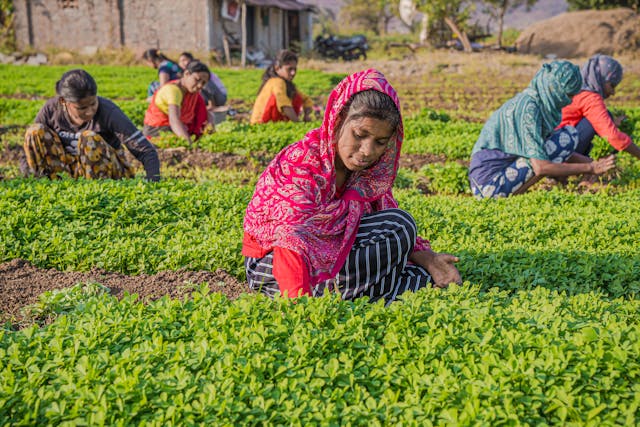
For decades, Indian agriculture was synonymous with distress, low returns, and uncertainty. Over the past ten years, however, a quieter transformation has been unfolding in the countryside—one that is beginning to redraw the economic map of rural India.
A Decade That Changed the Farm Economy
Between 2014–15 and 2023–24, farmers’ incomes in India grew by an estimated 126 per cent, according to a recent academic study. That translates to annual growth of over 10 per cent, a pace that outstripped manufacturing and even overall economic growth during the same period.
For a sector that supports nearly 58 per cent of India’s rural population, the numbers signal more than statistical success—they reflect a meaningful shift in livelihoods, confidence, and opportunity across India’s villages.
This growth roughly aligns with the tenure of Prime Minister Narendra Modi, during which the goal of doubling farmers’ income became a defining policy objective. While scepticism initially surrounded the ambition, fresh data now suggests that the target was not only met but exceeded.
What the Data Reveals
The findings, authored by noted agriculture economist and NITI Aayog member Ramesh Chand, were published in the Quarterly Journal of the Indian Association of Social Science Institutions. The study highlights that farm income growth during the period surpassed that of several non-agricultural sectors—challenging the long-held belief that agriculture is destined to lag behind industry and services.
Crucially, the income gains were not driven by a single policy or subsidy. Instead, they resulted from a combination of direct income support, market reforms, crop diversification, technological adoption, and improved access to inputs and markets.
Farmers increasingly moved away from low-return monocropping toward diversified, higher-value cultivation. Better price realisation, improved supply chains, and scientific farming practices helped convert effort into earnings.
Agriculture Outpacing Industry
Perhaps the most striking insight is that agriculture—often perceived as India’s weakest link—outperformed manufacturing in income growth during this period. Schemes like PM-KISAN, expanded crop insurance, soil health cards, and digitised market access played a role in stabilising farmer incomes.
More importantly, rising agricultural earnings have had a ripple effect. Higher rural incomes boosted local consumption, strengthened village economies, and reduced distress migration. In many regions, farming began to feel less like survival and more like a viable enterprise.
Beed’s Breakthrough: A Story from the Ground
National data tells one part of the story. The rest lies in villages like those in Beed district, Maharashtra, one of the state’s most drought-prone regions.
Here, a quiet experiment called Krishikul, led by social entrepreneur Mayank Gandhi under the Global Vikas Trust (GVT), reimagined what farming could look like in a climate-stressed landscape. Farmers were encouraged to shift from traditional crops such as soybean and cotton to high-value fruit crops including papaya, guava, sweet lime, pomegranate, bananas, and mulberry.
Using high-density plantation techniques and scientific farm management, Krishikul demonstrated what was possible when knowledge, trust, and market access came together.
An independent evaluation by the Tata Institute of Social Sciences (TISS) in 2024 revealed that per-acre income rose more than tenfold—from ₹38,700 to nearly ₹3.93 lakh in a short transition period.
Today, over 30,000 farm families across 5,000 villages have benefited, with more than 6.7 crore fruit trees planted across 43,000 acres.
How Krishikul Made It Work
Krishikul’s success was not accidental. It began with listening—understanding farmers’ fears, constraints, and aspirations. High-quality saplings were procured in bulk to reduce costs, then provided to farmers at subsidised rates through CSR funding, including significant support from the Motilal Oswal Foundation.
Equally important was trust. Farmers were not asked to abandon tradition blindly but were guided step by step, blending modern science with local knowledge. Training, demonstration farms, and assured market linkages reduced risk and built confidence.
Echoes of the White Revolution
The Krishikul story inevitably draws comparisons with India’s White Revolution, which transformed milk production through cooperative-led, farmer-centric models. That movement succeeded not because of top-down mandates, but because it empowered small producers with structure, scale, and support.
Today, agriculture stands at a similar inflection point. The question is whether successful local models like Krishikul can be scaled nationally, with coordinated support from state and central governments.
The Road Ahead: Growth with Resilience
Despite the progress, challenges remain. Climate uncertainty, particularly the threat of El Niño-induced monsoon disruptions, looms large in 2026. Water stress, soil degradation, and market volatility continue to test farmers’ resilience.
Sustaining income growth will require climate-smart agriculture, better irrigation management, investment in storage and logistics, and continued policy innovation. Just as importantly, farmers must remain at the centre of decision-making.
A Quiet Revolution Still Unfolding
India’s agricultural story over the past decade is not one of sudden miracles, but of steady, structural change. Rising incomes, successful grassroots models, and supportive policies have together reshaped what is possible for millions of farmers.
The challenge now is continuity—ensuring that this momentum survives climate shocks, market swings, and political cycles. If it does, India may well look back on this period as the moment when farming stopped being a problem to manage—and started becoming a growth story worth believing in.