

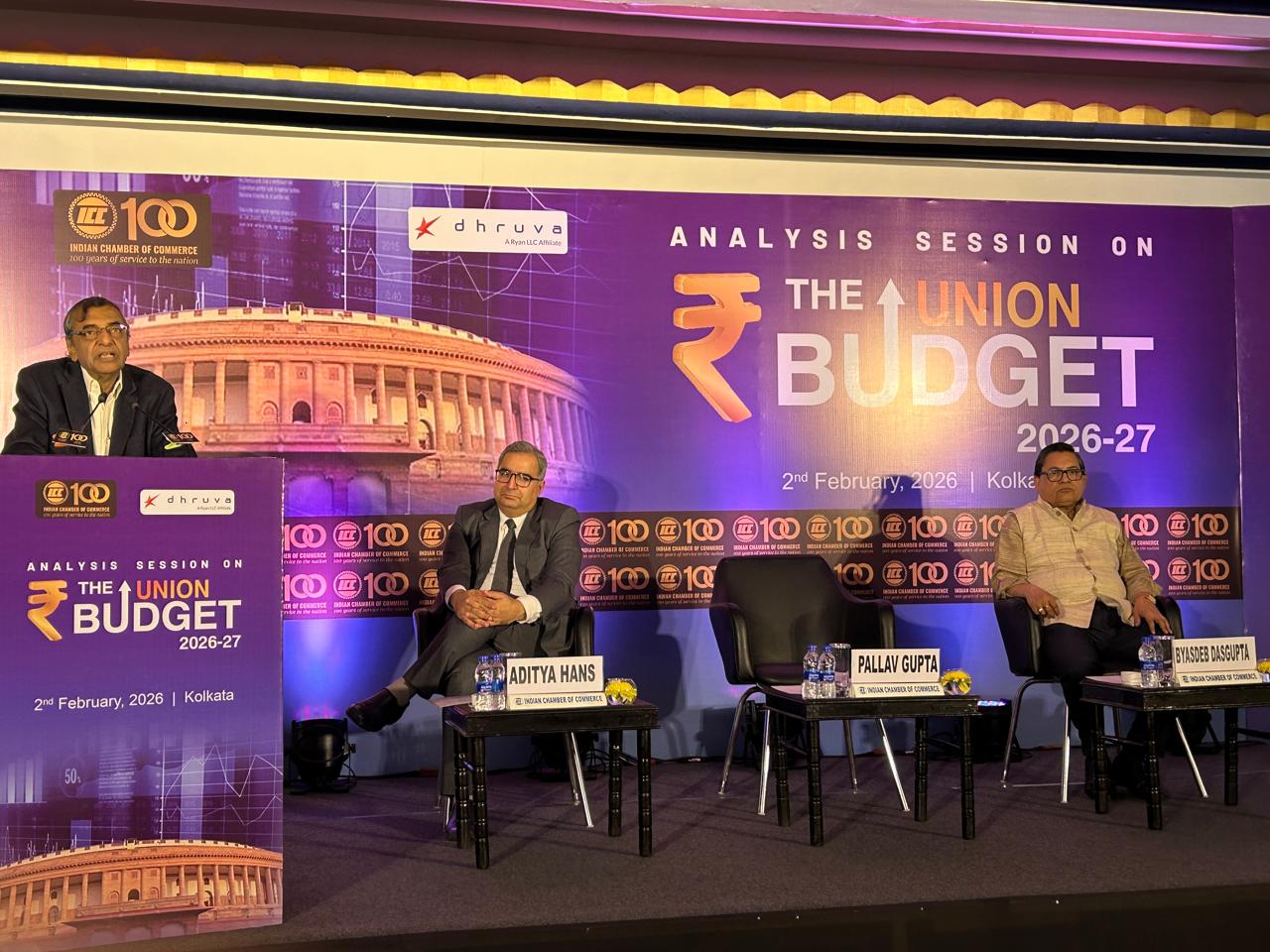
Kolkata, Feb 02: The Indian Chamber of Commerce (ICC) organised an analysis session on the Union Budget 2026–27 on Monday in the presence of leading industry and policy experts, including Mr. Pallav Gupta, Chairman of the Expert Committee on Taxation, ICC; Mr. Aditya Hans, Partner, Dhruva Advisors India Private Limited; and Dr Byasdeb Dasgupta, Director, Institute of Development Studies, Kolkata.
Leading tax and economic experts said the Union Budget reflects a carefully balanced approach aimed at preserving macroeconomic stability while laying the foundation for long-term structural transformation amid global uncertainty.
Mr Pallav Gupta, Chairman of the Expert Committee on Taxation, ICC, described the Budget as “a very tricky budget” but one that ensures “on the economics front, the fiscal deficit, debt-to-GDP ratio — everything is getting controlled.” He noted that inflation appears to be under control and the overall macro picture “is looking fairly clean.”
Gupta observed that the government’s tax collection projections appear conservative and may be exceeded. However, he cautioned that surplus liquidity could have side effects. “If collections are overshot, banks can cash in the system, and deposit rates may get affected if banks are not keen on increasing deposits. We will have to see how this evolves in the coming months,” he said.
Referring to the global backdrop, Gupta said India’s Budget must be viewed in the context of “tremendous geopolitical uncertainty,” adding that policies may need recalibration during the year. He highlighted incentives for foreign and NRI investments and long-term tax benefits for international firms investing in Indian data centres, but warned of practical constraints. “Massive data centres have major energy and water implications, and India itself is energy-deficient. So, this is very challenging,” he said.
Mr Aditya Hans, Partner at Dhruva Advisors India Pvt Ltd, said the economy has moved beyond recovery. “India is no longer in a recovery stage; the economy has found its rhythm again,” he said, pointing to strong real GDP growth, moderating inflation and returning fiscal discipline.
He said India stands out globally. “At a time when many advanced economies are growing below 2 per cent, India places itself firmly as the fastest-growing major economy,” Hans noted. He emphasised that easing inflation is largely supply-driven. “Food prices have fallen meaningfully. Inflation is easing because the supply tap has opened, not because demand has stalled,” he said.
On fiscal management, Hans said consolidation has been steady and credible since the pandemic spike. Regarding the rupee’s weakness, he attributed it mainly to global capital flows and higher growth-linked imports. “A faster-growing economy naturally imports more. Part of the trade deficit is a byproduct of growth itself,” he said, adding that services exports and remittances provide strong external buffers.
Hans underlined the Budget’s investment-led strategy, citing a sharp rise in public capital expenditure focused on infrastructure and strategic manufacturing. “This is not consumption spending; this is productivity in advance,” he said, pointing to policy thrusts in biopharma, semiconductors, electronics, chemicals and construction equipment to move India up the value chain.
Dr Byasdeb Dasgupta, Director, Institute of Development Studies, Kolkata, said the Budget marks a shift from short-term relief to long-term structural change. “Some may not like it, but freebies are not a permanent solution to structural problems,” he said, stressing that fiscal restraint is now a global reality.
He described the fiscal framework as credible and aligned with long-term stability. “Capital expenditure-led growth, not free cash transfers, is the focus. Sustainability is the keyword,” Dr Dasgupta said. He highlighted the emphasis on infrastructure, urban development, MSMEs, strategic sectors and human capital, alongside environmentally conscious growth.
According to him, “This Budget should be viewed as a long-term developmental blueprint,” aimed at strengthening market-driven growth and building capacity for sustained expansion. “If we want to remove structural bottlenecks, we need a strong long-term path. The government clearly has that perspective in mind,” he said.