


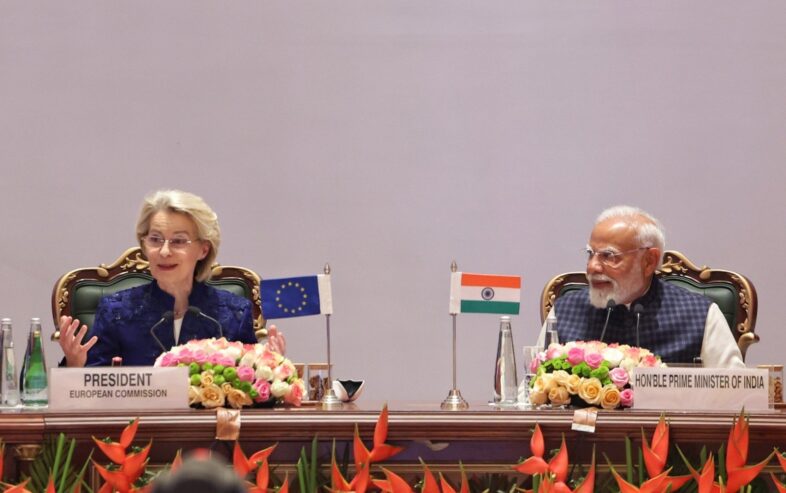
India and the European Union seal the largest Free Trade Agreement in India’s history, unlocking growth across manufacturing, technology, energy, and innovation.
A Historic Handshake for Global Growth
In a landmark moment for global trade, Prime Minister Narendra Modi announced the conclusion of the historic India–European Union Free Trade Agreement (FTA), marking a decisive step toward deeper economic integration between the world’s second-largest and fourth-largest economies.
Sharing the announcement alongside European Council President Antonio Costa and European Commission President Ursula von der Leyen, Prime Minister Modi described the agreement as a symbol of trust, ambition, and a shared vision for a prosperous and sustainable future.
“This agreement will deepen economic ties, create opportunities for our people, and strengthen the India–Europe partnership,” the Prime Minister said, calling it a milestone achieved through years of constructive dialogue and cooperation.
Why This Deal Matters
The India–EU FTA is India’s largest trade agreement to date, impacting 1.4 billion people and one of the world’s most influential economic blocs. The agreement is designed to:
-
Reduce tariffs and trade barriers
-
Improve market access
-
Encourage investment and innovation
-
Create quality employment
-
Strengthen global supply chains
At its core, the deal aims to align economic growth with sustainability, digital transformation, and industrial resilience.
Sector-by-Sector Impact: What Changes on the Ground
1. Manufacturing: Strengthening ‘Make in India’
What’s new:
Lower tariffs and simplified regulations will make Indian manufacturing more competitive in European markets.
Impact:
-
Increased exports of industrial goods
-
Higher foreign direct investment (FDI)
-
Integration into EU supply chains
-
Boost to MSMEs and small industries
Why it matters:
Manufacturing will become a key driver of jobs, productivity, and industrial scale.
2. Pharmaceuticals & Healthcare: Expanding Global Reach
What’s new:
Easier access to EU markets and regulatory cooperation.
Impact:
-
Growth in pharma exports
-
Joint research and development
-
Affordable medicines reaching wider populations
Why it matters:
India strengthens its position as the “pharmacy of the world.”
3. Information Technology & Digital Services
What’s new:
Enhanced digital trade frameworks and services cooperation.
Impact:
-
Expansion of IT and software exports
-
Growth in AI, fintech, and cybersecurity services
-
Stronger digital partnerships
Why it matters:
India’s tech talent gains broader global opportunities.
4. Semiconductor Sector: Powering the Future
What’s new:
Strategic collaboration in advanced manufacturing and chip production.
Impact:
-
Investment in semiconductor fabs
-
Technology transfer and skill development
-
Reduced dependence on limited global suppliers
Why it matters:
Semiconductors are critical for electronics, defence, and digital infrastructure.
5. Automobile & Mobility Sector
What’s new:
Reduced tariffs and alignment of technical standards.
Impact:
-
Growth in electric vehicles (EVs)
-
Export of auto components
-
Collaboration on clean mobility technologies
Why it matters:
Positions India as a global hub for next-generation mobility.
6. Energy Sector: Driving Green Transition
What’s new:
Stronger cooperation on clean and renewable energy.
Impact:
-
Investments in solar, wind, and green hydrogen
-
Energy security and climate action
-
Joint innovation in clean technologies
Why it matters:
Supports India’s net-zero ambitions and sustainable growth.
7. Textile & Apparel Industry: A Boost for Employment
What’s new:
Improved market access for Indian textile products.
Impact:
-
Higher exports to Europe
-
Job creation, especially for women
-
Growth of sustainable textiles
Why it matters:
Textiles remain one of India’s largest employment-generating sectors.
People, Mobility, and Opportunity
Beyond industries, the agreement focuses on people-centric growth:
-
Easier mobility for professionals, students, and researchers
-
Creation of high-quality jobs
-
Skill development and innovation ecosystems
-
Stronger academic and research partnerships
This human dimension makes the FTA not just an economic pact, but a social and developmental one.
A Shared Vision for Tomorrow
Calling it a deal that benefits the global economy, Prime Minister Modi said the agreement opens “unprecedented opportunities and new avenues of growth and cooperation.”
Together, India and the European Union are moving forward with confidence — shaping a future that is prosperous, inclusive, innovative, and sustainable.