


Artificial Intelligence is no longer a technology reserved for research laboratories or major technology companies. It is rapidly becoming part of everyday business operations, transforming how organisations communicate, analyse information, serve customers and make strategic decisions.
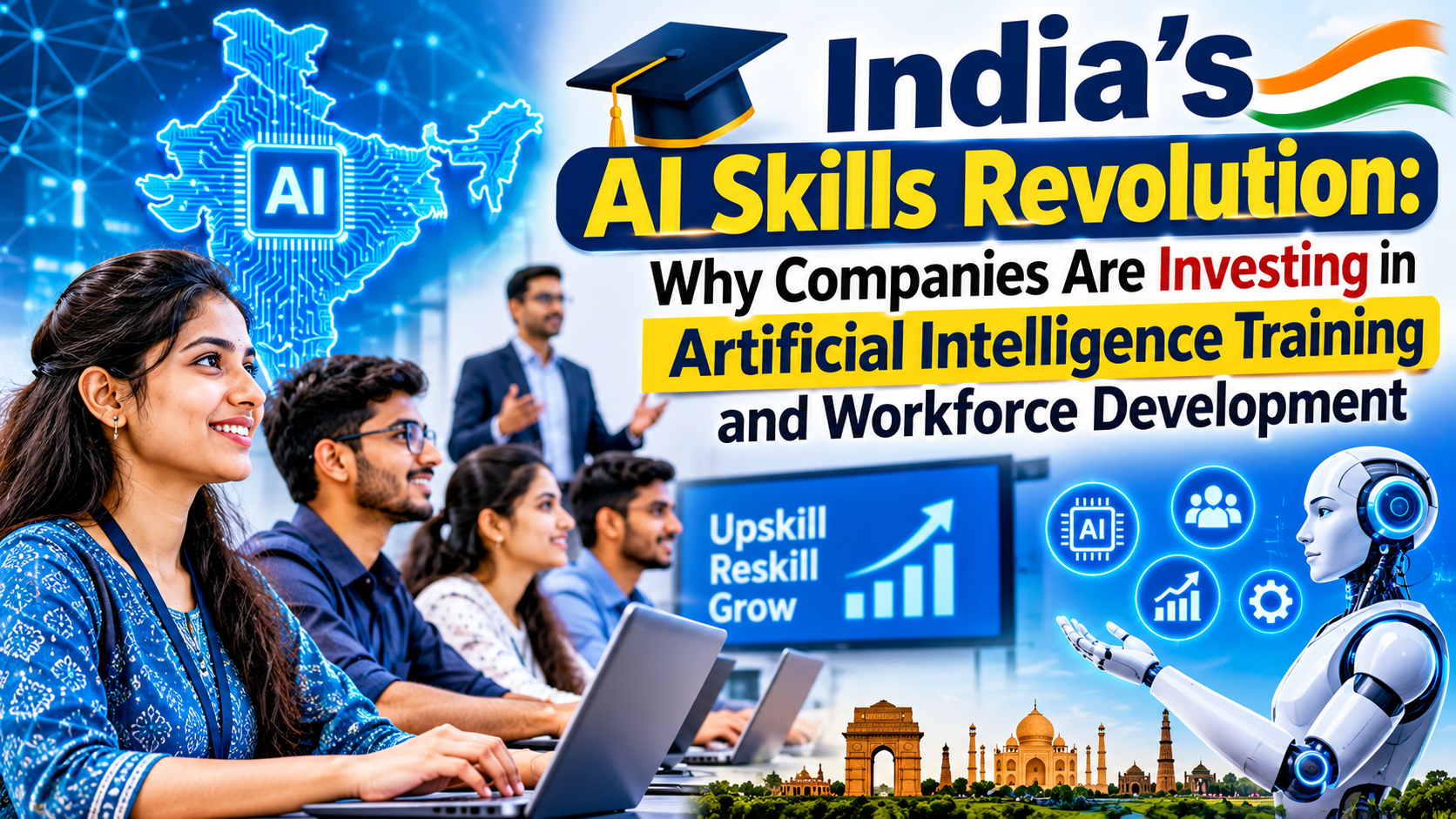
Across India, businesses are beginning to recognise that adopting AI technology is only one part of digital transformation. The real competitive advantage lies in having employees who know how to use it effectively.
From multinational corporations and IT companies to startups, banks, manufacturing businesses and digital enterprises, organisations are increasingly investing in artificial intelligence training and workforce development. Their objective is not simply to introduce new software but to prepare employees for a workplace where human intelligence and machine intelligence work together.
This emerging shift is creating a new professional landscape in India, where AI literacy, adaptability and continuous learning are becoming essential career assets.
The Shift from Hiring Talent to Building AI Skills
For years, companies primarily focused on recruiting employees with specialised technical qualifications. However, the rapid evolution of AI is changing this approach.
Businesses are increasingly exploring ways to upgrade the capabilities of their existing workforce rather than depending entirely on external recruitment.
An employee working in marketing, finance, administration, customer service or human resources may not need to become an AI engineer. However, understanding how AI tools work and how they can improve everyday responsibilities is becoming increasingly valuable.
Companies are therefore introducing internal learning programmes, practical workshops, digital certifications and AI-focused training sessions.
This approach allows employees to develop new capabilities while helping organisations build a workforce that can adapt to technological changes.
Generative AI Is Changing the Definition of Workplace Productivity
One of the biggest reasons behind the growing investment in AI training is the emergence of generative AI.
AI-powered applications can assist with content creation, research, data interpretation, software development, document preparation and customer communication.
For example, marketing teams can use AI to study consumer behaviour and generate campaign ideas. Financial professionals can use intelligent tools to organise information and support data analysis. Human resource departments can streamline certain recruitment and administrative activities.
However, using AI effectively requires more than knowing how to enter a prompt.
Employees must understand how to provide accurate instructions, evaluate generated information, identify errors and maintain confidentiality.
As a result, companies are moving towards practical AI education that focuses on real business applications rather than theoretical knowledge alone.
Why AI Training Is Becoming a Business Investment, Not an Employee Benefit
AI training is increasingly being viewed as a long-term business investment.
Organisations understand that technology delivers limited value when employees lack the skills to use it properly.
Investing in workforce development can help businesses achieve several objectives:
Higher operational efficiency: Employees can use AI to reduce repetitive tasks and concentrate on more valuable responsibilities.
Improved decision-making: AI-assisted analysis can help teams identify patterns, understand market behaviour and evaluate business information.
Faster innovation: AI-skilled employees can explore new ideas, develop solutions and improve existing business processes.
Stronger competitiveness: Organisations with digitally capable teams may respond more effectively to changing customer expectations and industry developments.
Workforce adaptability: Continuous training can help employees transition into new responsibilities as business requirements evolve.
The focus is gradually shifting from simply purchasing advanced technology to building the human capabilities needed to maximise its value.
India’s AI Talent Ecosystem Is Expanding
India has an important opportunity to become a major centre for AI talent, innovation and technology-driven services.
The country’s large graduate population, established IT industry, startup ecosystem and growing digital infrastructure provide a strong foundation for developing AI capabilities.
Government initiatives are also supporting this transformation.
The IndiaAI Mission focuses on strengthening the country’s AI ecosystem through computing infrastructure, innovation, datasets, startup development and future skills.
Meanwhile, Skill India and other digital learning initiatives are helping expand access to technology-oriented education.
Educational institutions, training organisations and private companies are also exploring partnerships to connect academic learning with practical industry requirements.
The objective is to develop talent across different skill levels, from students learning basic AI concepts to professionals specialising in machine learning, data science and advanced AI applications.
AI Is Creating New Opportunities Beyond the IT Industry
A common misconception is that artificial intelligence skills are relevant only to software developers and technology professionals.
In reality, AI adoption is creating opportunities across a wide range of industries.
Banking and finance: AI can support fraud detection, risk assessment and customer service.
Healthcare: AI-assisted systems can help analyse medical information, support research and improve administrative efficiency.
Education: Intelligent learning platforms can support personalised learning experiences and educational content development.
Manufacturing: AI applications can assist with quality inspection, equipment monitoring and production planning.
Digital media and marketing: AI can support research, content planning, audience analysis and creative workflows.
Retail and e-commerce: Businesses can use AI to analyse purchasing patterns, improve recommendations and manage customer interactions.
This expansion means that AI knowledge is becoming relevant to professionals from both technical and non-technical backgrounds.
The Rise of a New Professional: The AI-Enabled Employee
The future workplace may not be divided simply between people who understand technology and those who do not.
Instead, a growing distinction could emerge between employees who can effectively collaborate with AI and those who have limited experience with intelligent tools.
An AI-enabled employee combines professional knowledge with technological awareness.
For example, a content writer who understands AI can accelerate research while maintaining originality and editorial judgement. An accountant can use AI-assisted tools to organise financial information while retaining responsibility for verification. A business executive can use AI analytics to support strategic planning.
This combination of domain expertise, critical thinking and AI literacy could become an important advantage in the employment market.
The Skills Companies Want Their Workforce to Develop
As AI adoption increases, employers are looking beyond traditional academic qualifications and focusing on a broader combination of skills.
Some important areas include:
-
AI literacy: Understanding AI capabilities, limitations and practical applications.
-
Prompt engineering: Communicating effectively with generative AI systems.
-
Data literacy: Interpreting information and identifying meaningful insights.
-
Digital problem-solving: Using technology to address workplace challenges.
-
Cybersecurity awareness: Protecting business information and sensitive data.
-
Critical thinking: Evaluating AI-generated results before using them.
-
Communication and creativity: Combining human judgement with AI-supported productivity.
Importantly, the ability to learn continuously may become just as valuable as any individual technical qualification.
The Challenges Behind India’s AI Upskilling Movement
Despite the growing interest in AI training, developing a future-ready workforce is not without challenges.
The digital skills gap remains a concern, particularly among employees who have limited exposure to advanced technologies.
Access to quality training also differs across regions, educational backgrounds and economic conditions. Professionals in smaller cities may face additional difficulties accessing practical learning opportunities.
Another challenge is the speed of technological development. Skills that are relevant today may require updating as new AI applications and business models emerge.
Companies must also address concerns surrounding job displacement, employee privacy, algorithmic bias and responsible AI usage.
Simply introducing AI tools without providing proper training could create confusion rather than improve productivity.
Therefore, successful workforce development requires continuous learning, practical experience, responsible technology policies and equal access to skill-building opportunities.
The Future of Work: Human Intelligence and Artificial Intelligence Together
The future of India’s workforce will not depend on technology alone. It will depend on how effectively people and intelligent systems collaborate.
AI can process information, identify patterns and automate selected activities. Human professionals contribute creativity, empathy, ethical judgement, communication and strategic understanding.
These capabilities are complementary rather than interchangeable.
Companies that invest in both technological infrastructure and employee development may be better positioned to create sustainable business growth.
In the coming years, AI training could become an integral part of corporate learning strategies, professional development programmes and educational curricula.
For young graduates and working professionals, developing AI skills today could open doors to emerging career opportunities across multiple industries.
Conclusion: India’s Biggest AI Advantage Could Be Its People
India’s AI skills revolution represents a significant shift in the relationship between technology, employment and business growth.
As organisations accelerate AI adoption, investing in employee training is becoming an important part of their long-term strategies. The ability to understand, apply and responsibly manage artificial intelligence will increasingly influence workplace productivity and professional development.
However, the real opportunity extends beyond creating more AI specialists. It lies in preparing employees from different professions and industries to use intelligent technologies with confidence and responsibility.
India’s future competitiveness will not be measured only by the number of AI platforms it develops or companies it attracts. It will also depend on how effectively it empowers its people to participate in the AI-driven economy.