


The apparel manufacturing industry has always been shaped by innovation. From hand stitching and traditional tailoring to electrically operated sewing machines and computerised production systems, every technological advancement has changed the way garments are produced. What once required hours of manual effort can now be completed with greater speed, precision, and consistency.
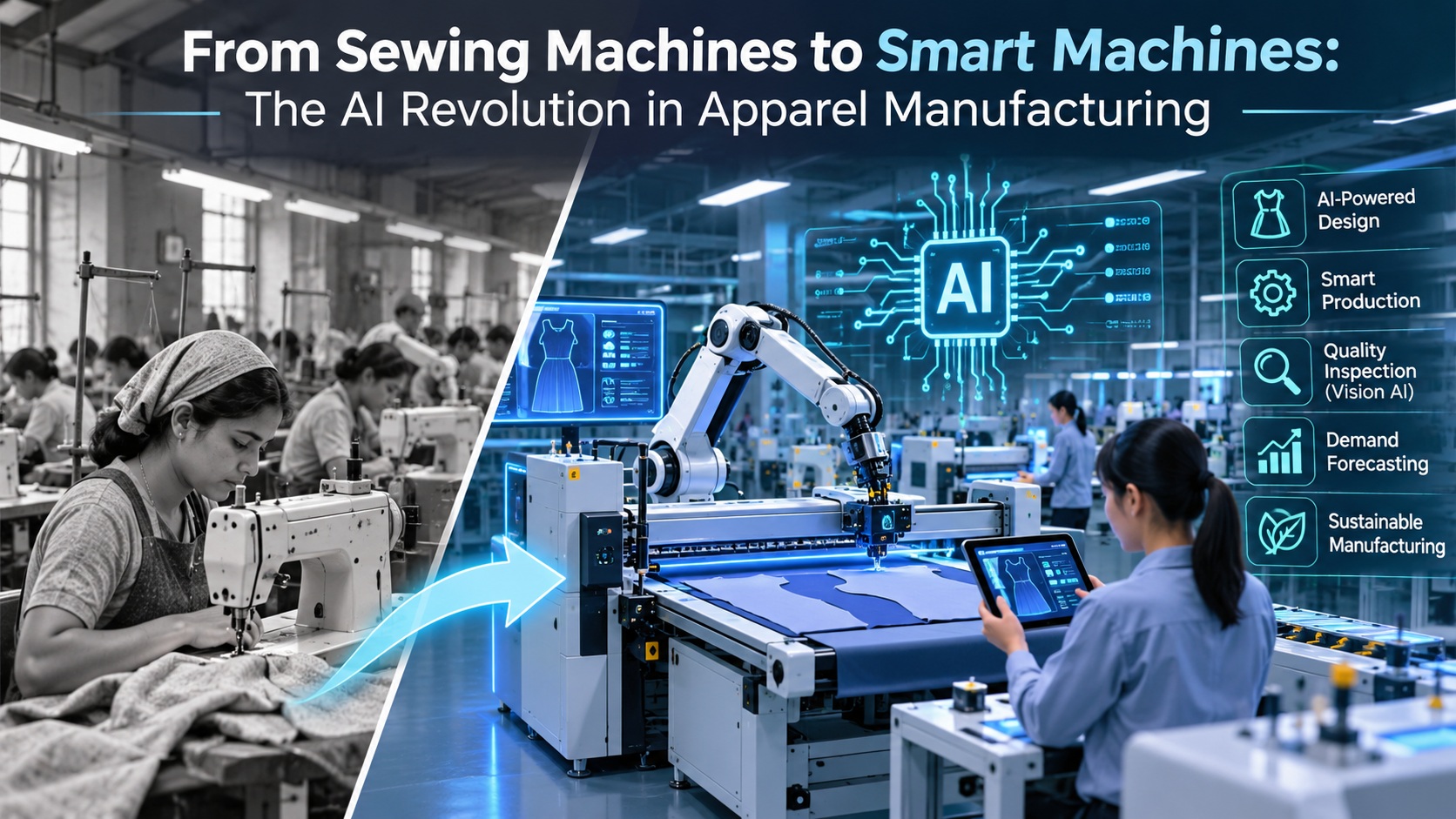
Today, the industry is experiencing another significant transformation: the integration of Artificial Intelligence (AI) into apparel manufacturing.
Unlike earlier technological developments, which primarily focused on increasing machine speed and reducing manual labour, AI introduces a new dimension to production. It enables machines and software systems to analyse information, recognise patterns, predict problems, and support decision-making.
From intelligent fabric inspection and automated cutting to virtual garment development and predictive maintenance, AI is gradually transforming every stage of the apparel production process.
This transformation is not simply about replacing traditional sewing machines with advanced equipment. It is about developing a manufacturing environment where machines, data, technology, and human expertise work together.
From Traditional Manufacturing to Smart Manufacturing
The history of apparel manufacturing reflects the continuous relationship between human creativity and technological progress.
Initially, garment production depended entirely on skilled workers who performed cutting, stitching, finishing, and quality inspection manually. The introduction of industrial sewing machines increased production capacity and established the foundation of modern garment factories.
Later, computer-aided design (CAD), computer-aided manufacturing (CAM), automated fabric spreading, and computerised embroidery introduced greater accuracy and efficiency.
However, these technologies mainly operated according to predefined instructions.
Artificial Intelligence represents a different stage of development. It allows systems to process production data, identify unusual patterns, learn from previous results, and assist in making decisions.
The Evolution of Apparel Manufacturing: From Manual Skills to Intelligent Production
The evolution of apparel manufacturing reflects the continuous advancement of technology, from traditional craftsmanship to intelligent, data-driven production systems. This transformation can be broadly classified into five major stages:
1. Manual Manufacturing: The earliest stage, characterised by hand-operated tools and processes that relied heavily on human skills, craftsmanship, and physical effort.
2. Mechanised Manufacturing: The introduction of industrial sewing machines and powered equipment improved production speed, reduced manual effort, and increased manufacturing capacity.
3. Computerised Manufacturing: The adoption of Computer-Aided Design (CAD), Computer-Aided Manufacturing (CAM), and digital pattern-making systems brought greater accuracy, consistency, and efficiency to garment development.
4. Automated Manufacturing: The integration of automatic fabric spreading, computerised cutting, specialised sewing equipment, and advanced production systems minimised repetitive manual operations and streamlined manufacturing processes.
5. Intelligent Manufacturing: The latest stage combines Artificial Intelligence (AI), machine learning, robotics, smart sensors, and interconnected digital systems to enable real-time monitoring, predictive analysis, intelligent decision-making, and continuous process improvement.
The transition from traditional to intelligent manufacturing represents a fundamental change in how apparel factories operate.
Intelligent Fabric Inspection: Giving Machines the Power of Vision
Fabric inspection is one of the most important activities in garment manufacturing because the quality of the finished garment depends significantly on the quality of the raw material.
Traditionally, fabric inspectors identify defects through visual examination. Common defects include holes, stains, broken yarns, slubs, shade variations, weaving faults, and irregular surface structures.
Although experienced inspectors play an essential role, manual inspection can be affected by fatigue, lighting conditions, and human limitations.
AI-powered fabric inspection systems are introducing a more advanced approach.
These systems use high-resolution cameras, image processing, and machine-learning algorithms to examine fabric surfaces. The collected images are analysed to identify defects and classify their types.
For example, an intelligent inspection system can distinguish between a minor surface irregularity and a significant fabric defect, helping quality-control teams make more informed decisions.
The major advantages include:
-
Improved inspection consistency.
-
Faster identification of fabric defects.
-
Reduced dependence on repetitive manual inspection.
-
Better control over fabric quality.
-
Reduced material wastage.
More importantly, accumulated inspection data can help manufacturers identify recurring quality problems and improve relationships with fabric suppliers.
AI is therefore transforming fabric inspection from a simple checking activity into a data-driven quality management process.
Smart Cutting Technology: Maximising Every Inch of Fabric
1. Fabric Cost: Fabric is one of the largest cost components in garment manufacturing, making efficient fabric utilisation essential for controlling production expenses.
2. Cost Savings: Even a small improvement in material utilisation can generate significant savings, particularly in high-volume production.
3. Traditional Cutting Process: The conventional cutting process involves four main stages: pattern preparation, marker making, fabric spreading, and cutting.
4. Role of AI: Although computerised marker-making systems have improved operational efficiency, Artificial Intelligence (AI) offers further opportunities to optimise the cutting process.
5. AI-Assisted Marker Planning: AI-based marker planning and fabric-nesting systems analyse pattern shapes, fabric width, order quantities, and material requirements to determine the most efficient arrangement of garment components.
Robotic Sewing: The Next Challenge in Apparel Automation
Sewing remains one of the most difficult operations to automate in garment manufacturing.
Unlike rigid industrial materials, fabric is flexible and continuously changes shape during handling. It can stretch, wrinkle, fold, and shift, making precise manipulation challenging for robotic systems.
However, advancements in robotics, computer vision, sensors, and artificial intelligence are creating new opportunities for automated sewing.
Modern specialised systems can support repetitive operations such as fabric positioning, seam guidance, pocket attachment, label placement, and stitching control.
AI-based vision systems can also help detect alignment problems and monitor stitching consistency.
Nevertheless, fully automated garment assembly remains a technical challenge, particularly for garments involving complex shapes, multiple fabric layers, and different material properties.
This means that the immediate future of robotic sewing is likely to involve specialised automation rather than the complete replacement of human sewing operators.
The most effective production model may be one in which machines handle repetitive and precision-based operations while skilled workers manage complex stitching, adjustments, and quality decisions.
AI in Fashion Design and Product Development
Artificial Intelligence is not limited to the production floor. It is also transforming the creative and developmental stages of the apparel industry.
Traditionally, product development involves sketching, fabric selection, pattern development, sample preparation, fitting, and multiple rounds of corrections.
This process can be time-consuming and expensive, particularly when brands develop several design variations before final approval.
AI-powered design tools can analyse fashion trends, colour preferences, customer behaviour, and historical sales information to support designers in developing new concepts.
Generative AI can assist in creating design variations, experimenting with prints, exploring colour combinations, and visualising garment concepts.
Another important development is 3D garment simulation.
Digital garment software allows designers and technical teams to visualise garment construction, drape, and fit on virtual models. This can reduce the need for repeated physical samples during the development process.
The benefits include:
-
Faster product development.
-
Reduced sample-making costs.
-
Improved design communication.
-
Greater design experimentation.
-
Reduced material consumption during sampling.
However, technology cannot replace the creative understanding of designers. Fashion requires cultural awareness, emotional expression, aesthetic judgement, and an understanding of human preferences.
AI can generate possibilities, but human creativity gives fashion its identity.
Predictive Maintenance: Machines That Identify Problems Before Failure
Machine breakdowns are a major concern in apparel manufacturing because even a short interruption can affect production targets and delivery schedules.
Traditionally, maintenance activities are performed after a machine develops a fault or according to a predetermined maintenance schedule.
Predictive maintenance introduces a more intelligent approach.
Sensors installed in manufacturing equipment collect operational information such as temperature, vibration, motor performance, operating hours, and machine speed.
AI algorithms analyse this information to identify unusual patterns that may indicate developing mechanical problems.
For example, an abnormal increase in the vibration of a sewing machine motor may indicate a developing mechanical issue. An intelligent monitoring system can alert the maintenance team so that the machine can be inspected before a major breakdown occurs.
This approach can help manufacturers:
-
Reduce unexpected downtime.
-
Improve machine reliability.
-
Extend equipment lifespan.
-
Plan maintenance activities effectively.
-
Reduce repair and replacement costs.
Predictive maintenance changes the role of maintenance teams from reactive problem-solvers to proactive equipment managers.
AI-Driven Production Planning: Making Manufacturing More Intelligent
Production planning is a complex process involving order allocation, line capacity, machine availability, workforce distribution, material requirements, and delivery commitments.
In conventional garment factories, many planning decisions depend on manual calculations, spreadsheets, and the experience of production managers.
AI-based production planning systems can analyse historical and real-time production data to support better operational decisions.
For example, if a particular production line is consistently falling behind its target, an intelligent system can help identify possible reasons, such as operation bottlenecks, machine downtime, or uneven workload distribution.
AI can also support:
Line balancing: Identifying workload differences between operations and helping improve production flow.
Demand forecasting: Analysing historical orders and market trends to estimate future requirements.
Inventory management: Supporting better control of raw materials and finished goods.
Workforce planning: Helping managers allocate available workers according to production requirements and skill levels.
Delivery management: Identifying possible delays and supporting corrective planning.
The objective is to create a manufacturing environment where decisions are supported by accurate information rather than depending entirely on assumptions or manual calculations.
Sustainable Manufacturing: Can AI Make Fashion Greener?
Sustainability has become one of the most important concerns in the global apparel industry.
The manufacturing process consumes significant quantities of fabric, water, energy, chemicals, and other resources. At the same time, overproduction, cutting waste, rejected garments, and textile disposal create environmental challenges.
AI can support sustainability by improving resource management across the production process.
One important application is intelligent fabric utilisation. Optimised cutting layouts can reduce leftover fabric and minimise material waste.
Another application is demand forecasting. By analysing sales patterns and customer preferences, AI systems can help manufacturers make more informed production decisions and reduce the risk of unnecessary inventory.
Smart monitoring systems can also identify inefficient energy consumption and help factories optimise equipment usage.
In addition, AI-assisted quality inspection can identify defects earlier, reducing the need for repeated processing and unnecessary material consumption.
The connection between AI and sustainability can be understood through four important areas:
-
Material efficiency: Reducing fabric waste through intelligent cutting.
-
Energy efficiency: Monitoring and optimising machine performance.
-
Production efficiency: Reducing unnecessary processing and overproduction.
-
Resource recovery: Supporting textile sorting and recycling operations.
However, technology alone cannot guarantee sustainable manufacturing. Responsible sourcing, environmental management, worker welfare, and effective business practices remain equally important.
The Changing Role of Garment Workers in the Age of AI
One of the most important questions surrounding the AI revolution is its impact on employment.
The apparel industry is labour-intensive and provides employment to millions of people worldwide. As automation becomes more advanced, certain repetitive activities may require less manual intervention.
However, this transformation also creates opportunities for new skills and professional roles.
Future apparel manufacturing may require employees who understand both garment production and digital technologies.
For example, traditional sewing operators may receive training in automated machine operation, while quality inspectors may learn to work with AI-powered inspection systems.
Similarly, production supervisors may increasingly use digital dashboards and data analytics to monitor factory performance.
Some emerging skill areas include:
-
Digital pattern development.
-
Computer-aided manufacturing.
-
Automated machine operation.
-
AI-assisted quality inspection.
-
Robotics and equipment maintenance.
-
Production data analysis.
-
Smart factory management.
This makes workforce development essential.
The real challenge is not simply introducing advanced machines but ensuring that workers receive the training and opportunities needed to adapt to changing manufacturing environments.
The future of apparel manufacturing should not be a competition between humans and machines. It should be a collaboration in which technology strengthens human capabilities.
Challenges in Adopting AI in the Apparel Industry
Although AI offers significant advantages, its implementation requires careful planning.
Several challenges can influence the adoption of intelligent manufacturing systems.
High initial investment: Advanced machinery, sensors, software, and infrastructure may require substantial capital.
Lack of technical expertise: Employees and managers may need specialised training to understand and operate AI-based systems.
Integration difficulties: Existing manufacturing equipment may not easily connect with modern digital technologies.
Data limitations: AI systems depend on reliable data. Inaccurate or incomplete information can affect the quality of their predictions.
Fabric complexity: Variations in fabric thickness, elasticity, texture, and construction make complete automation difficult.
Cybersecurity concerns: Connected production systems require proper protection against data breaches and digital threats.
For small and medium-sized apparel manufacturers, adopting AI gradually may be a more practical approach.
Instead of transforming the entire factory at once, businesses can begin with specific applications such as digital production monitoring, automated fabric inspection, or predictive maintenance.
The Future of Apparel Manufacturing: Towards Industry 5.0
The next stage of apparel manufacturing is expected to involve greater integration of AI, robotics, the Internet of Things (IoT), digital twins, and advanced data analytics.
While Industry 4.0 focuses strongly on connectivity, automation, and smart manufacturing, Industry 5.0 places greater emphasis on human-centric technology, sustainability, and resilience.
This concept is particularly relevant to the apparel industry because garment manufacturing requires both technical precision and human creativity.
Some developments that may shape the future include:
Digital twins: Virtual representations of manufacturing processes that allow factories to simulate operations and identify potential improvements.
Mass customisation: Intelligent production systems that support personalised garments and smaller production batches.
Connected machines: Equipment that communicates operational information through industrial IoT networks.
Advanced robotics: More capable automated systems for fabric handling, material positioning, and specialised sewing operations.
Intelligent supply chains: AI-based systems that support demand prediction, inventory management, and supplier coordination.
Human-machine collaboration: Production environments in which workers and intelligent systems perform complementary tasks.
The future factory will not simply focus on producing more garments in less time. It will aim to produce the right garments, with better quality, fewer resources, and greater flexibility.
Conclusion: The Future Is Not Just Automated, It Is Intelligent
The journey from sewing machines to smart machines represents a major turning point in apparel manufacturing. Artificial Intelligence is transforming traditional production methods by introducing intelligence into design, fabric inspection, cutting, sewing, maintenance, quality control, and production planning.
However, the true value of this revolution lies beyond machine speed and automation. It lies in the ability to make manufacturing more predictive, adaptable, resource-efficient, and responsive to changing market demands.
The transition will not happen overnight, and not every manufacturing operation can be fully automated. Human expertise will remain essential, particularly in areas requiring creativity, complex garment construction, technical judgement, and problem-solving.
For apparel manufacturers, the challenge is to embrace technological innovation while investing in people, skills, and sustainable practices.
The sewing machine once revolutionised how garments were stitched. Artificial Intelligence is now revolutionising how the entire garment industry operates.