


Agriculture is one of the most important sectors in the world, providing food, employment, and raw materials for millions of people. However, modern agriculture faces several challenges, including climate change, unpredictable weather conditions, water scarcity, soil degradation, pest attacks, and increasing food demand. Traditional farming methods alone are becoming less effective in addressing these challenges.
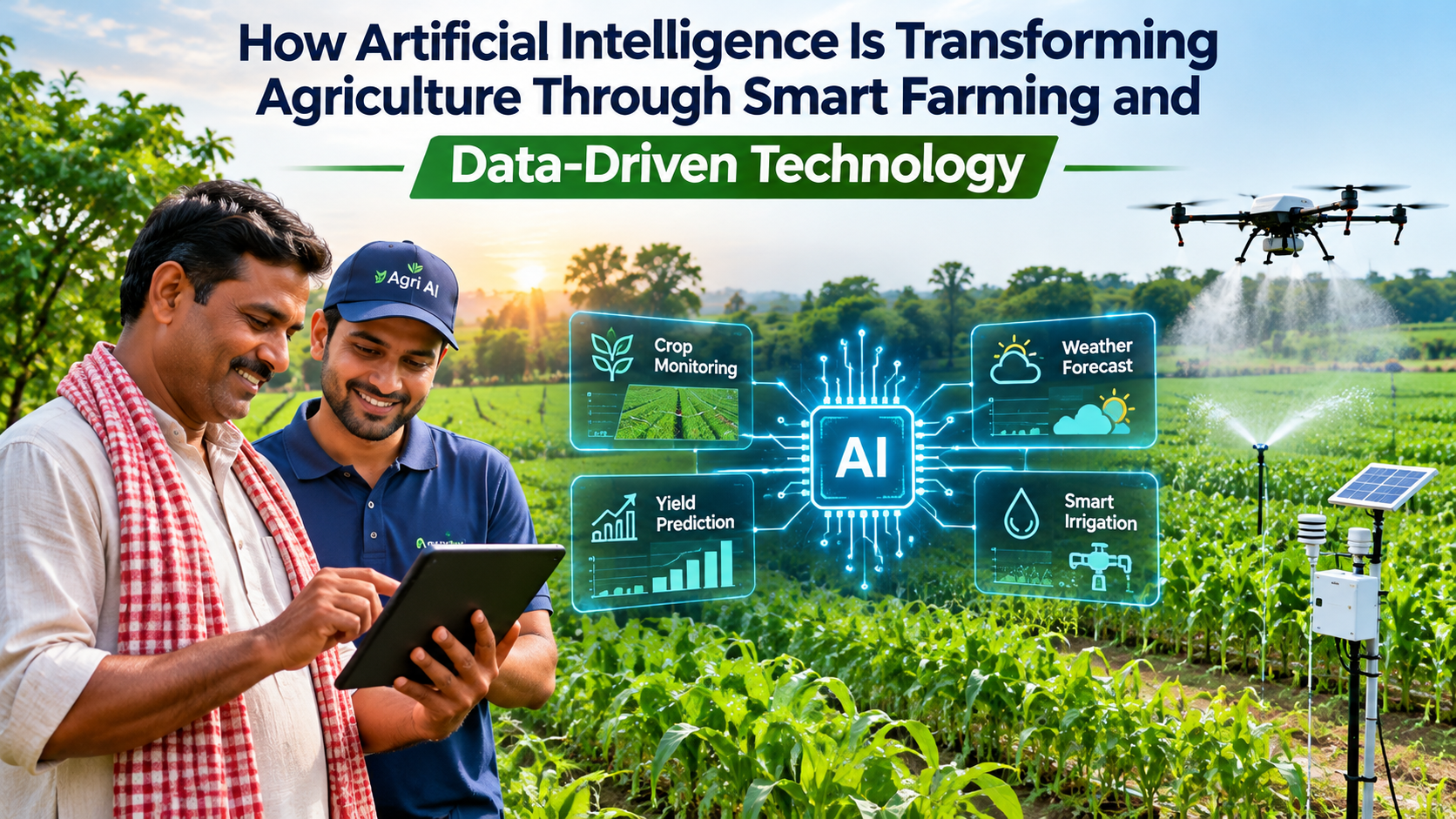
Artificial Intelligence (AI) is emerging as a powerful technology that is transforming the agricultural sector. By combining AI with smart farming techniques, sensors, drones, robotics, and data-driven technologies, farmers can make better decisions, improve productivity, reduce costs, and use natural resources more efficiently. This technological transformation is helping agriculture become smarter, more sustainable, and more productive.
Understanding Artificial Intelligence in Agriculture
Artificial Intelligence refers to the ability of computer systems and machines to perform tasks that normally require human intelligence, such as learning, problem-solving, decision-making, and analysing information.
In agriculture, AI uses data collected from farms, weather stations, satellites, sensors, and other digital devices to provide useful insights to farmers. These insights help farmers understand crop conditions, predict agricultural problems, and take timely action.
For example, AI-powered applications can analyse soil conditions, recommend suitable crops, detect plant diseases, and predict the amount of water required for irrigation. This allows farmers to move from traditional experience-based farming towards more accurate and data-driven farming practices.
Smart Farming: A New Era of Agriculture
Smart farming, also known as precision agriculture, is a modern approach that uses advanced technologies to improve farming operations. It combines AI, the Internet of Things (IoT), GPS, drones, robotics, and data analytics to monitor and manage agricultural activities.
Some important applications of smart farming include:
A. Smart Irrigation Systems
Water is an essential resource for agriculture, but excessive irrigation can lead to water wastage and soil damage. AI-powered irrigation systems use soil moisture sensors and weather forecasts to determine when and how much water crops need.
These systems automatically adjust irrigation according to crop requirements, helping farmers conserve water and reduce costs.
B. Drone Technology
Agricultural drones are used to monitor large farming areas, capture aerial images, and identify problems in crop fields. AI analyses these images to detect unhealthy plants, pest attacks, nutrient deficiencies, and irrigation problems.
Drones can also be used for spraying fertilisers and pesticides in specific areas, reducing unnecessary chemical usage.
C. AI-Based Crop Monitoring
AI-powered systems continuously monitor crop growth and health. By analysing images and sensor data, these systems can identify early signs of diseases and other crop-related problems.
Early detection allows farmers to take preventive measures before the problem spreads across the entire field.
Role of Data-Driven Technology in Agriculture
Data is one of the most valuable resources in modern agriculture. Farmers can collect large amounts of information through sensors, satellites, weather stations, drones, and agricultural machines.
AI processes this information and converts it into meaningful insights that support better agricultural decisions.
Important applications of data-driven technology include:
A. Weather Forecasting and Prediction
AI analyses historical weather information and real-time climate data to predict rainfall, temperature changes, droughts, and other weather conditions.
These predictions help farmers decide when to sow seeds, irrigate fields, and harvest crops. Accurate weather information can reduce the risk of crop losses caused by unexpected climate conditions.
B. Soil Health Analysis
Soil quality plays an important role in crop production. AI-powered soil monitoring systems analyse soil moisture, temperature, pH levels, and nutrient content.
Based on this information, farmers can select suitable crops and apply the correct amount of fertilisers. This improves soil health and prevents unnecessary chemical use.
C. Crop Yield Prediction
AI algorithms analyse factors such as soil conditions, weather patterns, crop varieties, and historical production data to estimate future crop yields.
Yield prediction helps farmers plan harvesting, storage, transportation, and marketing activities more effectively.
AI in Pest and Disease Detection
Pests and plant diseases are major causes of agricultural losses. Traditionally, farmers identify diseases through visual observation, which can sometimes result in delayed treatment.
AI-based image recognition technology makes disease detection faster and more accurate. Farmers can take pictures of affected plants using smartphones or cameras, and AI applications analyse the images to identify possible diseases.
These systems can also recommend suitable preventive measures and treatments.
The major benefits include:
-
Early detection of plant diseases.
-
Reduced crop damage and production losses.
-
Better pest management.
-
Reduced unnecessary pesticide application.
-
Improved crop quality and productivity.
Thus, AI helps farmers protect crops and maintain healthier agricultural production.
Robotics and Automation in Agriculture
Agricultural robots are increasingly being developed to perform tasks that traditionally require significant human labour.
AI-powered robots can assist with:
-
Automatic seed planting.
-
Weed identification and removal.
-
Fruit and vegetable harvesting.
-
Fertiliser and pesticide application.
-
Monitoring crop growth.
-
Sorting and grading agricultural products.
Automation can reduce labour-intensive activities, improve efficiency, and save time. It is particularly useful for large farms where managing extensive agricultural operations manually can be difficult.
Benefits of Artificial Intelligence in Agriculture
The integration of AI into agriculture provides several important advantages.
1. Increased Productivity: AI helps farmers identify the best farming practices, monitor crops, and improve agricultural output.
2. Reduced Operational Costs: Smart machines and automated systems reduce unnecessary labour, fertiliser, pesticide, and water expenses.
3. Efficient Resource Management: AI supports the efficient use of water, land, seeds, and other agricultural resources.
4. Better Decision-Making: Data-driven insights help farmers make informed decisions about planting, irrigation, harvesting, and crop management.
5. Sustainable Agriculture: Precision farming reduces excessive chemical use and supports environmentally friendly agricultural practices.
6. Climate Resilience: AI-based weather forecasting and crop analysis help farmers prepare for changing climatic conditions.
Challenges of Using AI in Agriculture
Although AI offers many opportunities, its adoption in agriculture also faces certain challenges.
A. High Initial Investment
Purchasing drones, sensors, automated machinery, and AI-based systems can be expensive, particularly for small and marginal farmers.
B. Lack of Technical Knowledge
Many farmers may not have sufficient digital skills or training to operate advanced agricultural technologies.
C. Internet Connectivity
Smart farming often requires reliable internet connectivity. However, many rural areas still experience poor network coverage and limited digital infrastructure.
D. Data Privacy and Security
Digital farming systems collect large amounts of agricultural and farm-related information. Protecting this data from misuse and unauthorised access is important.
E. Dependence on Technology
Technical failures, software errors, and equipment breakdowns can affect farming operations. Therefore, farmers need proper technical support and maintenance facilities.
Addressing these challenges through government support, affordable technology, digital education, and rural infrastructure development is essential for successful AI adoption.
Future of AI in Indian Agriculture
India is an agricultural country where millions of people depend on farming for their livelihoods. AI has significant potential to improve Indian agriculture, especially by supporting small and marginal farmers.
Technologies such as AI-based crop advisory systems, satellite monitoring, smart irrigation, and digital agricultural platforms can help farmers improve productivity and manage risks.
Government initiatives such as the Digital Agriculture Mission aim to strengthen digital infrastructure and promote technology-based agricultural services.
In the coming years, AI may support farmers through regional-language mobile applications, personalised crop recommendations, automated farm equipment, and improved market information.
The integration of AI with traditional agricultural knowledge can help India build a more productive, resilient, and sustainable agricultural system.
Conclusion
Artificial Intelligence is transforming agriculture by introducing smart farming practices and data-driven technologies. From smart irrigation and drone-based monitoring to disease detection, crop prediction, and agricultural robotics, AI is helping farmers improve efficiency and make better decisions.
Although challenges such as high costs, limited digital literacy, and poor internet connectivity remain, the future of AI in agriculture is promising. With proper training, government support, affordable technologies, and improved digital infrastructure, AI can make modern farming more accessible to farmers.
Ultimately, the combination of Artificial Intelligence, human knowledge, and sustainable farming practices can play a significant role in ensuring food security, increasing farmers’ income, conserving natural resources, and building a smarter agricultural future.