


Artificial Intelligence (AI) is transforming the education sector by making learning more personalized, interactive, flexible, and accessible. By 2027, AI-powered tutors, smart classrooms, personalized learning platforms, and automated assessment systems are expected to play an important role in education. These technologies help students understand difficult concepts, improve academic performance, and receive instant feedback. Teachers can also use AI tools to prepare lessons, create study materials, evaluate assignments, and monitor students’ progress.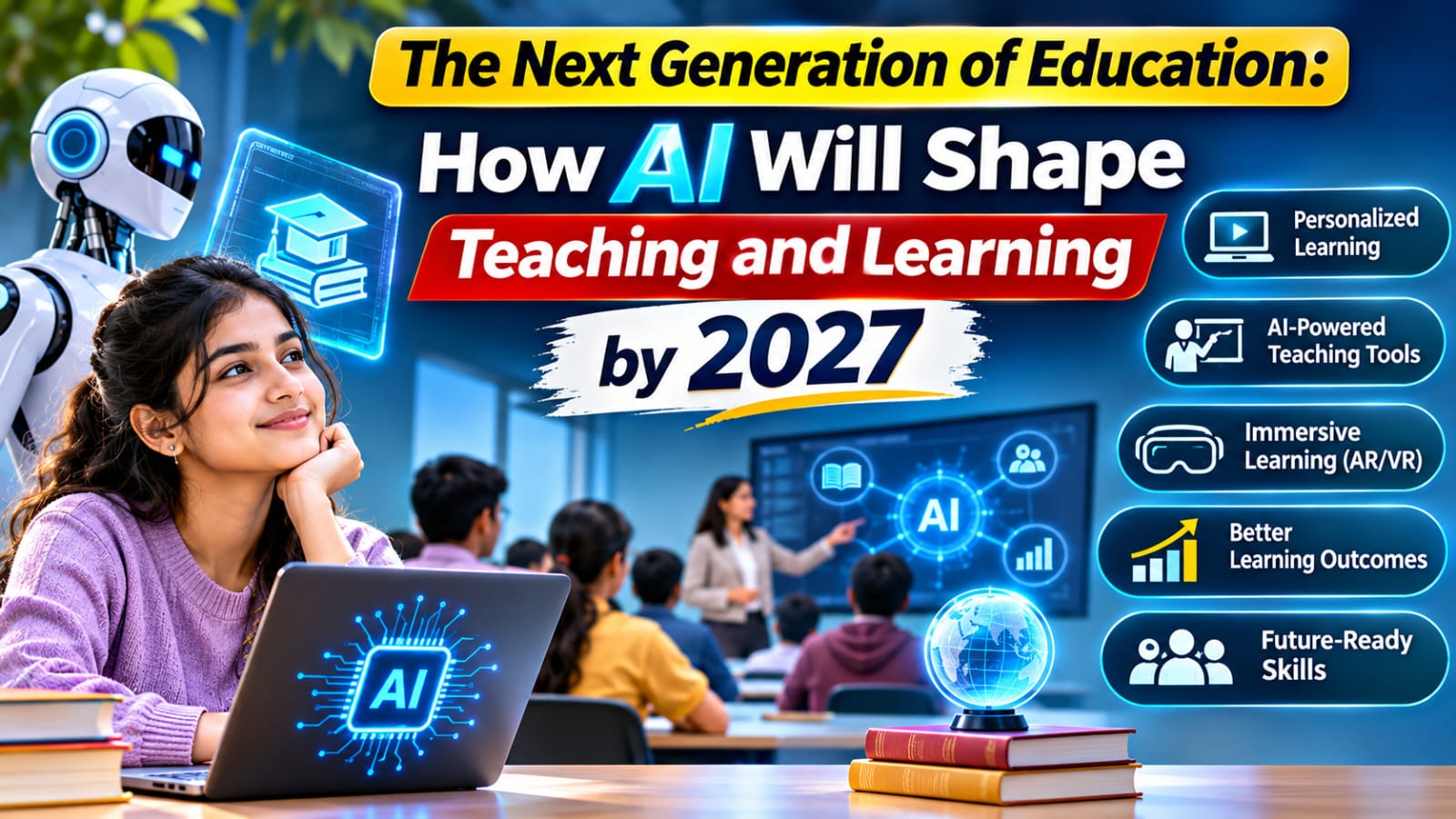
However, the increasing use of AI in education also creates challenges related to data privacy, academic dishonesty, digital inequality, and overdependence on technology. It is important to use AI responsibly while maintaining the importance of human teachers. Overall, Artificial Intelligence will play a significant role in shaping the future of education by 2027, making learning more innovative, efficient, inclusive, and student-centered.
The Next Generation of Education
Education is entering a new era where technology is reshaping the way knowledge is shared, understood, and applied. The integration of Artificial Intelligence (AI), digital learning platforms, smart classrooms, and virtual learning environments is creating new possibilities for students and educators. By 2027, learning is expected to become more personalized and interactive, allowing students to explore subjects according to their interests, abilities, and learning speed. AI-based tools will provide instant academic assistance, simplify complex topics, and help learners gain access to quality educational resources beyond traditional classrooms.
In this evolving educational landscape, the focus will shift from simply memorizing information to developing knowledge, creativity, innovation, and practical skills. Teachers will take on a more supportive role by guiding students, encouraging independent thinking, and connecting theoretical knowledge with real-world experiences. Although the adoption of AI brings challenges related to privacy, equal access, and responsible technology use, its potential to improve education is significant. Ultimately, the future of learning will be shaped by a balanced combination of human guidance and intelligent technology, making education more meaningful, inclusive, and future-ready.
1. Personalized Learning Through Artificial Intelligence
One of the most significant benefits of AI in education is personalized learning. Every student has different learning abilities, interests, strengths, and weaknesses. Traditional classrooms often follow a common teaching pace, making it difficult to address every student’s individual requirements.
AI-powered learning platforms can analyze students’ academic performance, identify learning gaps, and recommend suitable educational materials. For example, students who struggle with mathematics can receive additional exercises, explanations, and practice questions, while advanced learners can explore more challenging topics.
This approach allows students to learn at their own pace and develop a stronger understanding of different subjects. By 2027, adaptive learning technologies may become increasingly integrated into digital classrooms, supporting more student-centred educational experiences.
2. AI-Powered Tutors and Virtual Learning Assistants
AI-powered tutors are changing how students access academic support. These intelligent systems can explain difficult concepts, answer questions, generate practice exercises, and provide immediate feedback.
Students can use AI assistants to prepare for examinations, improve their writing skills, understand scientific concepts, and explore new subjects. Unlike traditional tutoring, AI-powered applications can provide assistance beyond regular classroom hours.
Virtual learning assistants can also help students organize study schedules, summarize educational materials, and identify areas that require improvement.
By 2027, advances in generative AI may make virtual tutoring systems more interactive and responsive to individual learning needs. However, these systems should complement classroom teaching rather than replace qualified educators.
3. The Changing Role of Teachers in the AI Era
Artificial Intelligence is gradually transforming the responsibilities of teachers. In traditional education, teachers primarily deliver information and guide students through textbooks and classroom activities. With AI-powered learning tools becoming more accessible, students can independently explore educational information and receive additional academic assistance.
Consequently, the role of teachers is increasingly shifting towards mentoring, guiding, facilitating, and supporting students.
Teachers can use AI applications to prepare lesson plans, create quizzes, develop presentations, and analyze assessment results. This can reduce routine administrative work and provide more time for meaningful classroom interaction.
However, teaching involves empathy, motivation, creativity, emotional support, and ethical guidance. These human qualities remain essential to student development.
The future of education will therefore depend on collaboration between teachers and AI rather than the replacement of human educators.
4. Smart Classrooms and Digital Learning Environments
Smart classrooms are becoming an important part of modern educational development. These learning environments combine artificial intelligence with interactive displays, digital learning platforms, multimedia resources, and connected devices.
AI-powered classroom applications can help teachers evaluate student understanding, identify learning difficulties, and recommend additional learning activities.
Virtual reality (VR) and augmented reality (AR) can further improve classroom experiences by allowing students to explore scientific models, historical environments, and complex concepts through interactive simulations.
Such technologies can make learning more engaging and practical. By 2027, smart classrooms may become more advanced as educational institutions continue integrating AI into their teaching infrastructure.
5. Generative AI and the Future of Academic Learning
Generative AI is one of the most influential developments in educational technology. These tools can generate text, summaries, explanations, presentations, quizzes, and other educational resources.
Students can use generative AI to brainstorm ideas, understand complex topics, organize research, and improve their writing. Teachers can use these applications to develop lesson plans, prepare assignments, and create customized educational materials.
For example, an AI tool can explain a difficult scientific concept in simpler language or generate practice questions for examination preparation.
However, students must understand that AI-generated information is not always accurate. They should verify important information using textbooks, teachers, and reliable academic sources.
Responsible use of generative AI can encourage independent learning while maintaining academic honesty.
6. Inclusive Education and Greater Accessibility
AI has the potential to make education more inclusive by reducing barriers faced by students with different learning requirements.
Speech-to-text applications, text-to-speech systems, real-time translation, and automated captioning can support students with disabilities and multilingual learners.
These technologies can make educational materials easier to understand and improve classroom participation.
AI-powered digital learning platforms can also provide educational resources to students in remote areas who have limited access to traditional educational facilities.
However, achieving inclusive education requires affordable digital devices, reliable internet connectivity, accessible learning materials, and appropriate institutional support.
7. Challenges of Artificial Intelligence in Education
Although AI offers many educational benefits, its implementation also creates several challenges.
Data Privacy and Security: AI platforms may collect personal information, academic records, and student learning behaviour. Educational institutions must protect student data and establish responsible information-management policies.
Academic Integrity: Excessive dependence on AI-generated assignments and answers can reduce independent thinking and create concerns about plagiarism and originality.
Accuracy and Reliability: AI systems may sometimes generate incorrect or misleading information. Students must learn to evaluate and verify AI-generated responses.
Digital Inequality: Students from economically disadvantaged backgrounds may have limited access to digital devices, reliable internet connections, and advanced educational technologies.
Overdependence on Technology: Excessive use of AI may reduce opportunities for critical thinking, creativity, independent problem-solving, and direct human interaction.
Addressing these challenges requires clear educational policies, digital literacy programmes, responsible AI practices, and continuous teacher training.
8. Preparing Students for the Future of Education
As AI becomes more important in education and employment, students will need new skills to succeed in a technology-driven world.
Critical thinking, creativity, communication, collaboration, digital literacy, and problem-solving will remain essential abilities.
AI literacy will also become increasingly important. Students should understand how artificial intelligence works, recognize its limitations, identify potential biases, and use AI tools ethically.
Educational institutions should integrate these skills into their curricula to prepare learners for changing academic and professional environments.
By 2027, the ability to work effectively with AI may become an important advantage for students entering higher education and the workforce.
Conclusion
The next generation of education will be significantly influenced by artificial intelligence. Personalized learning, AI-powered tutors, smart classrooms, generative AI, and accessible digital platforms are creating new opportunities to improve teaching and learning.
By 2027, AI is expected to become an increasingly important educational tool, helping students learn more flexibly and supporting teachers in delivering effective instruction.
However, technological development must be accompanied by responsible implementation, data protection, academic integrity, and equal access to educational opportunities.
Ultimately, artificial intelligence should strengthen rather than replace human teaching. A balanced combination of AI technology and human guidance can create a more personalized, inclusive, interactive, and future-ready education system.