


Berhampur, Oct 21: Odisha is set to strengthen its marine conservation efforts with plans to establish an international research centre dedicated to Olive Ridley sea turtles at Berhampur University in Ganjam district. The proposed facility aims to deepen scientific understanding of the endangered marine species, with a focus on migration routes, breeding behaviour, mass nesting and habitat protection.
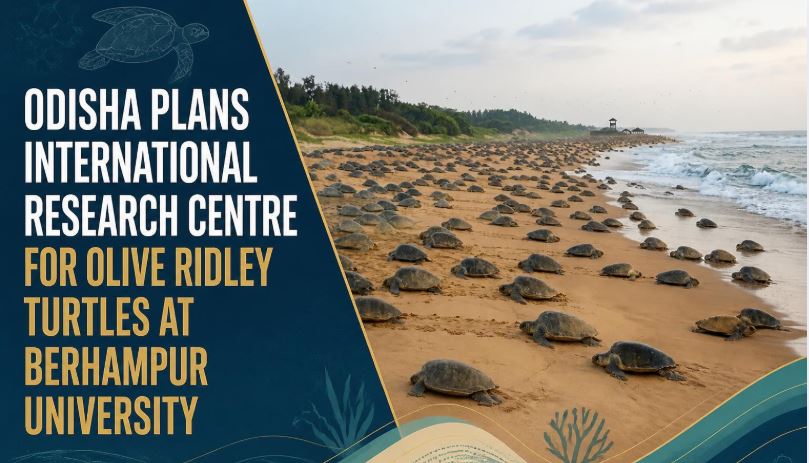
Representational Image
The initiative brings together the Forest Department, Berhampur University’s Department of Environmental Science and the Zoological Survey of India’s Gopalpur centre. Researchers and institutions from Odisha and beyond are expected to contribute to studies aimed at addressing critical questions about the turtles’ life cycle and annual movements.
Rushikulya Coast to Remain a Key Research Focus
The Rushikulya river mouth in Ganjam district is one of the world’s important nesting sites for Olive Ridley turtles, attracting large numbers of the species during the breeding season. The turtles travel long distances across the ocean before arriving at Odisha’s sandy shores to lay their eggs.
Following incubation, which generally lasts around 45 to 60 days, hatchlings emerge from the nests and make their way towards the sea. However, several aspects of their migration, breeding cycles and ability to return to specific nesting beaches continue to require further scientific investigation.
The proposed research centre is expected to provide a dedicated platform for examining these patterns and improving understanding of the environmental factors that influence turtle nesting and survival.
Advanced Technology to Support Conservation
Satellite tagging and other scientific techniques have already helped researchers track the movements of Olive Ridley turtles across marine environments. The new facility could expand such investigations by encouraging collaborative studies on migration corridors, nesting frequency, breeding behaviour and the condition of coastal habitats.
The findings could help conservation authorities develop more effective strategies to protect nesting beaches, reduce threats to hatchlings and adult turtles, and safeguard the marine ecosystems on which the species depends.
Research Institutions to Collaborate
Berhampur Divisional Forest Officer Sunny Khokhar said Berhampur University, Khallikote University, the Zoological Survey of India and other research institutions would be involved in the initiative.
He added that researchers interested in studying Olive Ridley turtles would be able to submit research proposals to the centre, opening opportunities for wider academic participation and scientific collaboration.
Professor Anjan Prusty of Berhampur University’s Department of Environmental Science said research conducted over the past three decades would provide an important foundation for future investigations.
According to Prusty, researchers intend to explore several unanswered questions, including whether the turtles follow mass or periodic nesting patterns, how their arrival patterns vary and what role habitat quality plays in their reproductive behaviour.
Strengthening Odisha’s Conservation Efforts
The proposed centre is expected to create opportunities for researchers from India and other countries to exchange scientific knowledge and develop a more comprehensive understanding of Olive Ridley turtles.
For Odisha, where large-scale turtle nesting is an important feature of the coastal ecosystem, the initiative could help bridge gaps between scientific research and practical conservation measures.
The centre’s operational timeline has not yet been announced. However, its proposed focus on long-term research and institutional collaboration signals a push towards strengthening the scientific basis of marine wildlife protection in the state.
As conservationists continue to work to safeguard Olive Ridley turtles and their nesting grounds, the planned facility could emerge as an important hub for research, knowledge-sharing and evidence-based protection of the species.