


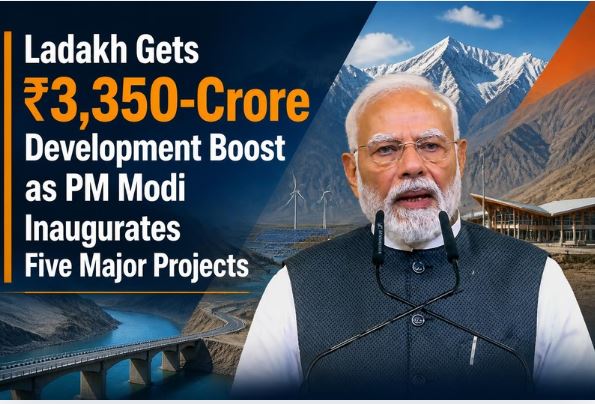
Leh, Oct 15: Prime Minister Narendra Modi on Thursday inaugurated five major development projects worth approximately ₹3,350 crore in Ladakh, highlighting the Centre’s focus on strengthening infrastructure, improving access to essential services and unlocking the region’s economic potential.
Representational Image
Addressing the gathering through video conferencing, Modi described the occasion as a historic milestone for Ladakh, saying the projects would expand access to electricity and water, improve connectivity and create new opportunities for local communities.
“A new chapter is being written today in the history of Ladakh,” the Prime Minister said, congratulating the people of the region, engineers, the Border Roads Organisation (BRO) and others involved in completing the projects.
New Leh Airport Terminal to Boost Tourism
A major highlight of the inauguration was the new terminal building at Leh airport, constructed at a cost of ₹650 crore.
According to the Prime Minister, the terminal is expected to increase the airport’s annual passenger-handling capacity from around 10 lakh to 35 lakh, while flight operations are projected to expand significantly.
The facility incorporates geothermal technology, which Modi described as a first-of-its-kind feature for an airport in India. The upgraded infrastructure is expected to support the growth of tourism and improve the region’s air connectivity.
Given Ladakh’s growing appeal among domestic and international travellers, the expansion could provide a significant boost to tourism-related businesses and local employment.
Nimmu-Padum-Darcha Road Cuts Travel Time
The Prime Minister also dedicated the Nimmu-Padum-Darcha Road to the people of Ladakh. Built at a cost of approximately ₹2,500 crore, the strategic road has reduced travel time along the route from around 12 hours to three hours, according to Modi.
The improved connectivity is expected to facilitate travel, strengthen trade links and improve access to remote areas. The road also adds to the region’s strategic infrastructure, where difficult terrain and harsh weather conditions have historically posed major transportation challenges.
Modi praised the contribution of the BRO in advancing infrastructure development in the mountainous region.
Hydropower Project to Strengthen Electricity Supply
The inauguration also included the 9 MW Hanu Hydroelectric Project and associated transmission infrastructure aimed at improving local power stability.
Emphasising the importance of reliable electricity, Modi said dependable power supplies could improve education, healthcare, village-level businesses and other essential services.
For remote communities, more stable electricity infrastructure is particularly important, given the region’s challenging geography and climatic conditions.
Forty Water Bodies to Address Seasonal Shortages
Under Project Amrit Him Sarovar, the Prime Minister dedicated 40 water bodies spread across 40 villages.
The initiative is intended to help mitigate seasonal water shortages and support irrigation for local farmers. Improved water availability could benefit agricultural activities and strengthen livelihoods in communities that face difficult environmental conditions.
The projects collectively target some of Ladakh’s most pressing development needs: reliable power, water security, transport connectivity and tourism infrastructure.
PM Highlights Expansion of Ladakh’s Infrastructure
During his address, Modi outlined the Centre’s claims of significant improvements in the region’s infrastructure since 2019.
He said Ladakh’s road network had expanded from approximately 1,800 kilometres to 4,000 kilometres, while the number of major bridges had risen from 19 to 75. The number of helipads, he added, had increased from seven to 40.
The Prime Minister also said access to safe drinking water had grown from 3.5 per cent of the population before 2019 to more than 99 per cent.
He highlighted progress on the Zojila Tunnel, saying the project would help make Ladakh accessible throughout the year by reducing its dependence on seasonal road access.
Homestays, Greenhouses and Local Products in Focus
Modi also pointed to the expansion of tourism and livelihood opportunities, stating that the number of homestays in Ladakh had increased from around 150 to 3,000. The number of greenhouses, he said, had crossed 11,000.
The growth of homestays is expected to provide more local families with opportunities to benefit from tourism, while greenhouses can support agricultural production in the region’s cold climate.
Highlighting Ladakh’s cultural and economic identity, the Prime Minister spoke about traditional products such as Pashmina and the region’s apricots, noting that local apricots had received a Geographical Indication (GI) tag.
He also underlined the importance of Buddhist monasteries, historical artefacts and the preservation of the region’s cultural heritage. The inauguration of the country’s first petroglyph conservation park in Leh was cited as another step towards protecting Ladakh’s ancient heritage.
Focus on Education and Access to Justice
The Prime Minister said the Centre was working to expand access to quality technological education so that young people in Ladakh would not have to leave the region to pursue advanced studies.
He referred to plans for campuses associated with IIT Jammu and IIM Jammu in Ladakh as part of efforts to strengthen higher education opportunities.
Modi also highlighted the sanctioning of a Leh bench of the Jammu and Kashmir and Ladakh High Court in August, describing it as a step towards bringing access to justice closer to the people.
‘Ladakh’s Development Is Our Priority’
Reiterating the government’s commitment to the region, Modi said Ladakh’s development remained a priority and called for collective efforts to take the Union Territory towards greater prosperity.
The inauguration of the five projects marks a fresh push to strengthen Ladakh’s infrastructure and public services. Their long-term impact will depend on effective implementation, reliable maintenance and the extent to which improved connectivity and essential services translate into better livelihoods for local residents.