


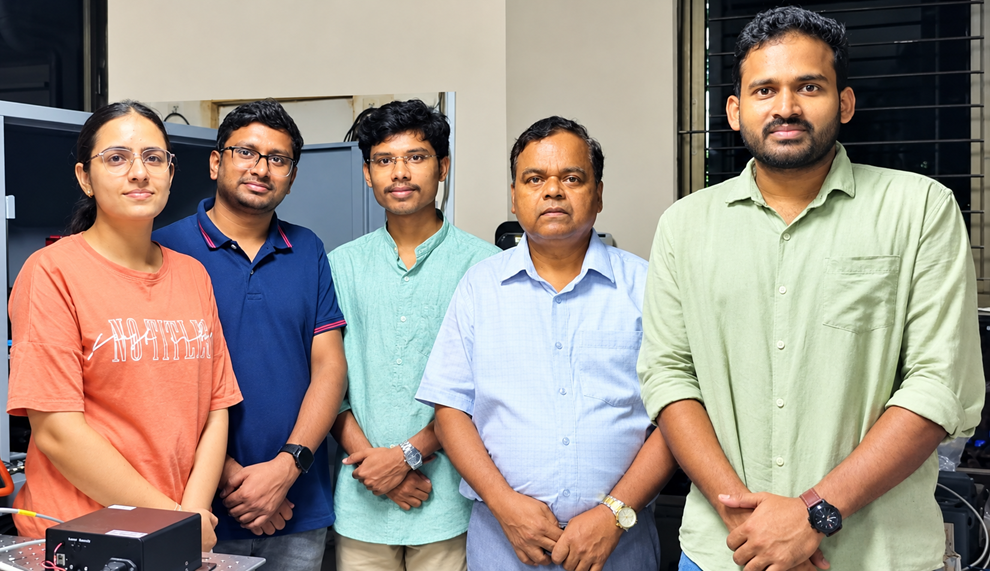
Guwahati, 12th October 2026: Indian Institute of Technology Guwahati (IIT Guwahati) researchers, in collaboration with Indian Institute of Technology Kharagpur, have developed a light-sensitive device that can detect, store, and process visual information with very little energy consumption, providing a revolution in electronic image processing applications. The developed technology can have widespread usage in intelligent facial recognition, artificial and robotic vision, and other smart computing applications.
In electronic image processing applications, the image capture, storage, and information processing activities are handled by separate components, including a camera, memory, and a processor. This necessitates considerable data transfer between the components and associated energy expenditure. On the other hand, the human brain is capable of simultaneously sensing, processing, storing, and learning information with far less energy consumption. This happens through the extremely large number of connections between nerve cells, called synapses
Explaining electronic image processing, Prof. P.K. Giri, Lead author of the research, and Professor, Department of Physics, IIT Guwahati, said, “When we capture the visual of an apple through electronic vision, the camera captures the light from the apple, converts it into digital information and sends it to a microprocessor to analyse the image pixel by pixel to identify it as an apple. On the other side, when we see an apple with our eyes, the brain immediately recognises it using the already stored information about colours, shapes, and related context. This reduces the need to consciously and sequentially analyse the image to identify any object.”
On a global level, scientists are trying to develop neuromorphic (brain-like) systems that mimic the human brain. An important component of such systems is the artificial synapse that acts similarly to the interconnected neurons in the brain.
In this context, Prof. P.K. Giri, along with his research team, has developed an ultrathin artificial synapse that can respond to light and store the information even after the light is switched off, simultaneously. This is like the brain storing information even after we have stopped looking at the object.
To achieve this, the research team used MXene nanosheets, an electrically conductive ultrathin 2D material, and an organic semiconductor, P3HT, which is capable of producing electrical charge/current in response to light, to make this device. When these two materials are brought into contact with each other, light-induced electrical charges separate at their interface and remain separated for a long time, causing a memory-like effect.
Explaining the developed technology and its significance, Prof. Giri said, “A brief light signal generates an electrical response that persists even after the light is switched off. Furthermore, repeated light signals can strengthen the response. In the developed device, a second light signal elicited a 180% stronger response than the first. This is similar to our neurons learning through repeated stimulation. Thus, our device combines sensing, memory, and information-processing functions in a single platform.”
In lab tests, the research team found the developed device to consume 500 times less energy than conventional MXene-based devices.
Developed through a low-cost solution processing technique, the research team has tested the developed device in applications such as facial recognition and traffic scene segmentation, and registered 90% accurate results in facial recognition and 85% accuracy in traffic segmentation.
The findings of this research have been published in the prestigious Carbon journal, in a paper co-authored by Prof. P.K. Giri, Professor, along with his research team Mr. Sanjoy Sur Roy, Dr. Sanju Nandi, Mr. Debabrata Sahu, Ms. Garima Choudhary, Prof. M. Meyyappan, from IIT Guwahati, and Mr. Saswata Goswami and Prof. Chandra Sekhar Tiwary from IIT Kharagpur.