


When Enzymes Stir the Molecular World
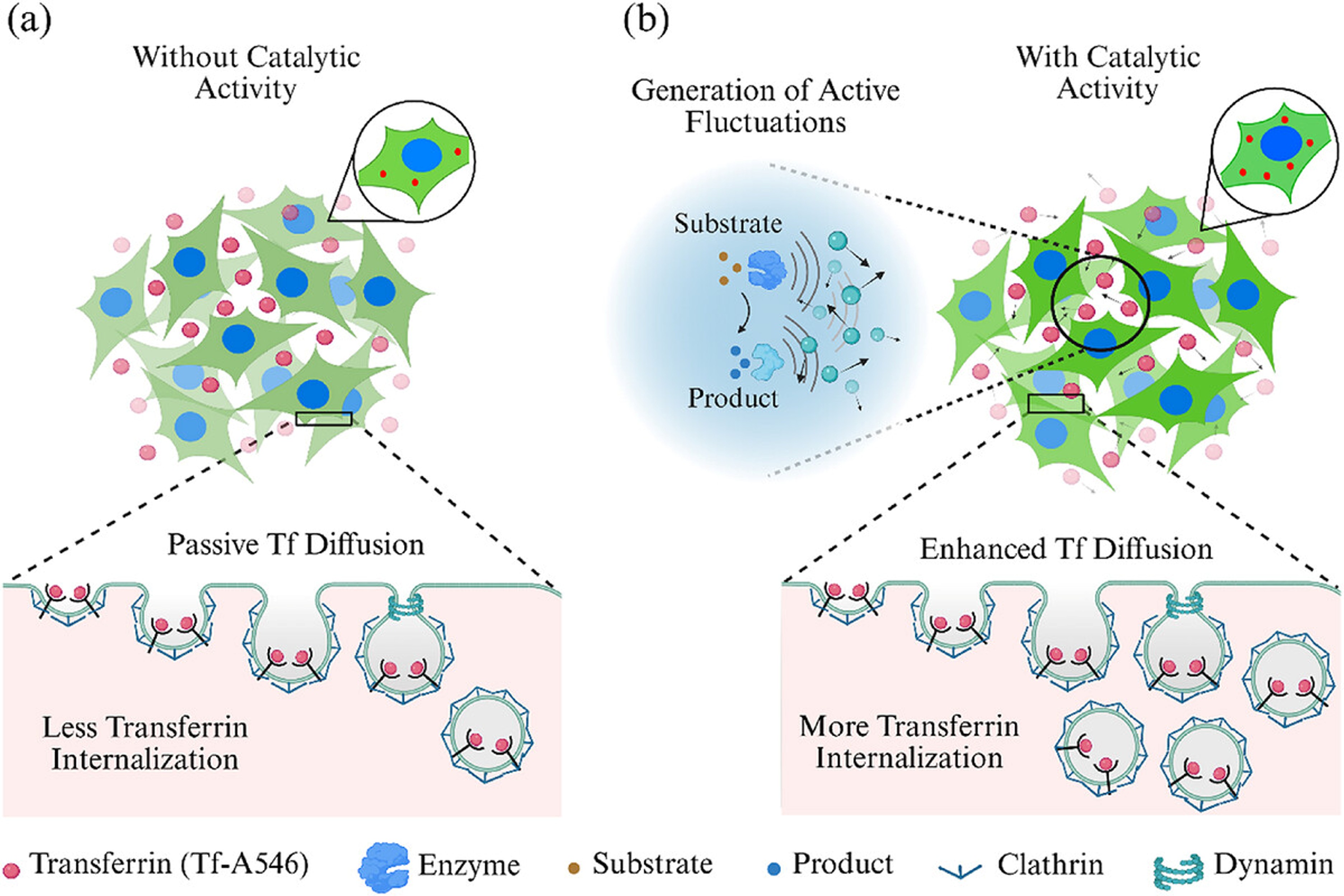
How active fluctuations affect transferrin uptake. (a) Without active fluctuations, transferrin (Tf) molecules drift slowly, meet receptors less often, and less Tf is taken into the cell. (b) With active fluctuations, Tf moves faster, binds receptors more often, and more Tf is taken into the cell.
Between Rest and Motion
A cell, sitting in fluid, looks like one of the most passive things in biology. Nutrients drift toward it on the aimless currents of molecular motion, and now and then one bumps into the right spot on the cell’s surface and gets pulled inside. This impression of the cell as a lottery run by chance, with the molecules wandering and the cell waiting, was a misconception.
Biologists have long known the picture is busier than that. Cells are active, and the fluid around them is crowded with working molecules. What researchers from the Indian Institute of Technology Gandhinagar (IITGN), with national and international partners, have now added is a new twist. Their study, published in Small, has shown that the fluid around a cell is not an empty, neutral stage, as one might assume. In fact, it plays a crucial role in the transport of molecules inside the cells.
Research teams from the University of Pennsylvania, IIT Jodhpur, and the Indian Institute of Science Education and Research Kolkata, worked with IITGN to report that a chemical reaction occurring in the fluid outside a cell can, on its own, cause the cell to take up more of a particular cargo.
“The agents of that change are enzymes, the protein machines that drive a vast range of reactions in the body, and, remarkably, they do it without entering the cell or altering the cargo at all,” explained Dr Krishna Kanti Dey, corresponding author of the study and an Associate Professor at the Department of Physics, IITGN. Dr Dey leads the Soft and Living Matter Laboratory, which studies how systems that generate their own motion behave at the smallest scales.
To understand this study better, picture a pond. If one drops a tennis ball in the still water, it would barely move. The ball would drift on whatever faint currents happen to exist. Now imagine the pond is full of small, tireless swimmers, each one kicking, sloshing water around. None of them touches the ball, but their collective churning sets up a restlessness in the water. The tennis ball now begins to roam far more widely, reaching the pond’s edge more frequently and much sooner than it would have on its own.
This effect is mirrored in the cellular experiments conducted by the research team, where the mechanical commotion stirred up by the ‘swimmers’ or enzymes helps push nearby molecules toward the cell, resulting in the cell absorbing more of them. The ‘tennis ball’ they are influencing is transferrin, a protein the body uses to shuttle iron into cells. And the ‘edge of the pond’ is the cell’s surface, dotted with receptors that act as cargo facilitators, grabbing passing transferrin and hauling it inside through clathrin-mediated endocytosis.
The Defining Movement
Clathrin-mediated endocytosis is essentially the cell dimpling its own membrane inward around a captured molecule, with a network of proteins helping the membrane bend into a small pocket. As the pocket deepens, it eventually pinches off from the cell surface, forming a small vesicle that carries the captured molecule into the cell. As one of the most thoroughly studied processes in cell biology, it served as an adequate testbed for the researchers to test their hypothesis.
“We chose transferrin because its journey into the cell has been mapped in fine detail over decades, so we knew exactly what ordinary uptake should look like. Against that well-established baseline, any change the enzymes produced would stand out clearly rather than get lost in the noise. And because we saw the same pattern with two very different enzyme–substrate systems, we are confident the effect is not a quirk of one particular reaction,” said Dr Dhiraj Bhatia, corresponding author of the study and an Associate Professor at IITGN’s Department of Biological Sciences and Engineering.
The researchers used fluorescently labelled transferrin for their experiments. They allowed cells to absorb these labelled iron transporters, with and without nearby active enzymes. The fluorescent dye functions as a glowing GPS signal, tracking the transferrin and also indicating the efficiency of uptake. More glow, more uptake.
The cells with working enzymes glowed brighter. They had taken up roughly 17 percent more transferrin. But a brighter cell proves only that something changed, not why.
Lighting up Cellular Traffic
There are many ways an extracellular enzyme could conceivably affect cellular uptake. It could alter the cell membrane, influence the transport machinery, affect receptor behaviour, or change the physical environment through which transferrin moves.
So the team watched the transferrin move using Total Internal Reflection Fluorescence (TIRF) microscopy. The imaging technique illuminates only the thinnest sliver of space at the cell’s surface, where the cargo (transferrin) meets the receptor. They clocked the transferrin moving roughly 50 per cent faster when the enzymes were active.
A second technique, fluorescence correlation spectroscopy, produced a similar result, measuring increases in transferrin diffusivity of approximately 40 percent with the urease enzyme and 44 percent with the alkaline phosphatase enzyme.
“Our experiments noted that the increased uptake is not influenced by changes in the cells, or the cargo’s chemistry, but rather by the fact that the busy enzymes are, in effect, stirring the extracellular fluid, which makes the cargo’s movement faster,” added Nividha, first author of the study and a PhD Scholar at IITGN’s Department of Physics.
But the researchers still needed to establish whether the enzymes were actually generating the physical disturbance suggested by their hypothesis.
The Force Behind the Motion
They turned to optical tweezers, a technique that uses a tightly focused laser beam to hold and measure tiny objects and forces. Here, it allowed them to measure the mechanical fluctuations generated by the enzyme reactions. Both enzyme systems generated forces in the piconewton range while actively catalysing their reactions.
The researchers then tested whether the effect could simply be due to the presence of enzymes, their substrates, or reaction products. “We observed that it could not. The effect appeared to depend on active enzyme catalysis, not merely on the ingredients of the reaction,” said Nividha.
A final question the team sought to answer was whether faster-moving transferrin encounters receptors more often; does that necessarily mean it will be taken into the cell?
To investigate this, the researchers blocked dynamin, a protein involved in the final step of clathrin-mediated endocytosis, when the membrane pocket separates from the cell surface. With dynamin inhibited, this transport route gets jammed. Cells still took up some transferrin. This indicated that other, dynamin-independent routes also carry it inside, but the enzyme-driven boost vanished entirely. Thus, the enhancement was riding specifically on the clathrin-mediated pathway, not on transferrin uptake in general.
A Built-In Ceiling
One of the queries that cropped up for the team was, if transferrin was moving ~50 percent faster, why did uptake rise by only about 17 percent? A large push had produced a comparatively modest gain.
To make sense of the mismatch, the researchers built a simple computational model of transferrin binding to its receptor and being drawn inside, using it to trace how changes in movement should translate into changes in uptake.
It was noted that since a cell carries only a limited number of transferrin receptors, faster-moving cargo fills those receptors sooner. But once they are all occupied, extra speed has nowhere to go, and the gain levels off. The team saw the same ceiling when they raised the amount of transferrin on offer. The uptake climbed, then flattened once the receptors were saturated. Thus, enzyme-driven stirring could hurry cargo along only as far as the cell is equipped to receive it.
A Lever Worth Finding
The findings of this study can be considered in the context of the fundamental challenges in drug delivery. Getting a therapeutic molecule to the right cell. A molecule may have the right biological target, but it still has to navigate the crowded environment outside a cell, encounter the right receptor, and cross the cell membrane.
Much of the field has focused on engineering the cargo itself. This includes encapsulating it in nanoparticles, attaching targeting molecules, or designing systems that can actively move through biological environments. This study asks the question, what if the environment around the cell could be made to do some of the work?
“The findings could be relevant to future efforts to control molecular transport, including the delivery of therapeutic cargoes across biological barriers. But those applications remain to be tested. The present work establishes the effect in a controlled cellular system, though therapeutic applications are yet to be demonstrated,” said Dr Dey.
The work was supported by the Anusandhan National Research Foundation (ANRF), the Ministry of Education’s STARS scheme, and the Gujarat State Biotechnology Mission.
*****
Article Title: Enzyme-Regulated Non-Thermal Fluctuations Enhance Ligand Diffusion and Receptor-Mediated Endocytosis.
Authors: Nividha, Arnab Maiti, Kshitiz Parihar, Rik Chakraborty, Pratibha Agarwala, Dibyendu K Sasmal, Ravi Radhakrishnan, Tanmoy Ghosh, Bidisha Sinha, Dhiraj Bhatia, Krishna K Dey.
DOI: https://doi.org/10.1002/smll.74049