


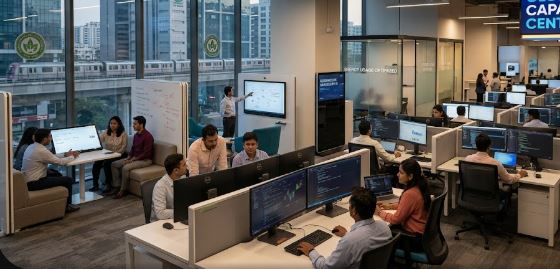
India’s office market is expanding at a time when the nature of corporate work itself is changing. The latest leasing numbers point to more than a strong real estate cycle: they reflect the growing importance of technology, Global Capability Centres (GCCs), artificial intelligence, digital services and skilled talent in India’s business economy.
Office absorption reached a record 66.4 million sq. ft. during January–September 2026, up 8% from a year earlier. The third quarter alone accounted for around 21 million sq. ft., while new supply during the first nine months reached nearly 51 million sq. ft.
The numbers show that companies are continuing to expand their physical presence even as technology changes where and how people work.
The office is becoming a technology asset
The modern corporate office is no longer simply a place where employees sit at desks.
For technology companies, financial institutions, engineering businesses and GCCs, an office increasingly needs to support secure digital networks, cloud-based operations, advanced collaboration, data-driven work and AI-enabled functions.
This is changing the way companies evaluate commercial buildings.
Location remains important, but businesses are increasingly looking at the quality of the building, connectivity, sustainability, employee experience and access to skilled talent when choosing office space.
That is helping create a shift towards premium, technology-ready workplaces.
More than half of the office supply added during the first nine months of 2026 came from premium Grade A+ assets, while green-certified buildings accounted for 80% of new supply completions in the third quarter.
GCCs are reshaping India’s corporate landscape
One of the biggest forces behind this office expansion is the growth of Global Capability Centres.
GCCs leased around 28 million sq. ft. during January–September 2026, accounting for roughly 42% of total office leasing during the period. Their quarterly leasing reached about 8.7 million sq. ft.
The significance of GCCs goes beyond the amount of office space they occupy.
Many multinational companies are increasingly using their Indian centres for technology development, engineering, analytics, research, finance, cybersecurity and product-related activities. This is gradually moving India’s role in global corporate operations towards more specialised and knowledge-intensive functions.
The result is a stronger connection between India’s talent economy and commercial real estate market.
AI is changing the workplace—but not eliminating it
Artificial intelligence has raised questions about how much office space companies will need in the future. Yet current evidence suggests that AI is influencing the type of workplace businesses want more immediately than the total amount of space they require.
A 2026 CBRE survey of more than 200 corporate occupiers found that 93% were at some stage of AI adoption, while 77% expected their India office portfolios to expand over the next two years.
This creates an interesting business dynamic.
AI may automate certain tasks, but companies still need people who can develop, manage and apply these technologies. As technology functions become more sophisticated, demand for specialised talent in areas such as software, data, engineering, cybersecurity and analytics can create new workplace requirements.
The office is consequently evolving rather than disappearing.
Talent is becoming as important as real estate
For technology-led businesses, finding the right people can be just as important as finding the right building.
This is why India’s established technology centres continue to attract substantial corporate demand. Bengaluru, Hyderabad, Delhi-NCR and other major markets offer combinations of skilled talent, universities, established technology ecosystems, infrastructure and corporate networks.
The office therefore becomes part of a company’s talent strategy.
A well-connected, modern workplace can help businesses attract employees, encourage collaboration and support corporate culture. CBRE’s 2026 occupier survey found that commute infrastructure was a key consideration for many companies when selecting office locations.
Flexible work becomes part of the corporate strategy
Another major change is the rise of flexible workspaces.
Flexible operators accounted for 24% of quarterly office leasing in Q3 2026, ahead of BFSI and technology occupiers in sectoral demand.
For companies operating in fast-moving technology markets, flexibility can be commercially valuable.
A business may need additional space when it launches a new project, enters a market or expands a team. Instead of committing immediately to a large conventional lease, companies can combine permanent offices with flexible capacity.
The core-plus-flex model is consequently becoming a more strategic approach to corporate real estate.
Technology is also making buildings smarter
The transformation is happening inside buildings as well.
Digital building-management systems can help companies monitor energy use, manage meeting rooms, optimise occupancy and improve the overall workplace experience.
Smart infrastructure can also support sustainability objectives by helping buildings operate more efficiently.
This convergence of technology and sustainability is increasingly important for large companies with environmental, social and governance commitments.
The rise of green-certified office space suggests that businesses are increasingly considering both the quality of their workplace and its long-term operating efficiency.
A wider economic multiplier
The office expansion has implications far beyond the property sector.
When a technology company, bank or GCC expands its workforce, the impact spreads across a broader economic ecosystem.
It creates demand for:
- commercial construction and development
- office interiors and furniture
- telecommunications and IT infrastructure
- cybersecurity and digital services
- transportation and logistics
- facility management
- food and hospitality services
- housing and retail around business districts
This makes office absorption an important indicator of broader corporate activity.
A growing office market can therefore become a physical manifestation of rising investment in India’s services and technology economy.
The next opportunity may extend beyond major hubs
India’s technology-led office expansion could increasingly spread into emerging business locations.
Tier-II cities offer companies access to growing talent pools, lower operating costs and opportunities to diversify their workforce. Better digital connectivity and improving infrastructure are making these locations more relevant to companies looking for scalable operating models.
For the commercial real estate industry, this could eventually create a wider network of technology and business centres rather than concentrating expansion entirely in the traditional metropolitan hubs.
The business story behind the numbers
The record 66.4 million sq. ft. of office absorption is therefore more than a property-market statistic.
It reflects several structural changes happening simultaneously: global companies are expanding their Indian operations, GCCs are taking on more sophisticated functions, technology businesses continue to require specialised talent, flexible work is becoming mainstream and companies are demanding better-quality, digitally enabled and sustainable workplaces.
India’s office market is consequently becoming closely intertwined with the country’s broader technology and knowledge economy.
The next phase of growth will not be defined simply by how much office space companies occupy, but by what they use that space for.
As AI, cloud computing, engineering, analytics and digital services become increasingly central to corporate strategy, India’s workplaces are evolving into infrastructure for innovation and talent.
The office boom, in this sense, is not just a real estate story. It is a reflection of India’s expanding role in the global technology and business ecosystem.