


Telangana loses nearly 60% of cyber–fraud losses to investment and stock–market scams: Shikha Goel
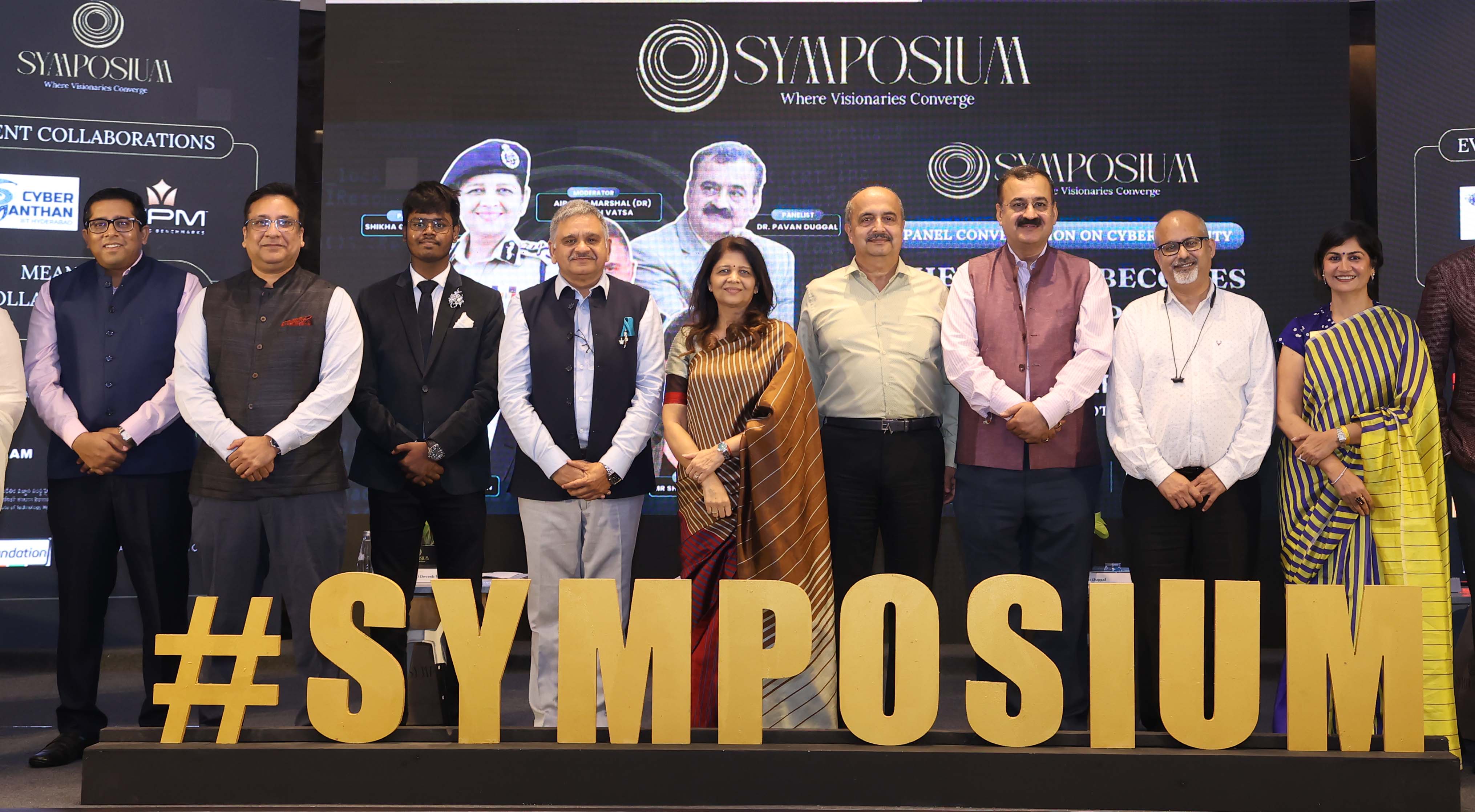
Hyderabad, Sept 30: Cybercrime is no longer merely a battle between technologies. It is increasingly a battle for human trust, judgement and behavior, cybersecurity experts, police officials and cyber-law specialists said at a special Symposium held in Hotel Avasa in Madhapur on Tuesday
Speaking at “Conversation on Cybersecurity: When Trust Becomes the Weapon – The New Battle for the Human Mind”, organized by Symposium, Hyderabad’s premium knowledge forum, organized in collaboration with the Telangana State Police, Telangana Cyber Security Bureau and Cyberabad Police, speakers warned that cybercriminals are increasingly exploiting human psychology through trust, fear, greed, urgency and impersonation.
The program was attended by more than 200 people.
One if the three panelists, Ms. Shikha Goel, IPS, Principal Secretary to Government, Home Department, Telangana, Director, Telangana Cyber Security Bureau and Director, Telangana Forensic Science Laboratories, said stock-market and investment-related cyber frauds had emerged as one of the most financially damaging categories of cybercrime in Telangana.
She said nearly 60% of the financial losses suffered by cybercrime victims in Telangana are linked to stock-trading and business investment frauds.
Cybercriminals are increasingly studying human behavior, building trust and then manipulating victims into transferring their own money, Ms. Goel said.
She said fraud networks had become increasingly sophisticated, with many operations being run from locations outside India, including Vietnam, Myanmar and Cambodia. According to her, these networks operate through multiple layers, geographically dispersed locations and different time zones, making it difficult for investigators to identify and reach the masterminds.
They run sophisticated call centers where people from different countries speak in the language of their targets, she said, explaining how organized cybercrime syndicates tailor their approach to individual victims.
Cybercrime is one of the most organized crimes. At the same time, it is also one of the most preventable crimes. People get trapped because of their fear, greed and ignorance, she said.
Ms. Goel said that ₹455 crore lost to cyber fraudsters had been recovered over the last two years, according to the figures she shared at the symposium.
She urged citizens not to depend on innocence or assume that they would never become victims.
Innocence doesn’t work. If you don’t want to fall prey to cyber fraud, you have to be intelligent. Trust your intelligence. Pause, think and verify before you act,” she said.
Lakshman Rekha was the original firewall said Air Vice Marshal (Dr) Devesh Vatsa.
The panel was moderated by Air Vice Marshal (Dr) Devesh Vatsa, VSM, Cyber Security & Critical Technologies Advisor, DSCI and former Indian Air Force officer.
Opening the conversation with an analogy from the Ramayana, Dr Vatsa described the Lakshman Rekha as the original firewall — a boundary designed to protect against a threat.
Cybercrime is nothing but greed, lust and fear,” he said, explaining how cybercriminals exploit fundamental human emotions.
We are entering an era where the weaponizing of trust is becoming a strategy,” he added.
He also pointed out that October is observed every year as Cybersecurity Awareness Month, stressing the importance of sustained public awareness rather than one-time campaigns.
Dr Pavan Duggal, Supreme Court Advocate and cyber-law expert, warned against excessive dependence on Artificial Intelligence and said people must preserve their ability to think, question and make independent decisions.
God has given you the ability to discern and join the dots. Use that ability. Don’t let that skill die. Don’t use AI for recommendations for every small thing. Keep AI at arm’s length, he said.
He warned that society was becoming increasingly dependent on AI for everyday decisions.
People are blindly going gaga over AI. They consider it a life coach, but it can become a suicidal coach, he said, urging people to remain extremely cautious about information and recommendations generated by AI.
Outsourcing all our work to Artificial Intelligence will eventually lead to the decay of the human mind, Duggal warned.
He said governments need to establish clear legal principles governing AI.
Dedicated laws on Artificial Intelligence and deepfakes are the need of the hour, he said, pointing to regulatory developments in countries including China, South Korea, Japan, Hungary and El Salvador.
Duggal also highlighted the need for accountability in AI and cautioned that people should not treat AI-generated information as unquestionable truth.
Duggal also pointed to developments within India’s legal system, saying that the Supreme Court has drafted regulations governing the use of Artificial Intelligence in courts and legal practice.
The draft Regulations for Use of Artificial Intelligence (AI) in Courts, 2026, prepared under the aegis of the Supreme Court’s AI Committee, seek to establish a framework for responsible use of AI while retaining human and judicial oversight.
Duggal said the larger challenge was to ensure that technological convenience did not come at the cost of human judgement.
We have become cognitive slaves to AI. Respect the cognitive minds of people, he said, calling for legal principles that ensure accountability for AI-related harms.
He said that people were either victims of cybercrime or potentially vulnerable to becoming victims, making cyber awareness and human judgement essential.
Mr Jiten Jain, Cybersecurity Expert and CEO, Indian Infosec Consortium, another panelist urged citizens to treat their mobile numbers as sensitive personal information.
He asked people to take a pledge not to routinely share their mobile numbers while shopping or billing, warning that phone numbers can become an entry point for further social-engineering attempts and identity-related fraud.
“Your mobile number should be extremely personal,” he said, urging people to question why their number is being collected and where it may subsequently be used.
Mr Shubhank Singhai, young cybersecurity enthusiast and ethical hacker, said the most valuable target for a cybercriminal is not necessarily a server, bank account or government database — it is the victim’s trust.
“We spend billions building stronger encryption, better firewalls and smarter detection systems. Yet some of the biggest attacks today don’t begin with malicious code. They begin with a phone call, a message, a familiar face or a voice that sounds just like someone we love,” he said.
He highlighted the growing threat posed by social engineering, impersonation, cloned voices and AI-generated content.
The central message of the symposium was that cybersecurity can no longer be treated merely as an IT issue. It is fundamentally an issue of trust, human behavior and human judgement.
A special highlight of the program was the unveiling of a series of public-interest cybersecurity videos and awareness creatives prepared in collaboration with the Telangana Cyber Security Bureau.
This important initiative helped create awareness among nearly 2.95 lakh pensioners and over 3 lakh serving employees across the State of Telangana.
The videos and easy-to-follow awareness material are intended to provide citizens with practical guidance on preventing cybercrime. The awareness collaterals will subsequently be distributed through gazetted officers associated with Symposium’s collaborations to take cybersecurity awareness to a wider section of society.
A paper capturing the discussions and insights from the previous edition of the symposium was also presented to Ms. Shikha Goel.
Speaking in her opening remarks, Ms. Shruti Mallpani, Managing Trustee, Symposium, said the real battle is not technology; it is human judgement.
She said the objective of the forum was to create conversations that help citizens understand emerging threats and make safer decisions in the digital environment.