


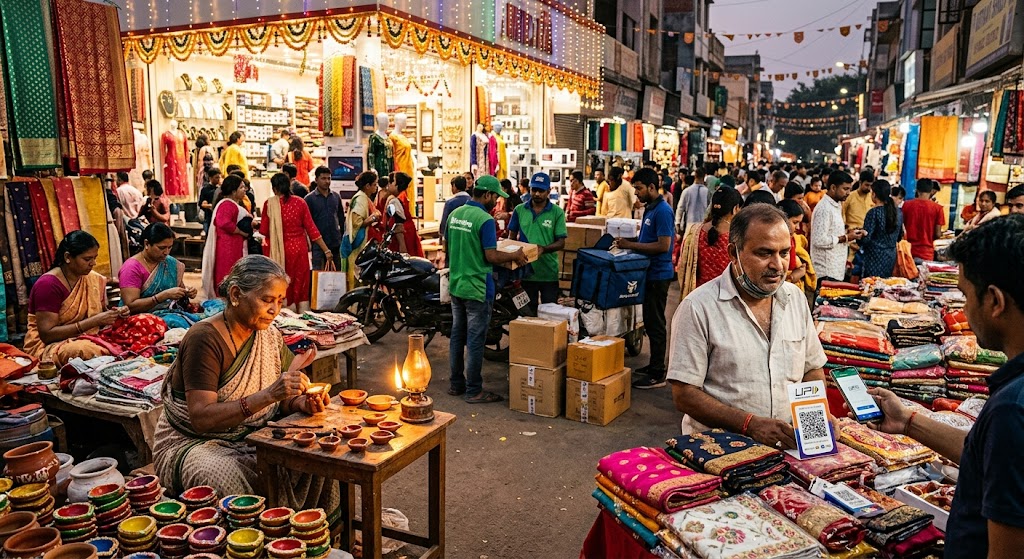
India’s festive season economy is emerging as one of the country’s biggest annual engines of consumer demand, bringing together retail sales, manufacturing, MSMEs, e-commerce, logistics, digital payments and traditional artisan businesses.
From Ganesh Chaturthi and Durga Puja to Dussehra, Diwali and the wedding season, millions of households increase spending on clothing, jewellery, electronics, automobiles, home décor, food, travel and gifts. Behind this surge is a wider economic chain that connects consumers with manufacturers, small businesses, workers, traders and artisans across the country.
The festive season is therefore much more than a period of celebration. It has become an important economic growth cycle, particularly for India’s consumption-driven economy.
Why the festive season matters to the Indian economy
Festivals create a concentrated period of consumer spending. Households that may postpone discretionary purchases during other parts of the year often bring forward spending during the festive months.
This increased consumer spending in India benefits several industries simultaneously. Retailers increase inventory, manufacturers raise production, logistics companies handle larger shipment volumes and financial institutions see greater demand for consumer credit and working capital.
The impact extends from large cities to smaller towns and rural markets, making festive demand an important link between India’s urban consumption centres and its wider production network.
MSMEs at the heart of India’s festive economy
Micro, Small and Medium Enterprises are among the biggest beneficiaries of increased festive demand.
India’s MSME sector contributes significantly to the country’s economy, accounting for 31.1 per cent of GDP, 35.4 per cent of manufacturing and 48.58 per cent of exports, according to the Economic Survey 2025-26.
During the festive season, small manufacturers and retailers prepare months in advance. Garment makers, furniture manufacturers, food businesses, packaging companies, handicraft producers and other enterprises increase production and stock inventory to meet higher demand.
For many MSMEs in India, the festive season can also provide an important opportunity to improve sales, generate cash flow and expand their customer base.
The increased demand creates activity beyond the businesses themselves. Suppliers receive larger orders, transporters move more goods, warehouses require additional workers and retailers increase staffing.
Festive spending creates a wider employment cycle
One of the less visible effects of festive business in India is its impact on employment.
Higher demand creates additional requirements for delivery personnel, warehouse workers, sales staff, tailors, packaging workers, drivers, food workers and other service providers.
Seasonal employment can be particularly important for small businesses that need additional manpower during periods of high sales.
The economic effect therefore spreads through multiple layers of the supply chain rather than remaining with the final retailer.
Artisans turn Indian traditions into economic opportunities
India’s traditional artisans and craftspeople occupy a unique position in the festive economy.
Demand for handloom, handicrafts, traditional jewellery, pottery, diyas, decorations, textiles and regional products typically rises during festivals and weddings.
A Diwali diya, an embroidered garment, a handwoven sari or an artisan-made home decoration represents not only a cultural product but also a source of income for the person who makes it.
The Khadi and Village Industries ecosystem demonstrates the scale of India’s rural enterprise economy. Government data show that sales of Khadi and Village Industries products reached ₹1.87 lakh crore in 2025-26, while the sector provided employment to around 2.04 crore people.
The festive season can therefore help strengthen the connection between rural producers and urban consumers.
E-commerce expands the festive marketplace
The rise of e-commerce has fundamentally changed festive shopping in India.
Consumers in Tier-2 and Tier-3 cities can now access products that were previously concentrated in metropolitan markets. At the same time, small sellers can use digital marketplaces and social-commerce channels to reach customers beyond their local areas.
This has created a more integrated retail ecosystem in which traditional shops, large retailers, online marketplaces and independent sellers compete and collaborate for the same festive demand.
Online festive sales have also become a significant part of India’s annual retail cycle, with consumers increasingly comparing prices, offers, delivery times and product choices across digital and physical channels.
UPI and digital payments strengthen festive consumption
The expansion of digital payments has added another layer to India’s festive economy.
UPI has enabled millions of small businesses, neighbourhood stores and independent sellers to accept instant digital payments. During major shopping periods, the increase in transaction activity provides a clear indication of the scale of India’s consumption economy.
UPI transactions reached a record 20.70 billion transactions worth ₹27.28 lakh crore in October 2025, according to reported data.
For small businesses, digital payments can also improve transaction records and make it easier to participate in the formal financial system.
The combination of UPI, e-commerce and digital banking is therefore making the festive marketplace faster and more accessible.
Credit supports festive demand
Consumer demand is only one side of the equation. Businesses also need money to prepare for the festive season.
An MSME may need to purchase raw materials, hire workers and build inventory weeks before receiving payment from customers. Retailers similarly need working capital to stock products ahead of peak demand.
Banks, NBFCs and fintech companies play an important role by providing working-capital finance and consumer credit.
For consumers, financing options such as EMIs can make higher-value purchases of automobiles, electronics, appliances and other products more manageable.
This creates a financial link between consumer credit, MSME financing and festive consumption.
From one festive purchase to multiple businesses
The wider economic impact can be understood through a simple example.
A consumer purchasing a traditional outfit during Diwali may be spending money at a local retailer. That retailer may have purchased the product from a wholesaler, who sourced it from a manufacturer.
The manufacturer may have purchased fabric from another supplier and employed workers to produce the garment. A logistics company may have transported the finished product, while a digital payment platform processed the transaction.
If the outfit includes hand embroidery, the supply chain may extend further to artisans working from small towns or villages.
One purchase can therefore generate income across several businesses and occupations.
Festive season and India’s retail growth
The importance of the festive period is particularly visible in India’s retail sector.
Retailers typically use the season to launch new collections, offer promotional schemes and increase inventory. Categories such as fashion, jewellery, electronics, automobiles, home appliances, beauty products and food see heightened consumer attention.
For brands, the festive period is also an important opportunity to acquire new customers. For smaller retailers, it can provide a chance to compete through personalised service, regional products and local relationships.
This makes festive retail sales in India an important indicator of consumer sentiment and household demand.
The rural economy gets a boost
The festive consumption cycle also has a strong rural dimension.
Farm income, agricultural activity, government transfers, wages and rural employment conditions can influence spending capacity in smaller towns and villages. Increased demand for clothing, consumer goods, agricultural equipment, household products and festive items can subsequently benefit local businesses.
The flow of money between urban consumers and rural producers is becoming increasingly important as India’s digital and physical supply networks improve.
The festive GDP lever is becoming more digital
India’s festive economy is gradually moving from a traditional shopping cycle towards an integrated digital marketplace.
Consumers can discover products through social media, compare prices online, make payments through UPI and receive products through increasingly sophisticated logistics networks. At the same time, artisans and MSMEs are gaining new ways to market products beyond their immediate geographical markets.
Yet the traditional economy remains central. Local markets, family-run businesses, craftsmen and neighbourhood retailers continue to account for a substantial part of India’s festive activity.
The result is a hybrid festive economy where digital platforms and traditional businesses operate alongside each other.
What the festive economy means for India
The real strength of India’s festive season lies in its ability to connect different parts of the economy at the same time.
Consumers create demand. MSMEs produce and distribute goods. Artisans preserve traditional products while earning income. Logistics companies move merchandise. Banks provide credit. Digital platforms enable payments and commerce.
Together, these activities create a multiplier effect across the economy.
As India’s middle class expands, digital infrastructure improves and consumer markets deepen, the economic significance of the festive season is likely to remain substantial.
The festive season economy in India ultimately demonstrates how cultural traditions can generate powerful commercial activity. Behind every purchase is a network of businesses, workers and producers — making festivals not only occasions for celebration, but also a major annual driver of consumer demand, MSME growth, retail activity and grassroots economic participation.