


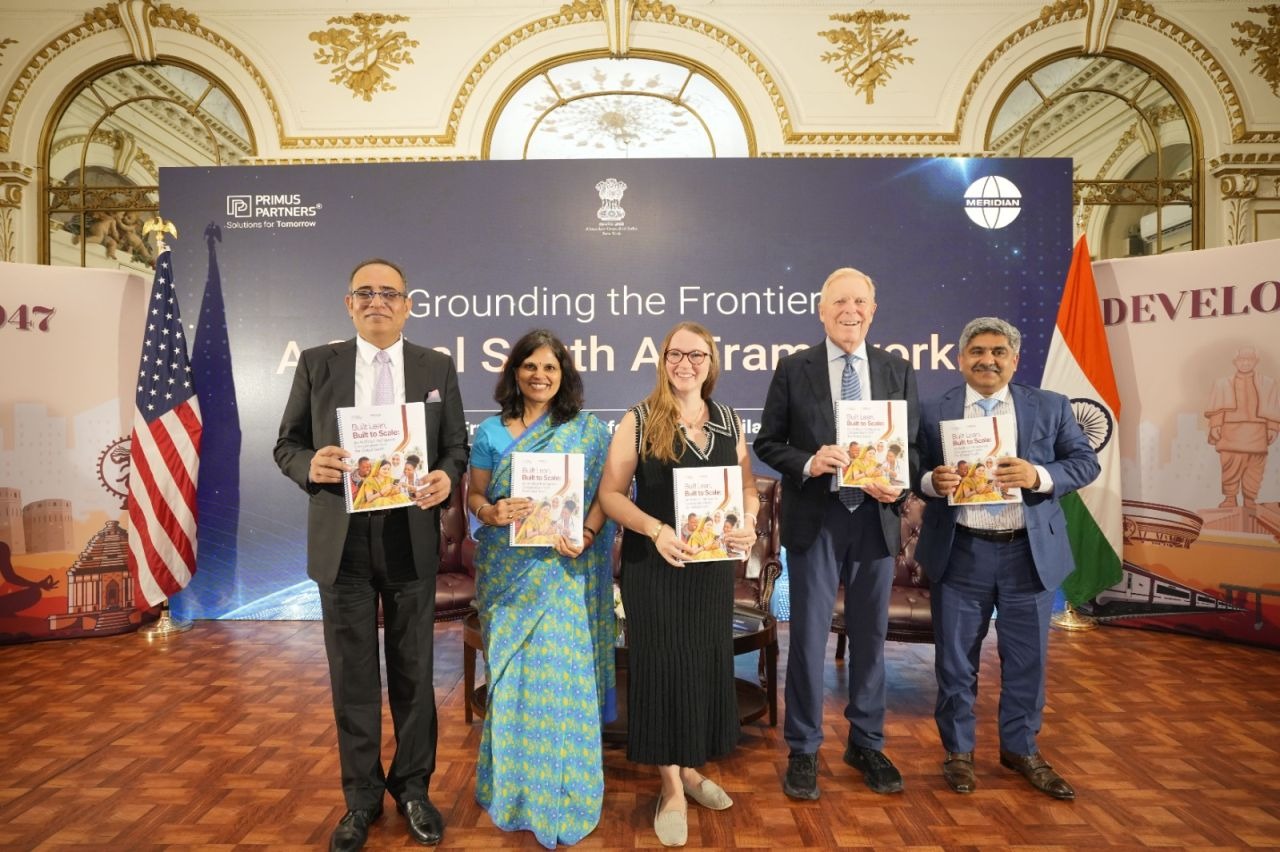
Mumbai, September 24, 2026: Primus Partners, a global management consulting firm specialising in policy, strategy, technology and sustainability, launched ‘Built Lean, Built to Scale: An Artificial Intelligence Compendium from the Global South’ at “Grounding the Frontier: A Global South AI Framework”, a high-level dialogue convened at the Consulate General of India, New York, during the week of the 81st United Nations General Assembly. The compendium examines how countries across the Global South are developing context-specific AI solutions shaped by real-world constraints, bringing together research, case studies and practitioner perspectives across compute, data and skilling. Featuring a Foreword by Hon’ble Minister of State for Electronics & Information Technology and Commerce & Industry, Government of India, Shri Jitin Prasada, it emphasises that AI’s value should be measured by its impact on people and economies, and highlights the potential of efficient models, representative data, shared compute, local languages and skilled talent to drive locally grounded innovation. The compendium also features perspectives and case studies involving practitioners including IIT Bombay, Intel Corporation, Karya, Bhashini, Katha and CoRover.ai, demonstrating how frugal, edge, multilingual and sector-specific approaches can expand the reach and relevance of AI.
The compendium was formally launched by Richard (Dick) A. Gephardt, Former Member of US Congress and House Majority Leader (1989-95). Speaking at the launch, Gephardt said, “I am a big believer in self-government. I have been part of the Congress for 28 years, and I know how difficult it is, but I also know how essential it is for all people to have a voice in their own governance. This compendium is necessary because the people of the Global South must be involved in how AI is researched and developed, from the perspective of their own countries and, equally importantly, from their own individual perspectives. The fact that this compendium is organised around three broad chapters, compute, data and skilling, gives us a clear north star for putting together practical solutions and recommendations for this development. AI will shape the future of our societies, and the Global South must not simply be a participant in that future; it must have a voice in shaping it.”
The event brought together perspectives from policymakers, technology leaders, industry practitioners and multilateral institutions to examine how the Global South can contribute to shaping the next phase of global AI governance.
Inaugurating the dialogue, Ambassador Binaya Srikanta Pradhan, Consul General of India, New York, said: ‘So as we stand today here with 18% of population, Africa has less than half a percentage of global data centre capacity. If you exclude China, I think the story of Global South would be something similar. So in this context, having this conversation is really, really important. I’m so happy that we have people from U.S. Government here to discuss that. We have people from Government of India, the policymakers. So let me again, once again, extend a warm welcome to everybody to have this meaningful conversation.’
The dialogue featured a fireside conversation with Smt. Punya Salila Srivastava, Secretary, Ministry of Health & Family Welfare, Government of India and Shri Rohit Kansal, Secretary, Ministry of Rural Development, Government of India, moderated by Nilaya Varma, Group CEO & Co-Founder, Primus Partners. The discussion explored how constraints have historically driven original innovation from mobile money in Africa to India’s digital public infrastructure and what it means for the Global South to move from being a recipient of AI to becoming a contributor to how AI is built, deployed and governed.
Speaking on the occasion, Nilaya Varma, Group CEO & Co-Founder, Primus Partners, said, “This conversation starts on a question, what if we look at AI not by the number of Large Language Models, but by how large a population can we impact? Building in contexts with varied compute capacity, and diverse languages, we look at different challenges. Majority of research in the Global South is focussed on design and innovation, but not scale as a solution, which is the next frontier for India, Africa and more. When investors are looking to invest in India, people are looking towards the outcome of the investments made, whereas in different parts of the world we’re looking at the products. When we look at AI from the perspective of the Global South, we have to focus on outcomes. India is cognizant of the fact that technology and solutions have to be made available at scale and at a fraction of the cost.”
The discussions converged on a clear message: the success of AI in the Global South will be determined less by the size or sophistication of individual models and more by their ability to solve real problems at population scale. Speakers emphasised the need to design AI around local languages, representative data and sector-specific realities, while building the institutional capacity, talent, compute and regulatory frameworks required to support deployment. India’s experience with population-scale digital systems was highlighted as an example of how technology can be built around outcomes rather than the technology itself, with context, incentives and accessibility determining whether solutions translate into meaningful impact. The dialogue also underscored the role of smaller, specialised and resource-efficient models in complementing frontier AI, particularly where cost, infrastructure and connectivity remain constraints, alongside the need for stronger local ecosystems, international cooperation and governance frameworks that enable countries to scale AI safely and responsibly.
Speaking at the event, Bharagava Reddy, Chief Business Officer and Founder Member, Qure.ai, said, “Different people across the world use AI in very different ways, and nowhere is this more important than in healthcare. The way AI is operationalised in the Global South can be very different from how it is applied elsewhere. An AI-generated interpretation cannot be the final step. Diseases can present differently across countries, populations and contexts, and healthcare systems have their own realities and constraints. If AI is to genuinely improve healthcare, it must understand and respond to these differences.”
Through the compendium and the wider dialogue, Primus Partners sought to bring greater attention to the innovation emerging from resource-constrained environments and contribute to a more diverse and grounded global conversation on the future of artificial intelligence.