


Lumami, Sep 21: A Nagaland Universitystudy has highlighted the need for location-specific agricultural extension strategies to promote adoption of sustainable farming practices among pineapple growers in the State.
The findings identify the importance of strengthening farmers’ access to technical information, extension services and institutional support while integrating sustainability into existing horticultural development programmes.
The research provides a basis for further work on district-level adoption patterns, the effectiveness of extension interventions and the development of practical sustainability frameworks suited to Nagaland’s pineapple-growing systems.
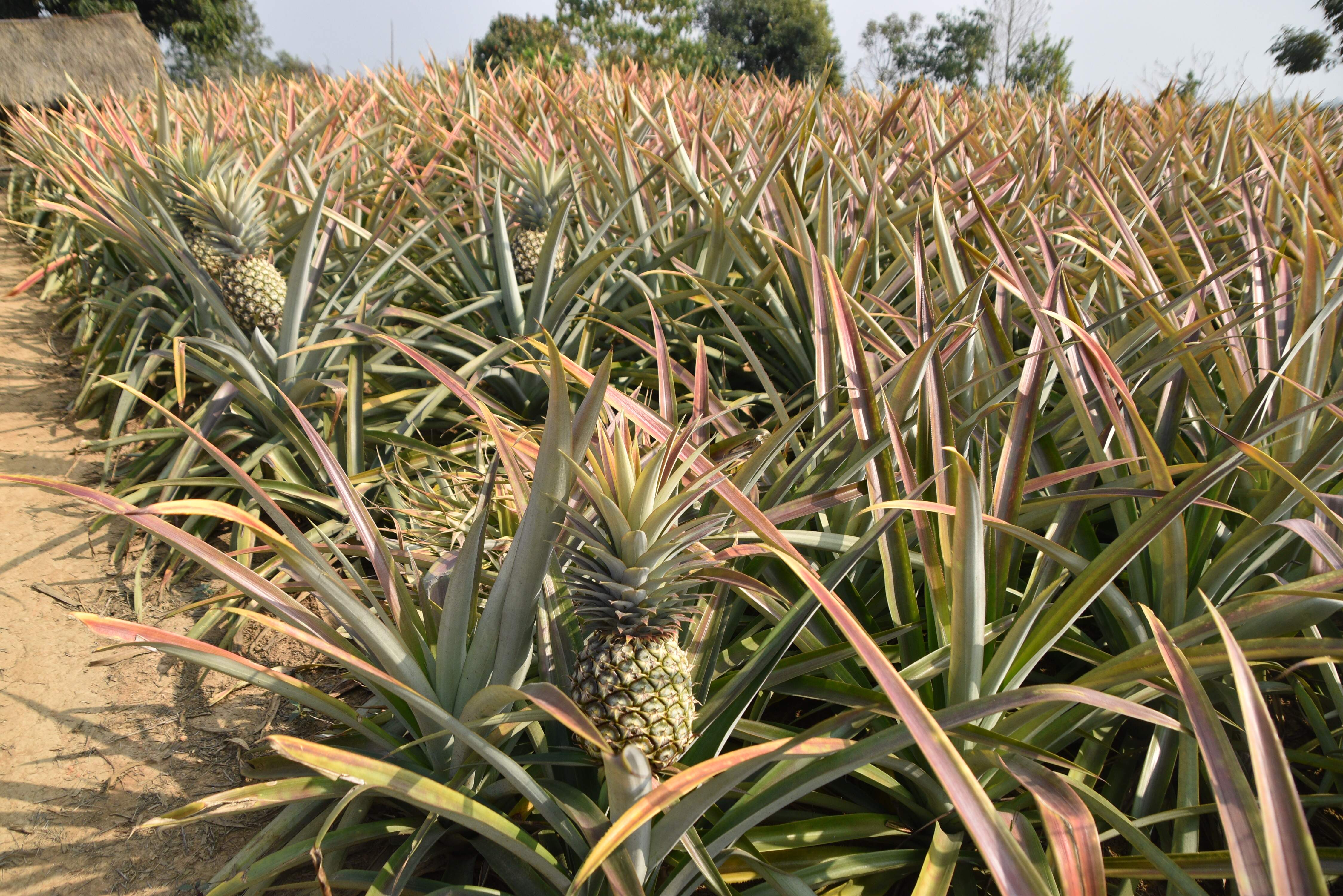
Pineapple is cultivated across all districts of Nagaland and is recognised for its distinctive flavour, sweetness, low fibre content and high total soluble solids, ranging from 16.5 to 18 per cent. Despite the crop’s economic and livelihood potential, growers continue to face challenges related to production, marketing, post-harvest management and long-term resource sustainability.
Emphasising the importance of premier academic institutions contributing to local communities, Prof. Jagadish K. Patnaik, Vice Chancellor, Nagaland University, said,
“This study provides valuable insights into the factors influencing the adoption of sustainable pineapple farming practices in Nagaland. The findings underline the importance of location-specific strategies, stronger agricultural extension services, efficient resource conservation and greater support to farmers. Nagaland University remains committed to promoting research that addresses local agricultural challenges and contributes to sustainable livelihoods and environmentally responsible development in the region.”
The study assessed the adoption of sustainable agricultural practices among pineapple growers across four key domains: agronomic practices, resource management, pest and disease management, and post-harvest management. It also examined differences in adoption across districts and identified the broader factors influencing farmers’ adoption behaviour.
The findings were published in Indian Journal of Extension Education, a peer-reviewed, Scopus indexed journal covering agricultural extension, rural development, agricultural communication, and related aspects of rural and farming communities, published by the Indian Society of Extension Education. The paper was co-authored by Ms. Sentibenla Pongener, Prof. Kaushal Kumar Jha and Dr. Shagolsem Herojit Singh from the Department of Agricultural Extension Education, Nagaland University.
Elaborating on the key findings, Prof. Kaushal Kumar Jha, Department of Agricultural Extension Education, School of Agricultural Sciences, Nagaland University, said,
“This study provides an integrated, context-specific assessment of sustainability in pineapple cultivation, going beyond the conventional focus on production, economics, marketing and post-harvest management. By examining sustainable practices across multiple stages of the production system and analysing inter-district variations, we highlight that the farmers’ adoption levels and challenges are shaped by local conditions. This underscores the need for tailored agricultural extension strategies and district-specific interventions, rather than a uniform approach, to promote sustainable and resilient pineapple farming in Nagaland.”
Further, Dr. Shagolsem Herojit Singh, Assistant Professor, Department of Agricultural Economics, School of Agricultural Sciences, Nagaland University, said,
“Our factor analysis identified three broad dimensions influencing the adoption of sustainable agricultural practices – land-use and income-related factors, motivational factors and access to extension services. These findings point to the importance of considering not only the availability of technologies but also farmers’ economic circumstances, motivation, awareness and access to institutional guidance when designing sustainability-focused programmes.”
The researchers noted that practices such as intercropping, mixed cropping, organic nutrient management, soil and water conservation, appropriate input management and crop-residue management can contribute to maintaining soil health, improving resource-use efficiency and enhancing the long-term resilience of pineapple-based farming systems.
Ms. Sentibenla Pongener, PhD Scholar, Department of Agricultural Extension Education, School of Agricultural Sciences, Nagaland University, said,
“We also emphasise the need to increase awareness of the long-term environmental and economic implications of farming practices, particularly in the context of climate change, soil degradation, nutrient depletion and other pressures on natural resources. Integrating sustainability awareness and capacity-building into existing initiatives could support more climate-resilient and environmentally responsible pineapple production.”
The findings have implications for the planning and implementation of horticultural and agricultural development programmes in Nagaland. The study recommends strengthening need-based and location-specific training, field demonstrations, farmer-to-farmer extension, technical guidance and regular follow-up. Improved extension contact and district-specific planning can help farmers make informed decisions about sustainable practices, from land preparation and planting to crop management, harvesting and post-harvest handling.