


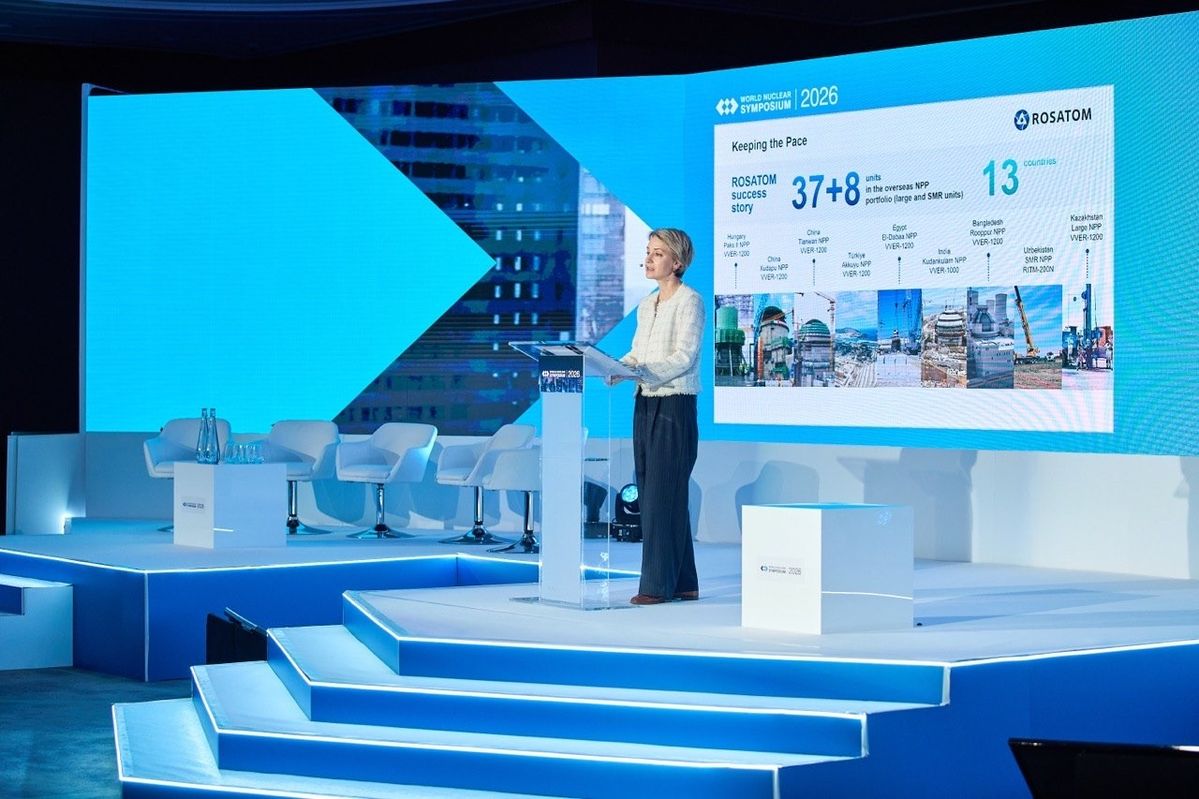
Moscow 18th September 2026: Representatives of Rosatom took part in the 51st annual World Nuclear Association (WNA) Symposium, which concluded in London, UK, on September 11. Held under the theme “From Ambition to Action,” this year’s event focused on the practical steps needed to accelerate the development of nuclear energy worldwide. Rosatom was represented by Polina Lion, Chief Sustainability Officer at Rosatom, and Ruan Nunes de Souza, Vice Director of Rosatom’s Regional Center in Latin America.
Polina Lion delivered a presentation titled “Scaling Nuclear Energy: Priorities for Joint Action.” Drawing on the experience of Rosatom’s projects, she identified four key elements requiring particular attention in the context of the global goal to triple nuclear capacity: joint efforts by the customer country, the regulator and the technology supplier throughout project delivery; strengthening supply chains and localisation; training personnel and increasing the appeal of nuclear careers among young people; and engaging financial institutions including international development banks and major energy consumers with a potential interest in investing in nuclear power generation.
“The more nuclear professionals, policymakers, universities, financial institutions and climate experts speak to each other, the faster we will find practical solutions for tripling nuclear capacity. At the end of the day, Rosatom’s experience confirms one clear point: global nuclear ambitions cannot be achieved without partnership, mutual trust and open dialogue,” she said.
Ruan Nunes de Souza, Vice Director of Rosatom’s Regional Center in Latin America, took part in an End Energy User Q&A Session focused on large electricity consumers that are creating a new segment of customers for nuclear energy.
“Rosatom works actively with a range of companies in Brazil. We are ready to offer our partners the best available technology option for each specific situation. A floating nuclear power plant can certainly be the right solution for a number of projects. We have already assessed the potential deployment of a floating power unit in remote areas of the Amazon, and we also see potential for floating NPPs to support offshore oil exploration and production,” said Ruan Nunes de Souza.
Elsie Pule, Head Coordinator of the BRICS Nuclear Energy Platform, took part in the “Taking a System-Wide View” session. She spoke about the key areas of cooperation in nuclear energy among BRICS countries, which account for more than 70% of nuclear capacity currently under construction.
Financing for new nuclear projects was another key focus of the Symposium. The World Nuclear Association presented the World Nuclear Investment Guide, a practical guide designed to help governments, developers and financial institutions structure nuclear projects more effectively, assess their investment attractiveness and create the conditions needed to mobilise capital.
Irina Skvortsova, Head of the International Business Projects Department at Rosatom, contributed to the preparation of the guide. The document brings together recommendations on project investment readiness, delivery models and cooperation between governments, industry and the financial community. According to the WNA, financing requirements for scaling up nuclear energy could exceed $250 billion a.