


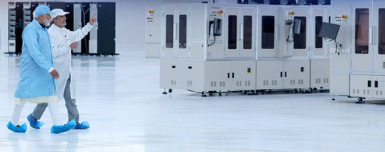
Pic Credit: https://x.com/PMOIndia
Prime Minister Narendra Modi has highlighted the rapid expansion of India’s infrastructure as a key factor supporting the country’s logistics and manufacturing sectors, saying improved connectivity is creating a stronger foundation for industrial growth.
Speaking at the inauguration of SEMICON India 2026 in New Delhi on Thursday, the Prime Minister said India’s expanding infrastructure network is helping businesses move goods more efficiently while strengthening the country’s manufacturing capabilities.
Over the past few years, India has significantly expanded its network of highways, railways, airports, ports and other transport infrastructure. The development of these networks is increasingly being linked with industrial corridors and manufacturing centres, helping improve connectivity between production hubs, suppliers and markets.
For the manufacturing sector, better logistics can reduce transportation time and costs while making supply chains more efficient. This is particularly important for industries such as electronics and semiconductors, where manufacturing involves multiple stages and requires the movement of specialised components and equipment.
The infrastructure push is also becoming increasingly important as India seeks to deepen its participation in global supply chains. Semiconductor manufacturing, electronics production and other technology-intensive industries require reliable transport, power, digital connectivity and supporting industrial infrastructure.
SEMICON India 2026, being held from September 17 to 19, brings together semiconductor companies, technology firms, policymakers, investors and industry experts from India and overseas. The event is focused on building a broader semiconductor ecosystem, covering areas ranging from chip design and manufacturing to advanced packaging, equipment, materials and research.
The government has approved 12 semiconductor projects under the first phase of its semiconductor programme, while the next phase is aimed at expanding the ecosystem further. India is also seeking greater participation from global companies and domestic firms across the semiconductor value chain.
The growth of the semiconductor industry could have a wider impact on India’s manufacturing landscape. Beyond chip production, it can create opportunities for component manufacturers, engineering companies, logistics providers, equipment suppliers, research institutions and startups.
The sector is already attracting growing investor interest. Recent industry data shows that India’s semiconductor sector has received around $1.4 billion in cumulative equity funding across 281 funded companies, with nearly half of that amount raised since 2025.
The combination of infrastructure development, technology adoption and industrial investment is therefore creating new opportunities for India to build more integrated manufacturing and supply-chain capabilities.
For businesses, the expansion of physical and digital infrastructure could be particularly significant as companies look for locations that offer efficient logistics, skilled manpower and access to suppliers and markets. For India, the broader objective is to move beyond assembly towards deeper domestic value addition and more technology-intensive manufacturing.
The emphasis on infrastructure at SEMICON India comes at a time when India is seeking to establish itself as a larger participant in the global technology and semiconductor supply chain. The success of this effort will depend not only on investment in factories, but also on the strength of supporting infrastructure, skills, research capabilities and domestic supplier networks.